 Blaine Siding
 One Product, One Standard
Homeowners sometimes ask why we don't offer a menu of siding brands the way some contractors do. The honest answer is that we made a decision years ago to install James Hardie fiber cement siding exclusively, and we haven't second-guessed it. That's not a marketing gimmick — it's a practical response to what siding actually has to survive in Blaine and the rest of Whatcom County. When one product consistently performs better in this climate than the alternatives, and when installing it correctly requires real specialization, spreading yourself across five different siding systems stops making sense.
This page walks through what James Hardie siding actually is, how it's engineered, and why we think it's the right call for homes facing salt air off the Strait of Georgia, near-constant winter rain, and a moss season that seems to start earlier every year.
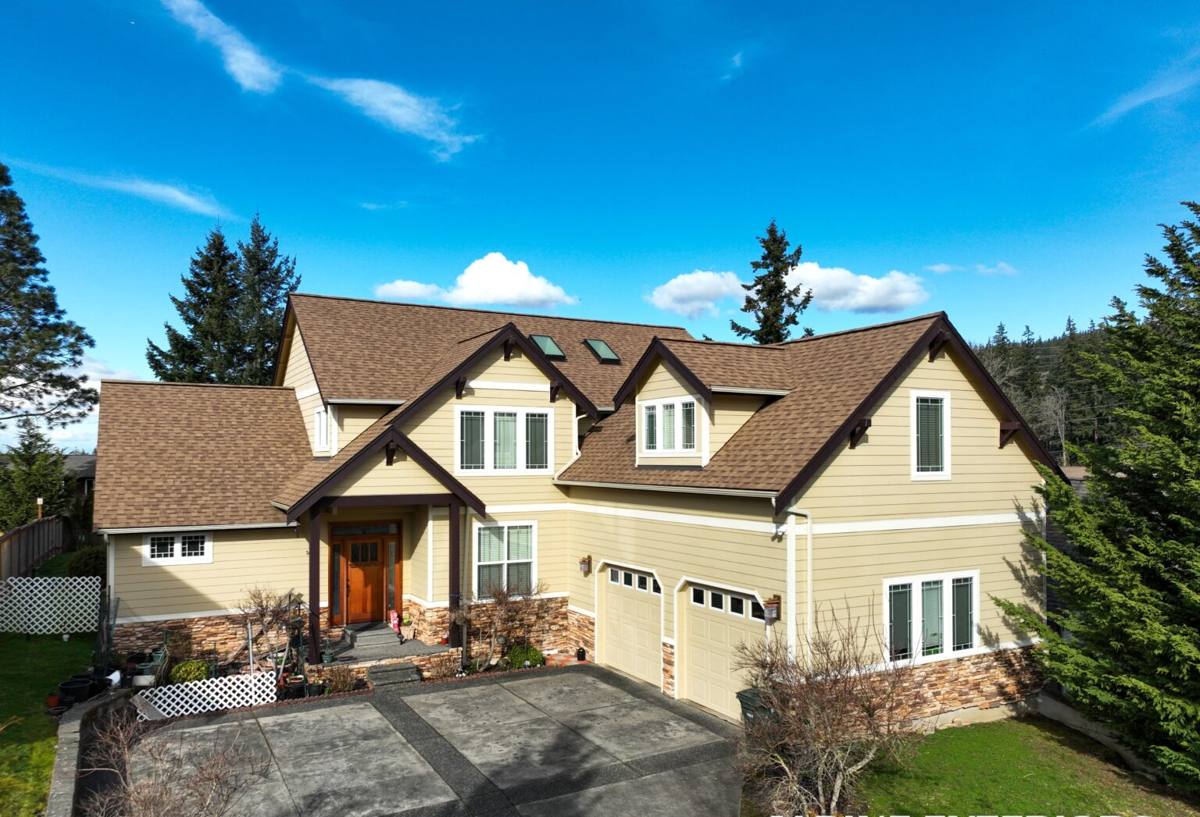
What Blaine's Climate Does to Siding
Blaine sits right on the water, which means siding here deals with more than typical Pacific Northwest rain. Salt-laden air off Semiahmoo Bay and the Strait accelerates corrosion on fasteners, trim, and any siding product with metal components or seams that trap moisture. Add in Whatcom County's long, wet winters — where it's common for siding to stay damp for weeks at a stretch — and you get ideal conditions for moss, algae, and mildew to take hold on north-facing walls and anything shaded by trees or eaves.
Wood-based and wood-adjacent siding products are the most vulnerable to this combination. Moisture that gets behind or into the material, combined with organic growth on the surface, is how siding fails early — not usually through one dramatic event, but through years of slow degradation that shows up as soft spots, peeling paint, or swelling at the seams. Any siding decision in this area has to start with how the product handles sustained moisture and salt exposure, not just how it looks on a sunny day.
Why This Matters More Here Than Elsewhere
Inland areas of Washington get plenty of rain too, but they don't get the salt component, and they often get more drying sun between storms. A Blaine or Birch Bay property can go through entire months in the winter without a real drying window. That's a meaningfully harder environment for siding, and it's a big part of why we don't think a one-size-fits-all siding recommendation makes sense for every region of the state — but it does make sense to standardize on the best-performing product for this specific coastline.
What James Hardie Siding Actually Is
James Hardie manufactures fiber cement siding — a blended material made from cement, sand, and cellulose fibers, cured into dense, rigid boards and panels. It's not a wood product, and it's not a plastic product. That distinction matters because it sidesteps the two biggest failure modes we see in this climate: rot and insect damage (the wood problem) and thermal expansion, cracking, and fading (a common vinyl problem).
Fiber cement is non-combustible, which matters for insurance considerations and general home safety, and it holds paint and factory finishes far more consistently than wood substrates because it doesn't absorb and release moisture the same way organic material does. It's heavier and more rigid than vinyl, which means fewer visible waves, sags, or panel flutter in wind — a real consideration for waterfront and near-waterfront lots that catch a lot of wind off the water.
The HZ5 Engineering
James Hardie doesn't sell one universal product — it engineers siding by climate zone, and the Pacific Northwest falls into their HZ5 category, formulated specifically for high-moisture, freeze-thaw-adjacent regions. The HZ5 formulation is designed to resist moisture absorption and hold up under the kind of sustained damp conditions that define a Whatcom County winter. That's a meaningfully different product than a general-purpose fiber cement board, and it's one of the clearer reasons we don't treat "fiber cement" as an interchangeable category — the engineering behind the specific product matters.
ColorPlus Technology: Why Factory Finish Matters
A lot of siding failures homeowners blame on the material are actually finish failures. Paint applied on a job site, in variable weather, over a porous or slightly damp substrate, rarely performs as well as a finish cured in a controlled factory environment. James Hardie's ColorPlus finish is baked on at the factory in multiple coats under consistent conditions, which produces more even color, better adhesion, and meaningfully longer resistance to fading and chipping than field-applied paint.
In a salt-air environment like Blaine's, this matters twice over. Salt accelerates the breakdown of lower-quality or improperly cured paint films, and it makes touch-up work more frequent on any siding that relies on field painting. A factory finish designed to resist UV and moisture cycling holds its color longer, which means fewer repaint cycles over the life of the siding — a real cost consideration, not just a cosmetic one.
Product Lines and Where They Fit
James Hardie offers several distinct product lines, and part of doing this work correctly is matching the right line to the right part of the house.
| Product Line | Typical Use | Why It Fits |
|---|---|---|
| HardiePlank Lap Siding | Primary wall cladding | Most common siding profile; wide color and texture range; the workhorse of most re-sides |
| HardiePanel Vertical Siding | Accent walls, gables, modern facades | Clean vertical lines; often paired with lap siding for visual contrast |
| HardieShingle | Accent areas, gables, coastal/craftsman styles | Mimics traditional cedar shingle look without the moisture vulnerability |
| HardieTrim | Corners, window and door trim, fascia | Matches the siding's moisture resistance so trim doesn't become the weak point |
| HardieSoffit | Eaves and overhangs | Vented and non-vented options for attic moisture management |
Using Hardie trim and soffit alongside Hardie siding isn't just brand consistency — it closes a gap we see on a lot of older homes where the main wall siding was upgraded at some point but the trim was left as untreated or under-protected wood, which becomes the first place rot shows up.
Why We Don't Install the Alternatives
We get asked about LP SmartSide, vinyl, and cedar fairly often, and we think homeowners deserve a straight answer rather than a sales pitch against them.
Engineered Wood (LP SmartSide and similar)
Engineered wood siding has improved a lot over the decades and performs reasonably well in drier climates. But it's still a wood-strand product with a resin binder, and any breach in the factory coating — a cut edge, a fastener hole, a caulking failure — creates a path for moisture to reach the wood fibers underneath. In a climate with as little drying time as Blaine gets, we've found that margin for error is too thin for our standards.
Vinyl Siding
Vinyl is inexpensive and low-maintenance in the sense that it doesn't need repainting, but it's a thin plastic product that expands, contracts, and can become brittle over time, especially with UV exposure and temperature swings. It also doesn't hold up as well structurally in high-wind coastal conditions, and it can't be painted to update a home's look later without voiding warranties on many products. It's a reasonable budget option in some markets — we just don't think it's the right long-term investment for this one.
Cedar and Primed Spruce
Real wood siding has genuine aesthetic appeal, and we understand the draw. But untreated or minimally treated wood is the most moisture- and pest-vulnerable option available, and it demands an ongoing maintenance commitment — recaulking, repainting, inspecting for rot — that most homeowners underestimate when they first install it. In a moss-prone, salt-air environment, that maintenance burden compounds fast.
None of this means these products are junk. It means that for the specific conditions homes face in Blaine and Whatcom County, we settled on the one product line that consistently performs best, and we'd rather be excellent at installing one system correctly than mediocre across several.
The Warranty Difference
James Hardie backs its siding products with a non-prorated limited warranty that's transferable to a subsequent homeowner within the coverage period, which matters for resale value on top of protection while you own the home. ColorPlus finishes carry their own separate finish warranty covering fading and chipping. The specifics vary by product line and are worth reading directly from Hardie's documentation before a project starts, but the general structure — long-term material coverage plus separate finish coverage — is stronger than what most engineered wood or vinyl products offer, and it reflects the confidence Hardie has in the HZ5 formulation for exactly this kind of climate.
What Correct Installation Actually Involves
Even the best siding product fails early if it's installed wrong, and fiber cement has installation requirements that differ from wood and vinyl in ways that matter.
- Proper nailing pattern and fastener depth — over-driven or under-driven nails are a leading cause of premature siding problems
- Correct clearance from grade, roofing, and decks to avoid wicking moisture into the bottom edge of the boards
- A weather-resistant barrier and rainscreen gap installed behind the siding, not just tight against the sheathing
- Properly flashed and caulked window and door penetrations, since these are the most common points of water intrusion
- Factory-cut and factory-primed edges used wherever possible, with field cuts sealed per manufacturer spec
- Correct board overlap and butt joint treatment to shed water rather than trap it
James Hardie publishes detailed installation specifications for a reason — following them is what activates the product warranty, and it's what determines whether the siding performs for its full expected lifespan or develops problems in year eight instead of year thirty.
What This Means for Your Project
Standardizing on one product lets our crews get genuinely fast and precise at installing it correctly, rather than switching techniques, fasteners, and moisture details between five different systems. For a Blaine homeowner, that translates into a re-side or new build that's built for the specific conditions of this coastline — salt air, sustained rain, and moss pressure — using a product engineered for exactly that.
If you're weighing a siding replacement or want to know what James Hardie would look like on your specific home, we're happy to walk the property, talk through color and profile options, and put together a straightforward, no-pressure estimate.