 Blaine Siding
 A Peninsula With Its Own Weather Problems
Point Roberts sits on its own patch of land at the tip of the Tsawwassen Peninsula, separated from the rest of Whatcom County by water and reachable by road only through Canada. That geography isn't just a quirk of the map — it puts homes here in direct line of wind and moisture coming off the Strait of Georgia and Boundary Bay with very little to slow it down. There's no ridge of hills, no dense inland tree cover, no neighboring development to break the wind before it hits a house. That exposure is the single biggest factor driving how exterior materials perform here, and it's why we treat Point Roberts differently than a sheltered lot a few miles inland in Blaine.
Homes on bluffs or waterfront lots get it worst, but even properties set back from the water deal with salt-laden air, near-constant humidity, and rain that doesn't just fall — it drives sideways into walls, trim, and anything with a seam. Add in a moss season that runs longer here than in drier parts of Whatcom County, and you've got an environment that punishes cheap materials and sloppy installation faster than almost anywhere else we work.
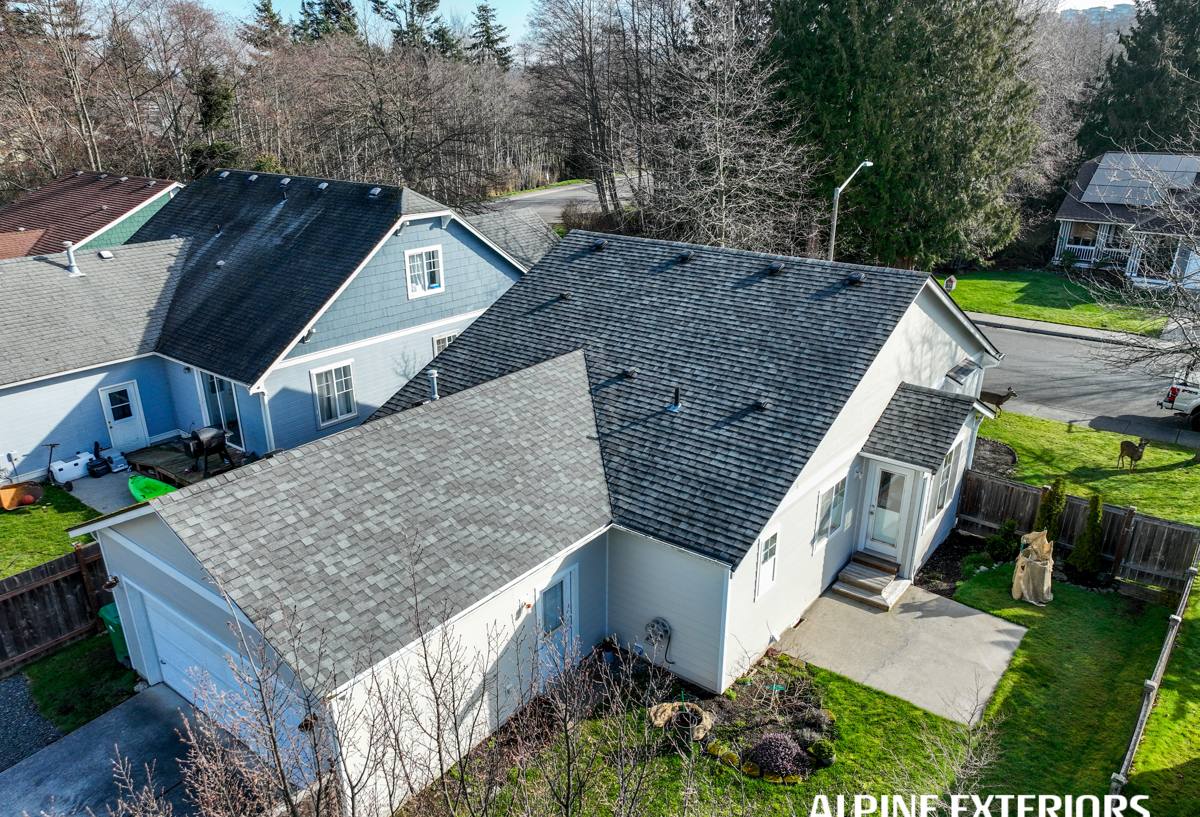
What Salt Air and Coastal Rain Actually Do to a House
Salt-Laden Air and Corrosion
Airborne salt doesn't just affect boats and metal railings. It accelerates corrosion on fasteners, flashing, window hardware, and any exposed metal trim. Over years, that corrosion can loosen the small connections that hold a siding or trim system together, and it can stain or streak lighter-colored finishes. Materials and fasteners need to be chosen with that in mind from day one — not swapped out after the first signs of rust show up.
Wind-Driven Rain and Moisture Intrusion
Point Roberts gets rain that hits walls at an angle instead of just running down a roof and off the eaves. That kind of exposure finds every weak seam, every under-caulked joint, and every spot where flashing was an afterthought. Materials that absorb water or swell when wet — and installations that don't account for wind-driven moisture — tend to fail here years before they would in a more sheltered location.
A Longer Moss and Mildew Season
Consistent moisture plus mild temperatures is exactly what moss, algae, and mildew need to take hold on roofs, siding, and decking. In Point Roberts that growing season stretches longer than it does in drier inland stretches of the county, which means surfaces that hold moisture or have a porous, absorbent finish will show green and black staining sooner — and need more frequent cleaning and maintenance to keep looking right.
Why We Only Install James Hardie Fiber Cement
We made a decision years ago to stop installing vinyl, LP SmartSide, and other engineered wood or composite siding products, even though they're less expensive up front. In an environment like Point Roberts, that decision matters more than almost anywhere else we serve. Fiber cement doesn't have the same moisture-absorption problems as wood-based products, and it doesn't warp, soften, or become a food source for the fungal growth that thrives in a wet coastal climate. It's also non-combustible, which matters given the dry-season wildfire smoke and ember exposure that has become a more regular part of Pacific Northwest summers.
James Hardie's ColorPlus factory-applied finish is baked on under controlled conditions rather than sprayed or brushed on-site, which gives it better adhesion and more consistent coverage than field-applied paint. That matters directly for salt air exposure — a factory finish designed to resist UV and moisture holds its color and its seal far longer than a site-applied coat, and it comes backed by its own finish warranty separate from the substrate warranty.
The HZ5 Product Line for Coastal and Damp Climates
Hardie engineers specific product formulations for different climate zones, and the HZ5 line is built for exactly the conditions Point Roberts sees: high moisture exposure, freeze-thaw cycling, and prolonged dampness. It's not a marketing label — the formulation and moisture-management engineering are different from the products Hardie sells in drier regions. When we spec a Point Roberts job, we're specifying for the actual climate zone the house sits in, not a generic national product.
Roofing, Windows, and Decks in the Same Environment
Siding is only part of the exterior envelope, and in a place like Point Roberts, the same forces that stress siding stress the rest of the house just as hard.
Roofing
Wind-driven rain finds its way under poorly sealed flashing and worn shingles, and the same extended moss season that stains siding also builds up on roof surfaces, holding moisture against the decking longer than it should sit. Roof inspections and moss treatment matter more here, and roofing materials and underlayment details need to account for that wind exposure specifically.
Windows
Salt air accelerates corrosion on window hardware and can degrade weaker seal systems faster than in inland homes. Proper flashing integration between the window and the siding system is one of the most common failure points we find on older Point Roberts homes — not because the window itself failed, but because the water management around it wasn't detailed for this kind of exposure.
Decks
Decks facing the water take the most direct hit from salt spray, UV, and standing moisture. Fastener choice, board spacing for drainage, and structural connections all need to be selected for a marine-adjacent environment rather than a standard inland build.
Cost Factors for Point Roberts Exterior Projects
Material and labor costs on the peninsula track closely with the rest of the Blaine and Whatcom County market, but a few local factors shift the numbers worth knowing about before you budget a project.
| Factor | Why It Matters in Point Roberts |
|---|---|
| Site exposure | Waterfront and bluff-facing homes need more robust flashing and fastening detail than sheltered inland lots, which affects labor time |
| Access and logistics | Point Roberts is reached by road only through Canada, which crews and material deliveries need to plan around when scheduling a project |
| Existing damage | Homes with long-neglected wood or composite siding often have hidden moisture damage behind the cladding that isn't visible until removal |
| Product selection | Climate-specific product lines like Hardie HZ5 cost more than generic siding but avoid the earlier repainting and repair cycles typical of other materials here |
Why a Local Crew Matters More Here Than Most Places
A contractor who mostly works sheltered inland jobs can miss the details that matter on an exposed peninsula like Point Roberts — how much flashing overlap is enough, where caulking will fail first under driving rain, which fastener finish will actually hold up against salt air. We're based in Blaine and work this stretch of Whatcom County regularly, so we plan around the border crossing and ferry-adjacent logistics that come with reaching Point Roberts, and we spec materials and installation details for the exposure level a given property actually has rather than a one-size-fits-all approach.
That local familiarity also means we know the difference between a house that needs a full siding replacement and one that just needs targeted repair and better moisture management around windows and trim. Not every problem on a Point Roberts home is a siding failure — sometimes it's a flashing detail that was never right in the first place.
Signs Your Point Roberts Home May Need an Exterior Assessment
- Streaking, staining, or green/black growth on siding, trim, or roofing that comes back quickly after cleaning
- Soft or spongy spots when pressing on wood-based or composite siding, especially near ground level or window trim
- Visible rust or corrosion around fasteners, flashing, or window hardware
- Paint that's peeling, bubbling, or chalking faster than it should for its age
- Gaps or cracking caulk lines around windows, doors, or siding seams
- Moss buildup on the roof, especially in shaded or north-facing sections
- Deck boards that feel damp long after rain has stopped, or hardware showing rust bleed
What to Expect From an Assessment
When we look at a Point Roberts property, we're checking the whole envelope, not just the siding surface. That means examining flashing details around windows and rooflines, checking for moisture trapped behind existing cladding, and evaluating how much direct wind and salt exposure the specific site actually gets based on its orientation and setting. From there we can give a straight answer on whether a full re-side makes sense, or whether targeted repair and better moisture detailing will get more years out of what's already there.
If you're dealing with a Point Roberts home showing any of the wear this climate causes, we're glad to come take a look. We offer free, no-pressure estimates and can walk you through exactly what we're seeing and what your realistic options are — no obligation either way.