 Blaine Siding
 Building on the Water in Semiahmoo
Semiahmoo sits at the edge of Semiahmoo Bay and Drayton Harbor, just west of Blaine and a short drive from the Canadian border. It's one of the more exposed pieces of real estate in Whatcom County — homes here face open water, marine wind, and weather that rolls in off the Strait of Georgia with very little to slow it down. That exposure is part of what makes the area desirable. It's also what makes exterior materials work harder here than almost anywhere else in the county.
We've worked on homes up and down this stretch of coastline, and the pattern is consistent: siding, trim, and roofing that would hold up fine in a sheltered inland neighborhood start showing problems years earlier when they're facing the bay. Salt-laden air, wind-driven rain, and a long stretch of damp, low-light months each play a role. None of that means exterior work in Semiahmoo is a losing battle — it means the materials and installation details matter more here than they do elsewhere, and cutting corners shows up faster.
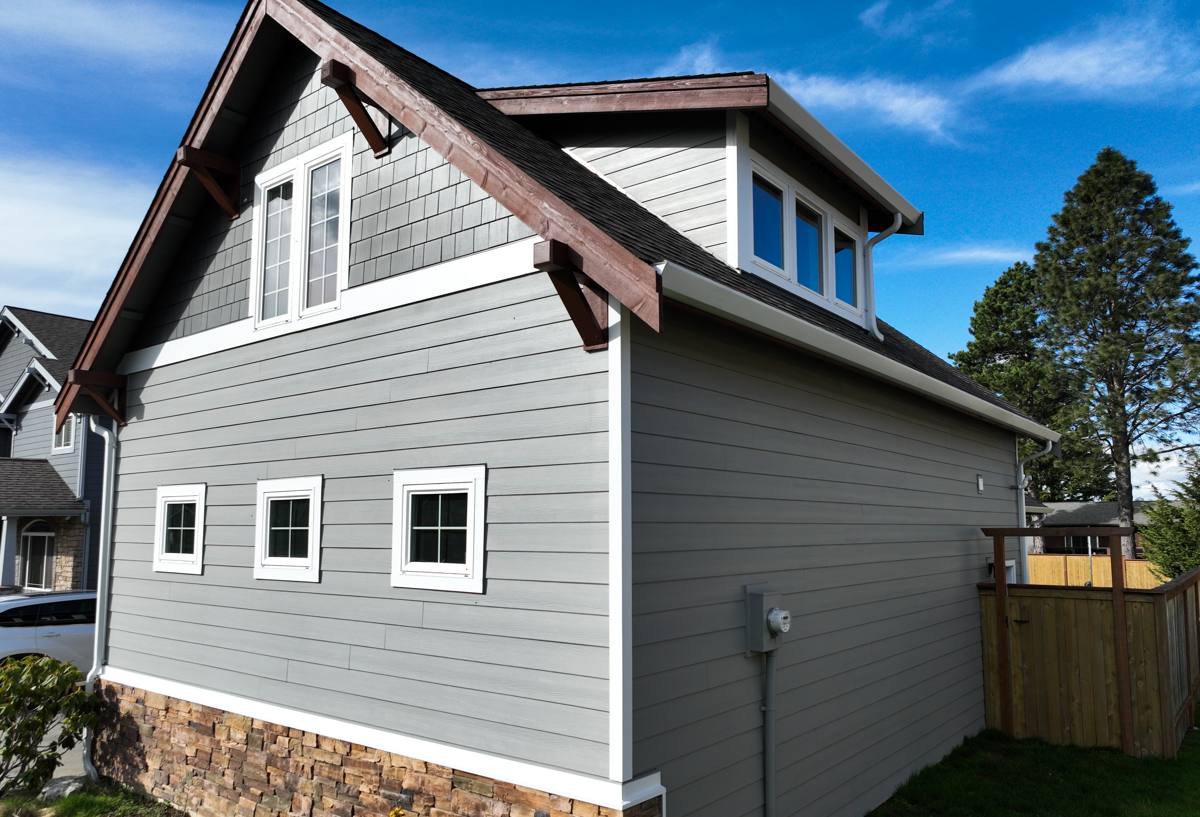
What Salt Air Actually Does to a House
Salt air isn't just a smell that comes with living near the water. It's airborne moisture carrying dissolved salts that settle on every exterior surface — siding, trim, fasteners, flashing, window frames. Over time, that has a few real consequences for a house:
- Metal fasteners and flashing corrode faster unless they're rated for coastal or marine exposure.
- Paint and factory finishes break down more quickly when they're repeatedly wetted with salt-bearing moisture and then dried by wind.
- Wood-based siding products absorb that moisture into the substrate itself, not just the surface, which accelerates rot from the inside out.
- Caulking and sealants around windows and trim lose flexibility and adhesion sooner, opening small gaps that let water in behind the siding.
None of this is dramatic on its own. It's cumulative. A house that would need a repaint or minor siding repair in year twelve inland might need it in year seven or eight right on Semiahmoo Bay. That's the math that should drive material choices out here, not just curb appeal.
Driving Rain and Wind-Driven Moisture
Whatcom County gets a lot of rain generally, but Semiahmoo's exposure means it also gets a lot of driving rain — wind pushing water sideways into walls rather than straight down onto roofs. That matters because siding systems are engineered assuming water mostly runs down a wall, not gets forced into laps, seams, and butt joints horizontally.
Driving rain finds every weak point in an exterior: undersized or missing flashing, gaps at trim and window returns, siding installed too tight to the ground or too close to horizontal surfaces where water can wick upward. On a sheltered lot, a marginal installation detail might never get tested. On an open waterfront lot in Semiahmoo, it gets tested every winter storm. This is a big part of why we're strict about installation details on every job here — the house doesn't get the benefit of the doubt that a house three miles inland does.
Moss, Shade, and the Long Wet Season
Between the marine humidity and the number of overcast, wet months this part of Washington gets, moss and algae growth on north-facing walls, under eaves, and in shaded side yards is a fact of life. It's mostly a cosmetic and maintenance issue rather than a structural one, but it interacts badly with certain siding materials. Wood and wood-composite products that stay damp under a moss or algae layer are more prone to rot underneath that growth, since the moisture gets trapped against the material instead of drying out between rain events.
Fiber cement doesn't feed mold or moss growth the way wood-based products can, and it doesn't break down structurally from sitting damp the way untreated or engineered wood substrates can. That doesn't mean a Semiahmoo home never needs a wash-down — algae and moss will grow on almost any exterior surface given enough shade and moisture — but it means the material itself isn't degrading underneath the growth.
Why We Only Install James Hardie Fiber Cement
We get asked fairly often why we don't offer vinyl, LP SmartSide, or other engineered wood siding products, especially since some of them cost less upfront. The honest answer is that we made a standard, and Semiahmoo-type conditions are exactly why.
Vinyl
Vinyl siding is inexpensive and low-maintenance in mild conditions, but it's a thin plastic product that becomes brittle in cold snaps and can warp or deform under sustained wind and temperature swings. On an exposed waterfront lot with real wind loads, that's a real durability concern, not a theoretical one. It also doesn't hold up structurally against wind-driven debris the way a rigid fiber cement board does.
LP SmartSide and engineered wood
Engineered wood siding has improved a lot over the decades, and it performs reasonably well in drier climates. But it's still a wood-based substrate, which means its long-term performance depends heavily on paint film integrity and installation details staying perfect for the life of the product. In a marine environment with this much sustained moisture exposure, any breach in that paint film or caulking is an invitation for the substrate to start absorbing water. We don't think that's a fair bet to make on a homeowner's behalf on a lot like this.
Why Hardie
James Hardie fiber cement is non-combustible, dimensionally stable, and doesn't rot or support insect damage because there's no organic wood fiber for pests or moisture to act on. Hardie's HZ5 product line is engineered specifically for cold, wet, freeze-prone climates like ours — it's not a generic product with a marketing label slapped on. The ColorPlus factory finish is baked on and warrantied against fading and peeling, which matters enormously in a spot where the sun, salt, and rain all work together to break down field-applied paint faster than normal. And Hardie backs the product with a strong, transferable limited warranty, which carries real weight on waterfront property where buyers and appraisers pay attention to exterior condition and documentation.
We're not going to tell you every other product is worthless — that's not honest, and it's not our call to make about someone else's siding job. What we will say is that after years of doing exterior work in this county, fiber cement is the only material we're willing to put our name behind on a house exposed to Semiahmoo's conditions.
It's Not Just Siding: Roofing, Windows, and Decks
The same conditions that stress siding stress the rest of a home's exterior. We handle roofing, window replacement, and decking as well, and on Semiahmoo properties we look at the whole envelope together rather than treating siding as an isolated project.
- Roofing — wind uplift and driving rain make proper underlayment, flashing, and ventilation details especially important on open, exposed roof planes.
- Windows — window flashing and sealant integration with the siding system is one of the most common failure points we find on older coastal homes; it's worth addressing at the same time as siding, not after.
- Decks — salt air and moisture affect fasteners and railing hardware on decks just as much as siding, so hardware selection matters as much as decking material.
If you're only budgeting for one of these right now, that's fine — we'll scope the job you're asking for. But we'll flag anything else we see while we're up there, because on a waterfront lot, small issues in one system tend to become bigger issues in the system next to it.
What Correct Installation Looks Like on a Job Like This
Material choice only gets you part of the way. Installation detail is where a lot of coastal siding jobs quietly fail years later. On Semiahmoo projects specifically, we pay close attention to:
| Detail | Why it matters here |
|---|---|
| Fastener selection | Corrosion-resistant fasteners rated for coastal exposure, not standard interior-grade hardware |
| Flashing at windows, doors, and roof-wall intersections | Primary defense against wind-driven rain intrusion |
| Proper clearance above grade, decks, and roof lines | Prevents moisture wicking and standing water contact with siding |
| Caulking and sealant joints | Marine air breaks down inferior sealants faster; joint quality affects service life |
| House wrap and drainage plane integration | Gives any water that does get behind the siding a path to drain and dry |
These aren't upsells. They're the difference between a siding job that looks right for a few years and one that actually performs for the decades Hardie's warranty is built around.
Working with a Local Crew
Blaine and the surrounding Whatcom County coastline have their own microclimate compared to, say, Bellingham a few miles south or inland communities east of I-5. A crew that works this coastline regularly knows what to expect from a Semiahmoo lot before the first board goes up — which sides of the house take the worst weather, how much clearance a given lot's drainage needs, what the salt exposure has already done to the existing exterior. That local knowledge shows up in fewer surprises during the job and a better outcome afterward.
Here's a short checklist worth using with any contractor bidding a Semiahmoo exterior project, us included:
- Do they have recent, verifiable experience on waterfront or near-waterfront properties in this county?
- Will they specify corrosion-resistant fasteners and flashing by name, not just "standard materials"?
- Are they licensed and insured to work in Washington, and can they provide proof without hesitation?
- Do they explain the manufacturer's warranty terms clearly, including what voids it?
- Will they walk you through their installation approach for your specific exposure, not a generic pitch?
If a contractor can't answer those clearly, that's worth noticing before you sign anything.
Get a Straightforward Look at Your Home
Every waterfront lot in Semiahmoo takes weather a little differently depending on orientation, tree cover, and elevation, so it's worth having someone look at your specific house rather than guessing from general climate patterns. If you'd like a free, no-pressure estimate on siding, roofing, windows, or decks, the form below will get you started — we're happy to walk the property, point out what we see, and give you a straight answer on what it would take.