 Blaine Siding
 Siding Built for Everson's Nooksack Valley Climate
Everson sits inland along the Nooksack River in Whatcom County, away from the direct salt-air exposure of the coast but squarely inside one of the wettest, dampest corners of Washington State. Homes here deal with a long, low-intensity rain season that runs from fall through spring, high ambient humidity off the river valley, and a moss and algae season that can stretch most of the year on shaded or north-facing walls. Add in the freeze-thaw cycles of winter and the seasonal flooding risk that comes with living near the Nooksack, and you have a climate that is genuinely hard on exterior building materials — even ones that look fine from the curb for the first few years.
Blaine Siding Contractors works throughout Whatcom County, and Everson is part of our regular service area. We know the difference between a siding job that looks good at installation and one that actually holds up through a decade of Nooksack Valley winters. That difference comes down to two things: the material and the installation. We only install James Hardie fiber cement siding, and we install it to the manufacturer's specification, every time.
What Everson's Climate Actually Does to Siding
Moisture and Humidity
The Nooksack Valley traps moisture. Fog sits longer here than it does closer to the water, and homes with tree cover or shaded exposures stay damp for extended stretches. Wood-based products — including primed spruce trim and engineered wood siding — absorb ambient moisture through cut edges and seams over time, even when the surface coating looks intact. That absorbed moisture is what drives swelling, delamination, and eventually rot at the most vulnerable points: butt joints, corners, and anywhere caulking has aged or cracked.
Moss and Algae
Constant dampness plus shade equals moss. It's not just cosmetic — moss holds moisture directly against a wall surface and keeps it there far longer than open air would. Over years, that sustained contact accelerates whatever degradation process a given material is prone to. Materials that don't absorb moisture in the first place are far less affected by moss growth than those that do.
Freeze-Thaw and Seasonal Flooding
Winters in Whatcom County bring repeated freeze-thaw cycles, and any trapped moisture inside a wall assembly expands when it freezes. Some parts of Everson also sit near the Nooksack River floodplain, and homeowners in those areas already understand how important it is to have an exterior envelope that sheds water well and doesn't hold it. Siding is only one piece of that puzzle, but it's an important one.
Why We Standardized on James Hardie Fiber Cement
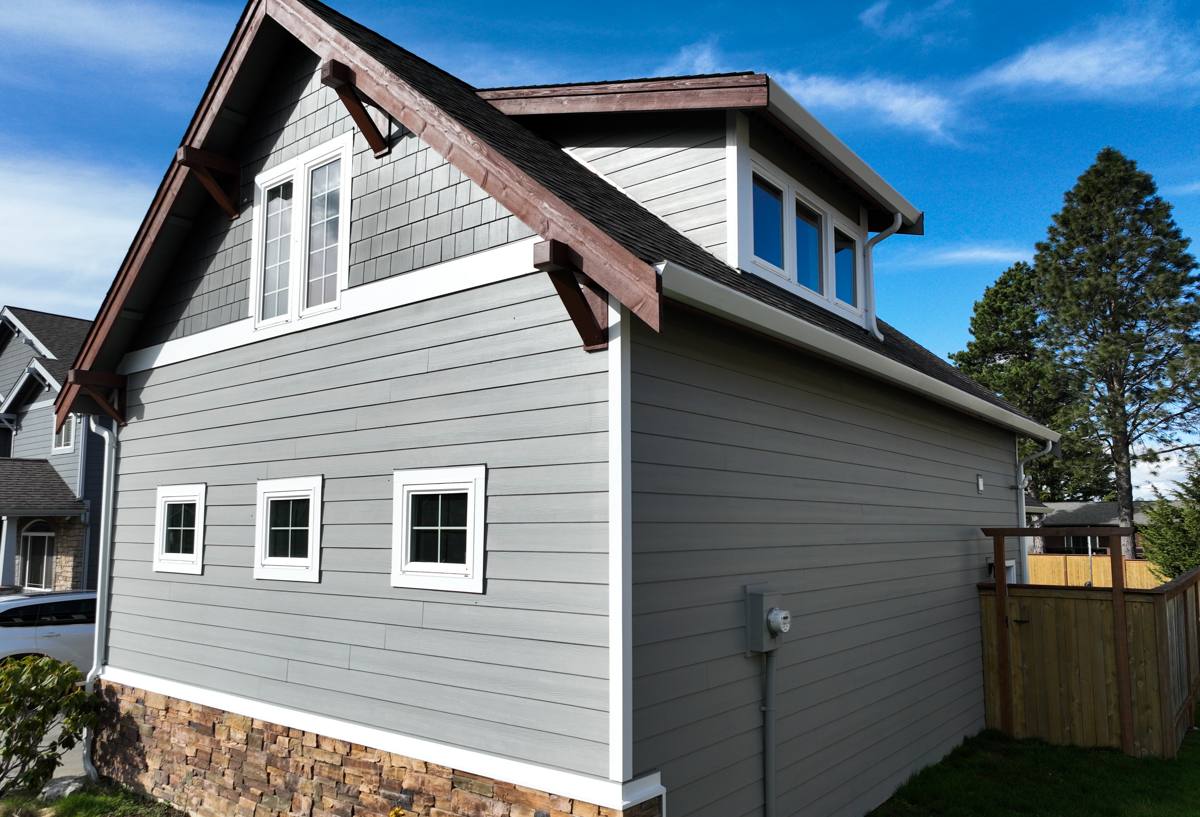
We made a deliberate decision as a company to install only James Hardie products, and we don't treat that as a sales pitch — it's an operating standard we hold ourselves to. Fiber cement is composed of sand, cement, and cellulose fibers, which means it doesn't absorb and swell the way wood-based or wood-composite products can. It won't feed pests, and it's non-combustible, which matters in a region where wildfire smoke and dry summer stretches are becoming a more regular concern even in historically wet counties.
James Hardie's ColorPlus factory-applied finish is baked on under controlled conditions rather than sprayed or brushed on-site, which gives it a more consistent bond and a longer service life before repainting is needed. For a climate like Everson's — where a field-applied paint job has to survive months of damp, low-light conditions every single year — that factory finish is a meaningful advantage, not a marketing detail.
HZ5 and Climate-Engineered Product Lines
James Hardie engineers its HZ (HardieZone) product lines for specific climate zones rather than selling one universal product nationwide. Western Washington falls into a wet, moderate-freeze climate zone, and the HZ5 formulation is built with that moisture and freeze-thaw exposure in mind. It's a small distinction on paper, but it reflects the kind of climate-specific engineering that generic siding products don't offer.
What We Won't Install, and Why
Homeowners in Everson sometimes ask why we don't offer vinyl, LP SmartSide, or other engineered wood products, since they're common and less expensive up front. We're direct about the trade-offs:
- Vinyl siding expands and contracts significantly with temperature swings, can warp or crack in cold snaps, and its seams and J-channels give moisture a path inward over time — a real concern in a valley that stays damp most of the year.
- LP SmartSide and similar engineered wood products use treated wood strand technology that performs reasonably when installed and maintained precisely to spec, but the margin for error is small. Caulking, paint touch-ups, and ground clearance all have to be maintained on schedule, or moisture finds its way into cut edges.
- Cedar and primed spruce are attractive natural materials, but they demand the most ongoing maintenance of any siding option — regular refinishing, vigilant caulk maintenance, and vulnerability to the exact moss and moisture conditions Everson sees every winter.
None of these are "bad" products in every application — they simply carry maintenance burdens and moisture-sensitivity trade-offs that don't match what we want to put our name behind in this climate. We'd rather install one product extremely well than offer five options and let homeowners discover the trade-offs later.
Comparing Siding Options for Everson Homes
| Material | Moisture Resistance | Maintenance Burden | Finish Durability |
|---|---|---|---|
| James Hardie Fiber Cement | Does not absorb/swell; won't rot | Low — factory finish, periodic caulk checks | Factory-baked ColorPlus, long repaint interval |
| Vinyl | Seams/channels can admit moisture | Low, but limited repair options if damaged | Color molded in, can fade unevenly over time |
| LP SmartSide / Engineered Wood | Good if maintained precisely; sensitive at cut edges | Moderate — caulk and coating upkeep required | Field or factory finish depending on product |
| Cedar / Primed Spruce | Absorbs moisture readily without upkeep | High — regular refinishing needed | Requires periodic repainting/staining |
These are general characteristics, not guarantees for any specific product or installation — real-world performance always depends on installation quality and ongoing maintenance.
How a Siding Project Works, From First Call to Final Walkthrough
Inspection and Estimate
We start with an on-site inspection of your home's current siding, trim, and any moisture-related issues we can identify — soft spots, staining, gaps at trim boards, or signs of pest activity. From there we put together a written estimate that reflects your home's actual square footage, trim detail, and any repair work needed underneath the new siding.
Removal and Substrate Check
Old siding comes off, and we take the opportunity to inspect the sheathing and framing underneath before anything new goes up. This step matters more in a climate like Everson's, because moisture problems often start at the substrate level long before they show up on the surface.
Weather Barrier and Flashing
Correct installation isn't just about the siding panels themselves — it's the water-resistive barrier, flashing at windows and doors, and proper drainage gaps behind the siding that determine whether water actually stays out. James Hardie's warranty terms assume installation to their specification, which is exactly how we install every job.
Installation and Finish
We install Hardie panels, lap siding, or shingle-style siding according to manufacturer fastening and clearance requirements, followed by trim work and a final walkthrough with the homeowner.
Beyond Siding: Roofing, Windows, and Decks
Siding doesn't work in isolation — it's one part of a home's exterior envelope. We also handle roofing, window replacement, and deck construction, because a siding job done well often surfaces issues in adjacent areas: a roofline that's letting water run behind the wall, a window that's no longer sealing correctly, or a deck ledger board that needs attention where it meets the house. Handling these trades under one roof means fewer contractors pointing fingers at each other and a more consistent standard of work across your whole exterior.
Why a Local Crew Matters in Everson
Whatcom County's climate isn't uniform — Everson's inland, river-valley conditions aren't identical to Blaine's coastal exposure or Bellingham's urban microclimates, and a crew that works this specific region regularly understands those differences. We know what a Nooksack Valley winter does to an exterior over ten or fifteen years, not just what a product spec sheet claims. That local, repeated exposure to the actual conditions your home faces is part of what informs how carefully we handle flashing, clearances, and drainage details on every job.
A Practical Checklist Before You Choose a Contractor
- Ask what siding product they install and why — and whether they install more than one, and if so, what determines the choice.
- Confirm they check and repair sheathing/substrate issues before new siding goes up, not just over it.
- Ask about flashing and water-resistive barrier details specifically, not just the visible siding product.
- Request their license and insurance information directly, and verify it independently.
- Get a written estimate that breaks out removal, substrate repair contingencies, and installation separately.
- Ask how they handle warranty claims — is it the manufacturer's warranty, a workmanship warranty, or both, and who do you call if an issue comes up in year six?
If your Everson home is due for new siding, or you're seeing early signs of moisture damage, moss buildup, or aging trim, we're happy to take a look and walk you through what we'd recommend and why. Reach out using the form below for a free, no-pressure estimate.