 Blaine Siding
 Dakota Creek's Exterior Climate: What Homes Are Actually Up Against
Dakota Creek sits close enough to the water and to open farmland that homes here take a steady beating most inland Whatcom County properties never see. Salt-laden air blows in off the Strait and Boundary Bay, driving rain comes in sideways during winter storms, and the region's long, cool, damp stretch from fall through spring gives moss and algae months to establish themselves on anything that stays wet. None of that is dramatic on its own — it's the cumulative effect that wears exteriors down. Fasteners corrode a little faster. Paint chalks and fades a little sooner. Wood-based trim and siding hold moisture a little longer between dry spells. Over ten or fifteen years, "a little faster" adds up to a siding job that looks tired well before it should.
We've worked enough homes in and around Blaine to know this isn't a hypothetical. It's the reason we're picky about what we put on a house here, and it's the reason this page exists — to walk through what Dakota Creek's climate actually does to exterior materials, and why our answer to it is James Hardie fiber cement, full stop.
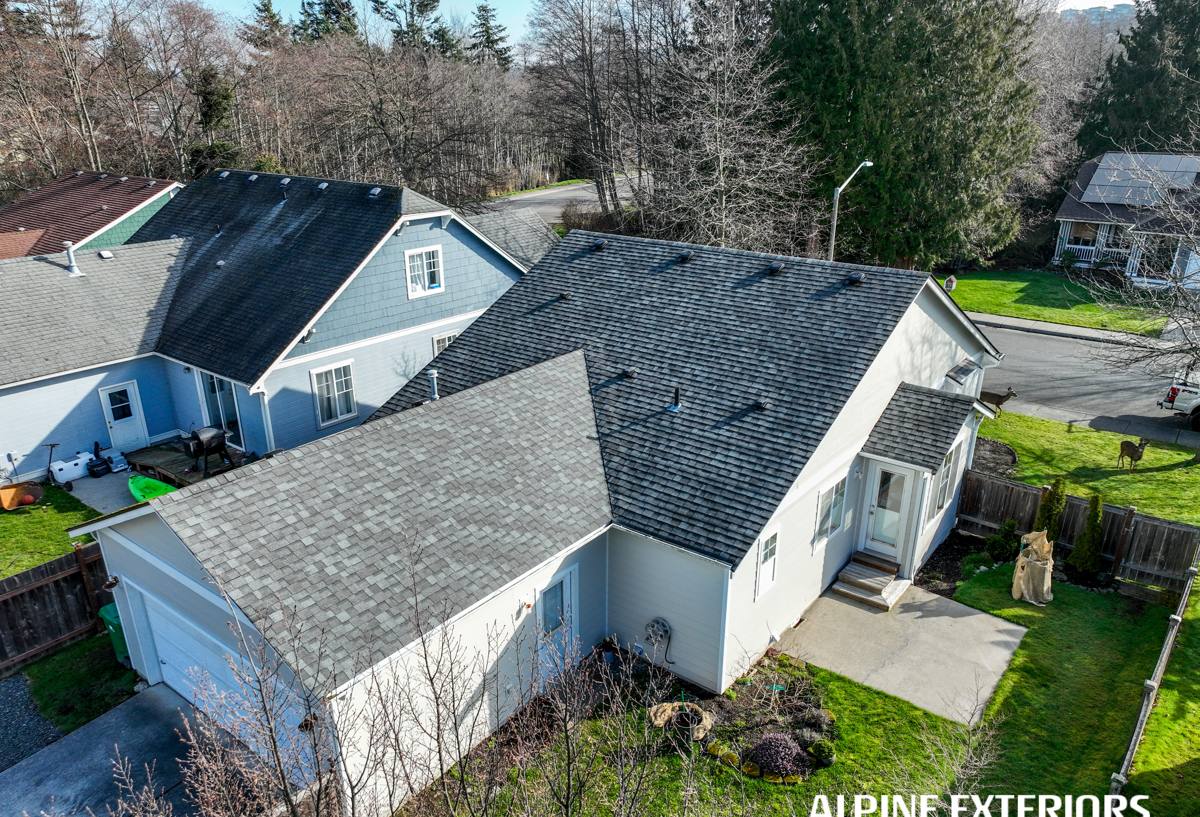
Why Salt Air, Rain, and Moss Are a Harder Combination Than They Sound
Salt Air
Airborne salt is corrosive to metal fasteners, flashing, and trim hardware, and it also tends to hold moisture against surfaces longer than plain humid air does. Materials that rely on a painted or coated surface to keep water out are more exposed here, because salt accelerates the breakdown of that surface layer over time.
Driving Rain
Blaine's storms don't always fall straight down — wind-driven rain gets pushed sideways into wall assemblies, seams, and butt joints. Any siding product that depends on caulking or careful field-painting to stay sealed is only as good as the crew who installed it, and caulking joints are exactly the kind of maintenance item homeowners forget until there's a moisture problem behind the wall.
Moss and Algae Season
Western Whatcom County stays cool and damp for a large part of the year, which is ideal growing conditions for moss and algae on north-facing walls, under eaves, and anywhere sun doesn't reach. Porous or absorbent siding surfaces give organic growth something to hold onto; denser, factory-finished surfaces give it far less to grab.
Why We Only Install James Hardie Fiber Cement
We don't install vinyl, LP SmartSide, Cemplank, Allura, primed spruce, or cedar siding. That's a deliberate standard, not a lack of options. Every one of those products can work fine in the right setting, but in a climate like Dakota Creek's, we've seen the trade-offs consistently outweigh the benefits:
- Vinyl can warp, crack, or fade under UV and temperature swings, and its seams and panel joints give wind-driven rain places to work its way in over time.
- LP SmartSide is an engineered wood product — well-engineered, but wood-based, which means it depends on intact factory coating and careful field sealing to keep moisture out over the long run, especially at cut edges and joints.
- Primed spruce and cedar are natural wood. They look great fresh, but they need ongoing repainting and sealing to hold up against sustained damp exposure, and that maintenance burden only grows near the water.
- Cemplank and Allura are also fiber cement, so they get closer to what we're after — but we've standardized on one manufacturer, one factory finish system, and one warranty structure so every job we do is consistent and every homeowner gets the same answer when something needs service.
James Hardie fiber cement is non-combustible, dimensionally stable, and engineered specifically for wet climates through its HZ5 product line — the version formulated for the Pacific Northwest's moisture and temperature profile. It doesn't absorb water the way wood-based products can, it holds paint and color far longer, and it resists the kind of moss and mildew growth that plagues porous siding in a climate like this one. It's also backed by a strong, transferable manufacturer warranty, which matters more here than in a mild inland climate because the material is being asked to do more work.
ColorPlus Factory Finish
Most of what we install carries Hardie's ColorPlus finish — color baked on at the factory under controlled conditions, rather than field-painted on site. That finish resists fading, chipping, and cracking far better than a job-site paint job, which matters a lot in a location where UV, salt, and rain are all working against a painted surface simultaneously.
What Correct Installation Involves — and Why It Matters More Here
Fiber cement siding is only as good as its installation. Hardie publishes detailed installation specifications for a reason: get the flashing, gapping, fastening, and clearances wrong, and even the best material can trap moisture or fail prematurely. In a climate that's already pushing moisture at your walls from multiple directions, sloppy installation is not something Dakota Creek homes can afford to absorb.
Details we treat as non-negotiable on every job:
- Proper starter strip and water-resistive barrier behind every course of siding
- Correct flashing at windows, doors, and any wall penetration
- Manufacturer-specified gaps at butt joints and trim to allow for expansion without forcing caulk to do all the sealing
- Fasteners set to spec — not overdriven, not underdriven — using corrosion-resistant fasteners appropriate for a coastal-influenced climate
- Proper clearance from grade, decks, and roof lines so siding isn't sitting in a wet zone
This is also where a lot of "why did my siding fail early" stories actually start — not with the product, but with shortcuts taken during installation that don't show up until a few winters of driving rain have had time to find them.
Beyond Siding: Roofing, Windows, and Decks for Dakota Creek Homes
Siding doesn't work in isolation — it's one piece of a home's exterior envelope, and the same climate pressures that wear on siding wear on the rest of the exterior too. We handle roofing, windows, and decks alongside siding work, which matters for a few practical reasons:
Roofing
Roof flashing, gutters, and drip edges directly affect how much water ends up running down your walls in the first place. A roof that's shedding water properly takes real pressure off your siding.
Windows
Window flashing and siding installation are directly connected — if we're already removing old siding, it's often the smartest time to address aging or leaking windows before the new siding goes back up around them.
Decks
Decks attached to the house create another intersection point where water management has to be done right, particularly with the amount of rain this area sees for much of the year.
Coordinating these trades under one crew means fewer seams where two contractors' work meets — and meeting points are exactly where problems tend to start.
Comparing Siding Materials for a Dakota Creek Home
| Material | How It Handles Salt Air & Driving Rain | Ongoing Maintenance | Our Position |
|---|---|---|---|
| James Hardie Fiber Cement (HZ5) | Engineered for wet coastal climates; doesn't absorb moisture like wood | Low — occasional wash, no repainting for many years with ColorPlus | What we install |
| Vinyl | Seams and panels can allow wind-driven rain intrusion over time | Low material upkeep, but limited repair options if damaged | Not installed |
| LP SmartSide | Engineered wood; depends on intact coating and sealed edges | Moderate — edge sealing and coating checks matter | Not installed |
| Cedar / Primed Spruce | Natural wood; absorbs moisture without diligent maintenance | High — regular repainting/sealing needed | Not installed |
| Cemplank / Allura | Also fiber cement; similar core performance | Low, similar profile to Hardie | Not our standardized product |
Maintenance Checklist for Dakota Creek Homeowners
Whatever siding a home ends up with, a little seasonal attention goes a long way in this climate. A few things worth checking a couple of times a year:
- Look at north-facing and shaded walls for early moss or algae growth and address it before it spreads
- Check caulking around windows, doors, and trim for cracking or gaps after winter storms
- Keep gutters clear so overflow isn't running directly down siding
- Trim back vegetation and shrubs that trap moisture against exterior walls
- Walk the exterior after major windstorms to check for loose or damaged panels or trim
- Have flashing at windows, decks, and roof intersections inspected periodically, since these are common water-entry points
Why a Local Crew Matters in This Area
Blaine and the surrounding parts of Whatcom County aren't like a generic Pacific Northwest suburb — the proximity to the water, the wind exposure, and the length of the wet season all shape how an exterior should be built and maintained. A crew that works this area regularly knows which walls in a given neighborhood take the worst of the wind-driven rain, how much moss pressure to expect on shaded elevations, and how local permitting and inspection processes actually run. That local knowledge shows up in small decisions — flashing details, fastener choices, where extra attention goes — that add up to an exterior that holds up rather than one that just looks good on install day.
It also matters for accountability. A local crew is easy to reach if a warranty question comes up years down the road, and we're not going anywhere — this is where we work.
Ready for a Straight Answer on Your Home
Every Dakota Creek home is a little different depending on sun exposure, tree cover, and how close it sits to open wind. If your siding is showing moss, chalking paint, soft spots, or you're just planning ahead, we're happy to take a look and give you a clear, honest assessment — no pressure, no upsell. Fill out the form below for a free estimate on siding, roofing, windows, or decks.