 Blaine Siding
 California Creek Is a Different Kind of Exposure
California Creek sits in the northwest corner of Whatcom County, close enough to Semiahmoo Bay and the Strait of Georgia that salt-laden air is a fact of daily life, not an occasional nuisance. Add in the wind that comes off the water during winter storms, the long stretch of gray, wet months typical of Blaine's marine climate, and the shaded, tree-lined lots common in this area, and you get exterior conditions that are genuinely harder on a home than what you'd find twenty miles inland. Siding, trim, roofing, and window seals here work against a combination of moisture, salt, and organic growth that most manufacturers' warranty language was written with a drier climate in mind.
We service California Creek regularly, and the failure patterns we see on older homes are consistent: soft or delaminating siding at the lower courses, caulk lines that have given out years before they should have, moss and algae staining on north- and shade-facing walls, and corrosion on fasteners and trim that weren't rated for salt exposure. None of this is unusual for the area — it's just what happens when a home's exterior wasn't built with this specific microclimate in mind.
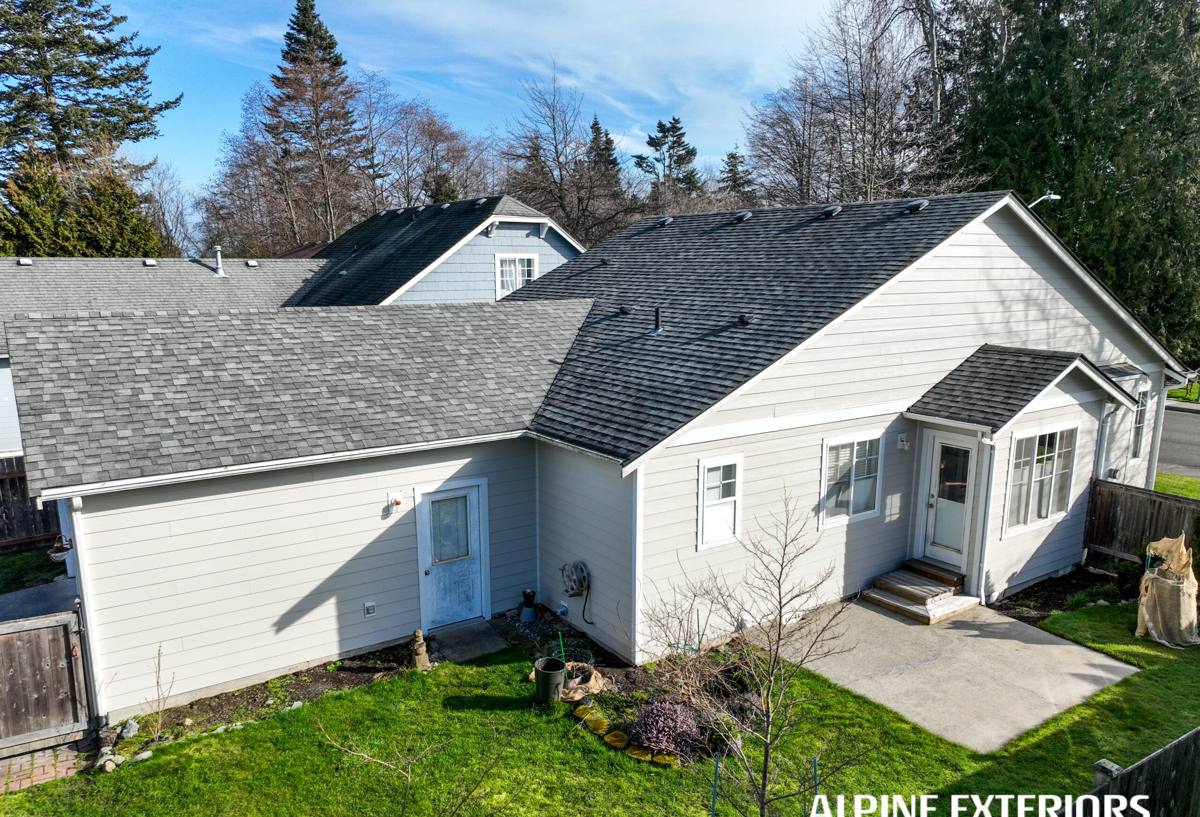
What Salt Air, Rain, and Moss Actually Do to a Home
Salt Air
Airborne salt from the bay doesn't just sit on the surface — it works into seams, fastener heads, and any place where two materials meet. Over years, it accelerates corrosion in metal flashing, nails, and screws, and it can degrade certain paints and coatings faster than the manufacturer's published lifespan would suggest. Materials and hardware chosen for this area need to be rated for coastal exposure, not just general exterior use.
Driving Rain
Wind-driven rain off the water doesn't fall straight down — it gets pushed sideways into wall assemblies, which puts a lot more stress on flashing details, siding laps, and window and door perimeters than a calm, vertical rainstorm would. A siding system that isn't installed with the right overlaps, gaps, and drainage plane behind it will eventually let moisture in, even if the material itself is sound.
Moss and Algae Season
Whatcom County's wet season runs long, and shaded, north-facing walls near mature trees — common throughout California Creek — stay damp for extended stretches. That's exactly the environment moss, mold, and algae need to take hold. Once organic growth establishes itself on a wood-based or poorly finished surface, it holds moisture against the material and accelerates whatever decay process is already underway underneath.
Why This Changes What We Recommend
Every siding material handles this combination of salt, rain, and moss differently. We install exclusively James Hardie fiber cement siding, and California Creek's climate is a big part of why. Fiber cement doesn't rot, doesn't feed moss and mold the way wood-based products can, and holds up structurally in damp, shaded conditions far better than materials that rely on a surface coating alone to keep moisture out.
| Material | Behavior in salt air / high moisture | Moss & algae resistance |
|---|---|---|
| James Hardie fiber cement | Non-combustible, dimensionally stable; factory ColorPlus finish resists fading and chipping | Won't rot or feed organic growth; surface can still be cleaned periodically |
| Vinyl siding | Can warp or become brittle with UV and temperature swings; seams are a moisture entry point | Won't feed growth, but growth sits on the surface and traps moisture behind panels |
| Primed wood / cedar | Absorbs moisture at cut ends and laps; needs consistent repainting to stay protected | Organic material is a food source for moss and mold once moisture gets in |
| LP SmartSide / engineered wood | Engineered to resist moisture better than raw wood, but edges and seams remain sensitive | Still an organic substrate; performance depends heavily on maintained caulking and paint |
We don't say this to knock every other product on the market — vinyl and engineered wood have legitimate uses, and plenty of homes carry them without major issues in gentler climates. But for a coastal, high-moisture, long-moss-season area like California Creek, we've made a standard: we only install what we're confident will still be performing correctly fifteen and twenty years from now, without the homeowner needing to repaint or patch it every few seasons. That's James Hardie.
How We Install Siding for This Kind of Exposure
The material is only half the equation. A lot of the siding failures we get called out to replace weren't caused by bad product — they were caused by installation shortcuts that don't show up as a problem until years later. For California Creek homes specifically, we pay close attention to a few things:
- Proper flashing and drainage plane behind the siding, so any moisture that does get past the surface has somewhere to go
- Correct fastener spacing and type — stainless or coated fasteners rated for coastal, high-moisture exposure
- Manufacturer-specified gaps and clearances at trim, windows, and the foundation line, so water doesn't wick up into the material
- Careful sealing at penetrations — vents, hose bibs, light fixtures — which are common weak points in wind-driven rain
- Attention to shaded, low-airflow wall sections where moss and mildew are most likely to establish
James Hardie publishes detailed installation specifications for a reason — their warranty coverage depends on the product going on correctly. A crew that treats fiber cement like any other siding material, without following those specs, can undercut the very durability the product is known for.
The Rest of the Exterior Matters Just as Much
Siding doesn't work in isolation. We also handle roofing, windows, and decks, because on a coastal, high-rainfall property like the ones in California Creek, these systems all depend on each other. A roof with failing flashing will send water down behind otherwise sound siding. Window seals that have given out let moisture into the wall cavity regardless of how good the siding above and below them is. A deck built without the right ledger flashing and moisture separation from the house wall creates a chronic wet spot right where it meets the siding.
When we're on a property for a siding project, we're looking at the whole exterior envelope, not just the walls. That's not upselling — it's how you avoid doing a nice siding job and then watching it get undermined by a roof or window problem a year later.
How the Systems Interact
| System | Common local issue | Effect on siding if ignored |
|---|---|---|
| Roofing | Worn flashing, clogged gutters, moss buildup on shaded slopes | Overflow and runoff concentrate water at wall sections below |
| Windows | Failed perimeter caulk or aging seals | Moisture tracks behind trim and into the wall cavity |
| Decks | Ledger boards attached directly to the house without proper flashing | Chronic damp zone right where deck meets siding |
Why a Local Crew Matters Here
California Creek's exposure isn't identical to a property a few miles inland in Blaine, and it's certainly not the same as siding conditions east of the Cascades. A crew that works this specific stretch of Whatcom County coastline regularly knows which wall orientations tend to hold moss, which lots need extra attention to drainage because of tree cover, and how much salt exposure a given property realistically deals with based on its distance from the water and prevailing wind direction. That local pattern recognition shapes decisions on flashing detail, fastener choice, and where to spend extra care during installation — decisions that a crew unfamiliar with this coastline might make differently, and not always for the better.
Maintenance in a Salt-Air, Moss-Prone Climate
Even with the right material and installation, an exterior in this area benefits from a little routine attention. None of this is heavy work, but skipping it for years is how small issues turn into replacement projects.
- Rinse siding and trim once or twice a year to clear accumulated salt residue and organic debris, especially on shaded walls
- Keep gutters clear so roof runoff doesn't concentrate against siding or foundation walls
- Trim back vegetation and tree limbs that keep wall sections shaded and damp longer than necessary
- Check caulking at windows, doors, and trim penetrations every couple of years and re-seal where it's cracked or pulling away
- Walk the exterior after major winter storms to catch loose flashing, damaged trim, or new moss growth early
What Drives Cost on a California Creek Project
Every property is different, but a few factors consistently move the price on siding, roofing, window, and deck work in this area:
| Factor | Why it matters here |
|---|---|
| Existing wall condition | Moisture damage or rot found once old siding comes off can require sheathing repair before new siding goes on |
| Home size and wall complexity | More corners, gables, and trim detail mean more flashing and labor time |
| Access and site conditions | Tree cover, slope, and setback from the road affect staging and scaffolding needs |
| Product line and profile | James Hardie's HZ product lines and ColorPlus finish options vary in price by style and color |
| Scope combined with other work | Bundling roofing, window, or deck work with siding can reduce overall disruption and sometimes overall cost |
Get a Straight Answer for Your Property
If you're noticing moss buildup, soft spots, failing caulk, or siding that just looks tired on a California Creek home, it's worth having someone take an honest look before deciding what it needs. We'll walk the exterior, tell you what we actually see — not just what's easiest to sell — and explain what a proper fix looks like given your home's specific exposure. Reach out for a free, no-pressure estimate using the form below.