 Blaine Siding
 Siding Built for Bellingham's Climate
Bellingham sits in a stretch of Whatcom County where marine air, persistent rain, and a shoulder season that never quite dries out all work against a home's exterior at the same time. Homes closer to Bellingham Bay deal with salt-laden air that accelerates corrosion on fasteners and trim. Homes tucked into wooded lots or shaded hillsides deal with moss, algae, and moisture that sits against siding for weeks at a stretch. Most properties in this area get some combination of both. Whatever material is on the wall has to handle wind-driven rain, wide seasonal humidity swings, and long stretches where surfaces simply don't get a chance to fully dry.
We install James Hardie fiber cement siding exclusively. That's not a marketing position — it's a decision we made after years of seeing which products actually hold up under Pacific Northwest conditions and which ones create ongoing maintenance headaches for homeowners. On a Bellingham job, we're thinking about the same three problems every time: moisture management, dimensional stability, and a finish that won't need repainting every few years.
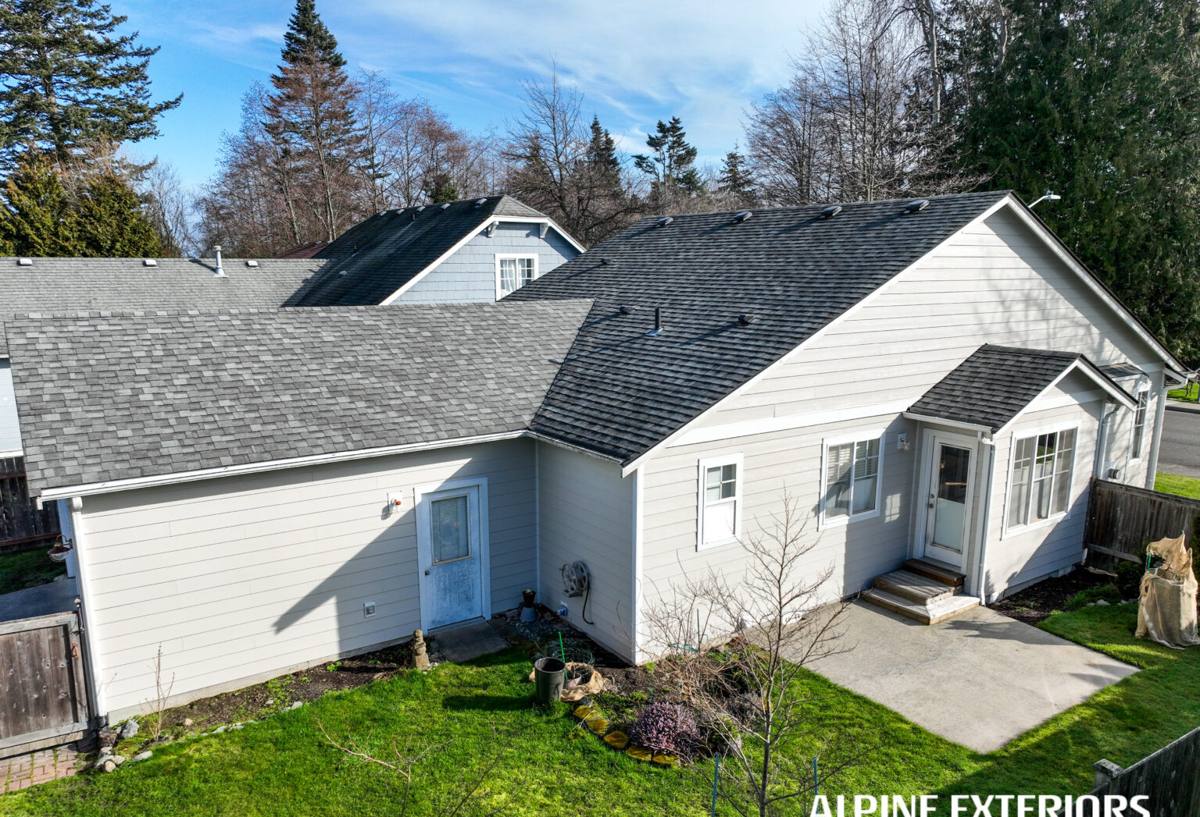
What Bellingham Homes Actually Face
Driving Rain and Wind-Driven Moisture
Storms coming off the Strait of Georgia and the Salish Sea don't just drop rain straight down — they push it sideways into walls, especially on exposed elevations and homes on open lots. That means water is testing not just the siding surface but every seam, joint, and piece of trim. Weak points show up as swelling, staining, or soft spots well before the rest of the wall shows any wear.
Moss, Algae, and Prolonged Dampness
Whatcom County's long wet season, paired with tree cover common in and around Bellingham, means north-facing walls and shaded siding can stay damp for extended periods. Wood-based products absorb that moisture, and organic growth follows. Fiber cement doesn't behave the same way — it doesn't wick moisture into its core the way wood-based sidings do, which is a meaningful advantage in a climate this consistently damp.
Salt Air Near the Bay
Properties closer to the water deal with airborne salt that speeds up corrosion on fasteners, flashing, and unprotected trim. This doesn't ruin siding overnight, but it shortens the life of anything not rated to handle it, and it's a factor we account for in material and fastener selection on jobs closer to the shoreline.
Why We Only Install James Hardie
We used to install a wider range of siding products. We stopped installing several of them — not because they're bad products in every application, but because we kept seeing the same failure patterns in this specific climate: paint that needed refreshing every five to seven years, edges and seams that took on moisture over time, and warranty language that left homeowners covering their own labor costs on a repair.
James Hardie fiber cement addresses the issues we saw most often:
- Non-combustible core — fiber cement doesn't feed a fire the way wood-based siding can, which matters for insurance conversations as much as safety.
- Factory-applied ColorPlus finish — baked on in a controlled environment rather than field-painted, so it resists fading and chipping far longer than site-applied paint.
- HZ5 product engineering — Hardie's HZ5 line is formulated for climates with prolonged moisture exposure and freeze-thaw cycling, which fits the Whatcom County weather pattern closely.
- Dimensional stability — fiber cement doesn't expand, contract, and warp with humidity swings the way wood and wood-composite products can.
- Strong transferable warranty — backed by a manufacturer warranty that holds up when the product is installed to spec, which is a real consideration if you plan to sell the home down the road.
We won't install LP SmartSide, vinyl, Cemplank, Allura, primed spruce, or cedar. Each of those has legitimate uses somewhere, but for the moisture load and salt exposure we see around Bellingham, we'd rather stand behind one product system we trust completely than offer a menu of options with different long-term risk profiles.
How the Job Works
Inspection and Assessment
We start by walking the exterior and looking at what's actually happening on your walls — moisture staining, failed caulk joints, soft trim, gaps around windows and doors, and how the existing siding is performing on each elevation. Bellingham's mix of older homes and newer builds means every house tells a slightly different story, so we don't quote off a generic template.
Moisture Barrier and Prep
Before any siding goes up, we address what's underneath it. A properly installed weather-resistive barrier and correctly flashed windows and doors matter more in a climate like this than almost anywhere else in the country, because the margin for error on water intrusion is smaller when a wall stays damp for days at a time.
Installation to Manufacturer Spec
James Hardie siding is only as good as its installation. Fastener spacing, joint treatment, clearances from grade and roofing, and caulking at penetrations all affect how the product performs over its lifespan. We install to Hardie's published specifications, not shortcuts that save an afternoon but cost a homeowner a callback in three years.
Final Walkthrough
We walk the finished job with you, point out anything worth knowing about maintenance, and make sure the work matches what was quoted before we consider the job done.
Comparing Siding Options for This Climate
| Factor | James Hardie Fiber Cement | Wood / Engineered Wood | Vinyl |
|---|---|---|---|
| Moisture resistance | Strong — engineered for wet climates (HZ5 line) | Moderate — vulnerable to prolonged dampness and rot | Sheds water but seams and gaps allow moisture behind panels |
| Finish durability | Factory-baked ColorPlus, long fade resistance | Field-painted, typically needs repainting every 5-7 years | Color molded in but can chalk and fade over time |
| Fire performance | Non-combustible core | Combustible | Combustible, can deform under heat |
| Moss/algae resistance | Does not wick moisture into core | Absorbs moisture, more prone to organic growth | Resistant to growth but traps moisture behind panels |
| Typical lifespan when properly installed | Multiple decades with periodic recaulk/repaint of trim | Shorter, especially without diligent maintenance | Variable, seams and fasteners are common failure points |
Beyond Siding: Roofing, Windows, and Decks
Siding doesn't work in isolation. A roof that's shedding water improperly, windows that aren't flashed correctly, or a deck ledger that's letting moisture into the wall assembly all undermine even a well-installed siding job. We handle roofing, windows, and decks alongside siding so we can look at a Bellingham home as one connected system rather than treating each surface as a separate project. If we spot a flashing issue at a window while we're up on a ladder for a siding estimate, we'll tell you about it whether or not it's part of the scope you called about.
What to Ask Before Hiring an Exterior Contractor
Whatcom County has plenty of contractors who'll put siding on a house. Fewer of them are set up to do it right in this specific climate. Before signing anything, it's worth asking:
- Is the crew installing to the manufacturer's written specifications, or to their own shortcuts?
- What's actually happening behind the siding — is there a proper weather-resistive barrier and correct window/door flashing?
- Does the warranty cover labor, or just materials, if something fails?
- How does the contractor handle fastener and trim selection for homes closer to the water?
- Can they explain why they recommend one product over another, in plain terms, without pressure?
A local crew that works in Whatcom County year-round has seen how different products actually perform here over time — not just how they're marketed. That's a different kind of knowledge than a crew passing through from out of the area.
Maintenance After Installation
James Hardie siding is low-maintenance, not no-maintenance. A rinse-down once or twice a year helps keep salt residue and organic buildup from settling on the surface, especially on shaded or bay-facing walls. Caulking at trim joints and penetrations should be checked periodically, since caulk is the one component that wears faster than the siding itself. Keeping gutters clear and vegetation trimmed back from walls also goes a long way toward preventing the kind of prolonged dampness that causes problems in this climate.
Get a Free Estimate
If you're weighing siding options for a home in Bellingham or elsewhere in Whatcom County, we're happy to take a look and walk you through what we're seeing and why we'd recommend one approach over another. There's no pressure and no obligation — just a straight assessment from a crew that works in this climate every day. Use the form below to request a free estimate.