 Blaine Siding
 Deck Building in Bellingham: Built for the Weather That's Actually Here
A deck in Bellingham lives outside year-round in a climate that doesn't let up for long. Marine air off Bellingham Bay carries a steady trace of salt, rain arrives sideways as often as it falls straight down, and shaded or north-facing surfaces can stay damp enough to grow moss for most of the calendar year. A deck built to a generic national spec, without accounting for any of that, tends to show it early: soft spots at the ledger, rusted fasteners bleeding through the boards, slick green film on stair treads by the second winter. We build decks for this specific stretch of Whatcom County, and the decisions we make on material, hardware, and drainage are shaped by what actually happens to a deck here, not by what works fine somewhere drier.
This page is about one service in one area: new deck construction for homes in and around Bellingham. If you're weighing whether to repair an aging deck or replace it, or you're starting from bare ground, the considerations below are the ones that matter most for getting it right the first time.
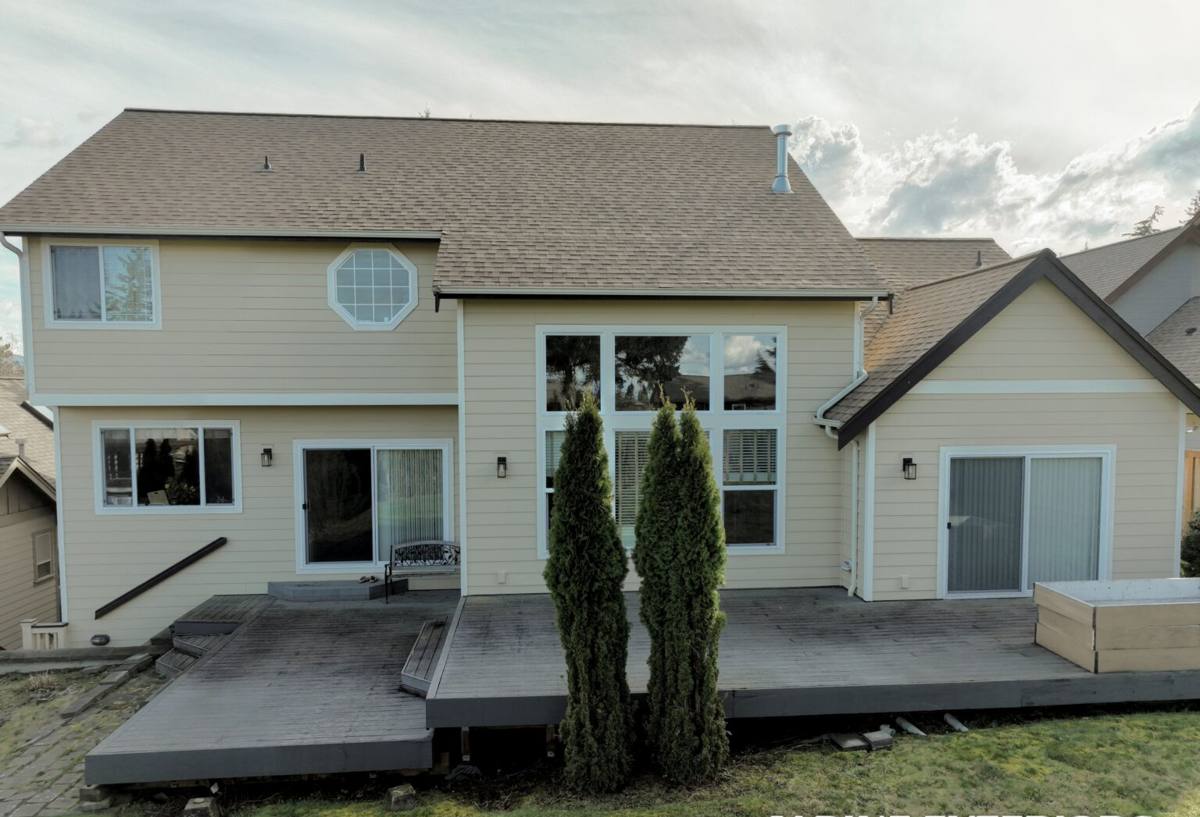
What Bellingham's Climate Does to a Deck
Salt Air and Bay Exposure
Bellingham's setting on the bay means a low, constant level of salt-laden moisture moving through the air, not just on days with an obvious storm rolling in. Over years, that exposure accelerates corrosion in anything metal: nails, screws, joist hangers, post bases. A fastener that would last decades in a dry inland climate can start bleeding rust stains into the decking within a few seasons here if it's the wrong grade for coastal use.
Driving Rain and Water That Doesn't Just Fall Straight Down
Rain in this part of Whatcom County is frequently pushed at an angle by wind off the water, which means water gets driven into places a purely vertical rainfall pattern wouldn't reach: under handrail caps, into ledger-to-house connections, along the underside of stair stringers. A deck that isn't detailed for wind-driven rain can develop hidden rot in exactly those spots, well before any damage is visible from the top.
A Long Moss and Algae Season
Mild temperatures, tree cover, and near-constant dampness add up to a moss and algae season that can run most of the year on shaded decking, especially under overhangs or on the north side of a house. Beyond the cosmetic issue, moss and algae on deck boards create a genuine slip hazard on stairs and walking surfaces, and they hold moisture against the board surface longer than an open, sun-exposed area would.
Choosing a Decking Material for This Climate
There's no single "best" decking material for every homeowner — budget, maintenance tolerance, and how much sun the deck actually gets all factor in. What we can tell you honestly is how each common option tends to perform under Bellingham's specific mix of salt air, rain, and shade.
| Material | How It Handles This Climate | Maintenance | General Cost Position |
|---|---|---|---|
| Pressure-treated pine | Affordable and structurally solid, but more prone to cupping, splintering, and moss growth in shaded, damp spots if not sealed regularly | Needs periodic cleaning and resealing, especially on shaded sections | Lowest upfront cost |
| Cedar | Naturally more rot- and insect-resistant than pine, with better dimensional stability, but still an organic material that will gray and can host moss without upkeep | Regular cleaning and staining or sealing to hold its color and resist moisture | Mid-range |
| Composite decking | Resists rot and won't splinter; some early-generation composites held moisture and grew mold in shaded coastal spots, so board quality and drainage gaps matter | Occasional washing; no staining or sealing required | Higher upfront, lower ongoing labor |
| PVC/capped polymer decking | Fully sealed surface resists moisture absorption and salt exposure well, and is the least hospitable surface for moss to take hold on | Lowest maintenance of the group; occasional washing | Highest upfront cost |
We'll walk through these trade-offs against your budget and how much sun exposure the deck site actually gets, since a heavily shaded deck under mature trees has different risks than one that sits in open sun most of the day.
What a Correctly Built Deck Involves
Whatever material sits on top, the structure underneath is what determines whether a deck lasts. In this climate, a handful of details matter more than they would somewhere drier:
- Ledger board flashing: Where the deck attaches to the house, proper flashing keeps wind-driven rain from working its way behind the ledger and into the house framing — this is one of the most common failure points on decks built without local conditions in mind.
- Corrosion-resistant hardware: Hot-dip galvanized or stainless steel fasteners, joist hangers, and post bases hold up to salt air far better than standard-grade hardware, which can start corroding within a few years this close to the water.
- Proper footing depth: Footings need to be set below the local frost line and sized for the loads they'll carry, so the structure doesn't shift over time.
- Drainage gaps between boards: Consistent spacing lets water shed through the deck surface instead of pooling on top of it, which cuts down on both rot risk and moss growth.
- Airflow underneath: Adequate clearance and ventilation below the deck keeps the framing drier and slows the kind of hidden rot that's hard to catch until it's advanced.
- Grading away from the house: The ground under and around the deck should shed water away from the foundation, not pool against it.
Framing and Fasteners: The Part You Don't See
Most of what determines whether a deck is still solid in fifteen years is invisible once the decking boards go down. We frame with lumber rated for ground contact where it's in contact with soil or moisture, and we use hardware graded for coastal exposure throughout — not just at the ledger. Hidden fastener systems, where the decking is clipped from underneath rather than screwed through the face, are worth considering here too: they eliminate the small gap around a screw head where moisture and moss can collect, though they come at a higher material and labor cost than standard face-screwing.
Because we're a siding and exterior crew first, we pay particular attention to the ledger connection — the point where the deck meets the house — since that's the same kind of water-intrusion detail we deal with on every siding job. A poorly flashed ledger can quietly let water into wall framing for years before it shows up as a problem, and it's one of the most consequential details on the whole build.
Railings, Stairs, and Local Code
Any deck built above a certain height needs a code-compliant guardrail, with baluster spacing tight enough to meet safety requirements, and stairs need consistent rise and run so they're safe to use in the dark or in wet conditions. Requirements can vary depending on whether a property sits within Bellingham city limits or unincorporated Whatcom County, and permitting is typically required for decks above a certain height or attached to the structure of the house. We handle the permitting conversation as part of the process so you're not left figuring out which jurisdiction's rules apply on your own.
Our Deck Building Process
- On-site assessment: We look at the site, sun and shade exposure, existing structure if there is one, and how water moves across the property.
- Design and material selection: We talk through decking material, railing style, and layout based on your budget and how the space will actually be used.
- Permitting: We handle the permit application and coordinate any required inspections with the local jurisdiction.
- Footings and framing: We set footings to proper depth and build a structurally sound frame with corrosion-resistant hardware throughout.
- Decking and railing installation: Boards go down with consistent drainage gaps, and railings and stairs are built to code.
- Final walkthrough: We go over the finished deck with you, including what maintenance the specific material you chose will need going forward.
Living With a Deck Through Bellingham's Moss Season
Even a well-built deck needs some upkeep in this climate, and the right upkeep depends heavily on the material. Wood decks need more attention than composite or PVC, but every deck in a shaded, damp environment benefits from a basic seasonal routine.
- Sweep leaves and debris off the deck regularly, especially in fall — trapped organic matter holds moisture and speeds moss growth.
- Clear debris out of the drainage gaps between boards so water can keep shedding through rather than pooling.
- Wash down shaded or north-facing sections more often than sun-exposed areas, since that's where moss and algae take hold first.
- For wood decks, reseal or restain on the schedule appropriate to the product — skipping this is the single biggest reason wood decks fail early here.
- Check fastener heads and hardware periodically for early rust staining, which is easier to address early than after it's spread.
- Keep an eye on the ledger connection and any spots where the deck meets the house for signs of water staining or soft wood.
Why Hire a Crew That Already Works Bellingham
A deck built by a crew unfamiliar with this climate can look fine on the day it's finished and still be making decisions — the wrong fastener grade, a ledger flashed the way it's done in a drier region, no thought given to shaded-area drainage — that cause problems three, five, or ten years down the road. We work throughout Whatcom County and see firsthand what holds up here and what doesn't, on decks as much as on the siding and exterior work we're built around. That means the framing hardware, the flashing details, and the material recommendations we give you aren't generic advice pulled from a manufacturer's spec sheet written for a national audience — they're based on what actually survives salt air, driving rain, and a long moss season in this specific corner of the Pacific Northwest.
If you're planning a new deck in Bellingham, we're happy to come take a look at your site, talk through material options honestly, and give you a straightforward, no-pressure estimate. Use the form below to get started.