 Blaine Siding
 Siding Built for Ferndale's Weather, Not Just Installed on It
Ferndale sits in a part of Whatcom County where the weather doesn't do anything halfway. Homes here take on moisture from the Strait of Georgia and Puget Sound, get soaked by long stretches of driving rain off the Pacific, and spend a good chunk of the year shaded and damp enough to grow a respectable coat of moss on anything that holds still. That combination is hard on exterior siding, and it's harder on the wrong siding. We install and service exteriors for homeowners throughout Whatcom County, and Ferndale's climate profile is one we plan around, not one we treat as an afterthought.
This page covers what Ferndale homes tend to face from the weather, how we approach siding, roofing, windows, and decks for this area, and why we've standardized on one siding product instead of offering a shelf full of options.
What Ferndale's Climate Actually Does to a House
Salt Air
Proximity to saltwater doesn't just mean occasional corrosion on metal fixtures. Salt-laden air accelerates the breakdown of paint films, degrades cheaper caulks and sealants faster than inland areas see, and can quietly work on fasteners and trim over years. It's a slow process, but it's constant, and it adds up differently than a dry-climate home ever experiences.
Driving Rain
Whatcom County doesn't just get a lot of rain — it gets wind-driven rain that hits siding at an angle instead of falling straight down. That matters because it pushes water into laps, seams, and butt joints that a vertical-rain climate would never test. Any weakness in flashing, caulking, or panel overlap tends to show up here first.
Moss and Sustained Dampness
Shaded north-facing walls, tree cover, and long stretches of overcast, damp weather give moss and mildew exactly what they need to take hold on siding, trim, and roofing. Once organic growth establishes itself on a porous or moisture-sensitive material, it holds water against the surface and accelerates whatever decay process was already underway.
None of this is unique to any one street or neighborhood in Ferndale — it's the general character of this part of Whatcom County, and it's the baseline we design every installation around.
Why We Only Install James Hardie Fiber Cement Siding
We made a deliberate decision years ago to stop offering vinyl, LP SmartSide, Cemplank, Allura, primed spruce, and cedar siding, and to install James Hardie fiber cement exclusively. That's not a marketing position — it's a response to what we've seen hold up in this climate and what hasn't.
What Fiber Cement Solves
James Hardie siding is a cement-based composite, not a wood product and not a vinyl or engineered-wood product. It doesn't feed moss and mildew the way wood-based sidings can, it doesn't soften or swell when it takes on water at a cut edge or fastener hole the way engineered wood can, and it holds paint and factory finish far longer than raw wood siding exposed to salt air and UV. It's also non-combustible, which matters to insurers and to homeowners thinking about wildfire exposure in a drier future summer.
Climate-Engineered Product Lines
James Hardie makes different formulations for different climate zones under its HardieZone system — HZ5 for regions with freeze-thaw cycles, HZ10 for wetter, milder climates like the Pacific Northwest. That's a meaningful distinction in a county that sees both driving rain and cold snaps, and it's part of why we don't treat "fiber cement" as a single generic product.
ColorPlus Factory Finish
Most of what we install carries James Hardie's ColorPlus finish — a baked-on, factory-applied color coat that resists fading and chipping far better than field-applied paint, backed by its own finish warranty separate from the substrate warranty. In a climate that's tough on paint, that factory finish is doing real work.
What We See Go Wrong on Ferndale Homes
Most of the siding failures and premature repairs we get called out for fall into a short list of recurring patterns:
| Issue | What Causes It | Why It's Common Here |
|---|---|---|
| Moss and algae streaking | Sustained shade and dampness on porous or textured surfaces | Tree cover and long overcast stretches |
| Paint failure / chalking | UV and salt air breaking down field-applied paint films | Coastal proximity, sun exposure on south walls |
| Swelling or soft spots at panel edges | Water intrusion into moisture-sensitive substrates | Driving rain forcing water into laps and seams |
| Caulk and sealant failure | Salt air and temperature swings accelerating sealant breakdown | Coastal salt exposure combined with rain cycles |
| Trim rot at corners and window returns | Wood trim absorbing and holding moisture | Repeated wet-dry cycling typical of this region |
Almost all of these are accelerated versions of problems that show up everywhere — they just happen faster and more often in a climate like Ferndale's.
How We Approach a Siding Installation
Assessment First
Before we talk product or price, we look at the actual condition of the wall assembly — sheathing, existing moisture barrier, window and door flashing, and any signs of past water intrusion. Siding is only as good as what's underneath it, and covering a wet or damaged wall with new siding just hides the problem for a while.
Proper Water Management
In a driving-rain climate, correct flashing at windows, doors, and horizontal transitions matters more than the siding material itself. We install a weather-resistive barrier, properly lapped and flashed penetrations, and correctly spaced fastening — all details that determine whether water sheds off the wall or finds its way behind it.
Product Selection
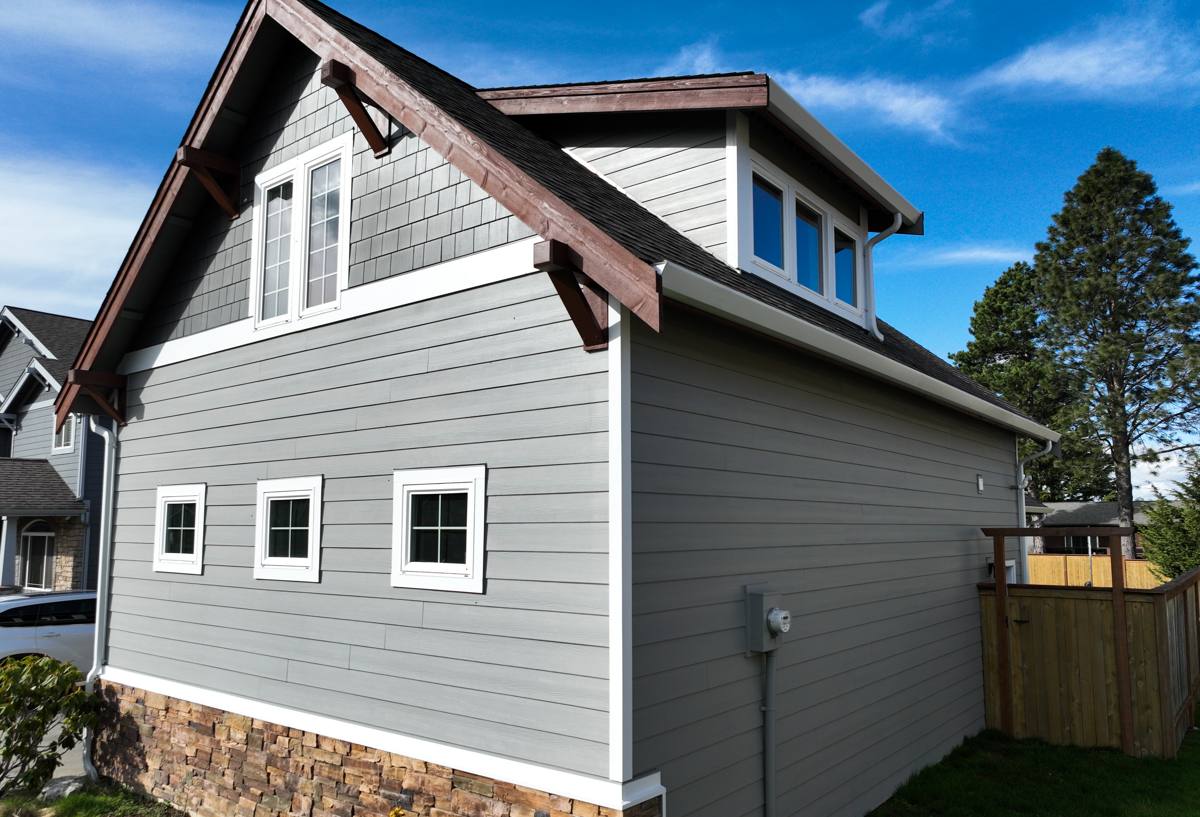
For Ferndale and the rest of Whatcom County, that generally means James Hardie's HZ10 formulation in either lap siding, panel siding, or shingle-style siding, depending on the home's architecture, plus Hardie trim boards to match. We'll walk through the specific product line and profile options during your estimate.
Beyond Siding: Roofing, Windows, and Decks
Siding doesn't work in isolation — it's one part of a home's exterior envelope, and the same climate stresses that affect siding affect the roof, windows, and any exposed deck structure.
Roofing
A roof in poor condition undermines even a perfect siding job, since water that gets past bad flashing or aging roofing material often ends up running down behind the siding. We handle roof repair and replacement alongside siding work so the whole envelope gets addressed together, not piecemeal.
Windows
Old or poorly flashed windows are one of the most common sources of hidden water intrusion we find when we open up a wall. Window replacement done at the same time as siding work lets us integrate flashing correctly instead of working around old, failing details.
Decks
Exposed decks take the same driving rain and damp-shade conditions as siding, plus foot traffic and standing water on horizontal surfaces. We build and repair decks with attention to the same moisture-management principles — proper flashing where the deck meets the house, drainage, and materials suited to sustained Pacific Northwest dampness.
Why a Local Whatcom County Crew Matters
Exterior work in this region isn't generic. A crew that mostly works drier inland climates can install siding correctly on paper and still miss the details that matter here — flashing sequencing for wind-driven rain, fastener spacing that accounts for our moisture cycles, or simply recognizing early moss growth as a warning sign rather than a cosmetic issue. Working throughout Whatcom County day in and day out means we see how different products and installation details actually perform in this specific climate over years, not just at the point of installation.
Local also means practical things: familiarity with permitting expectations in the county, realistic scheduling around our wet season, and being reachable if a question comes up after the job is done.
Maintaining Your Siding in a Ferndale Climate
Even low-maintenance fiber cement siding benefits from a bit of regular attention in this climate. A simple annual routine goes a long way:
- Rinse siding gently once or twice a year to knock down early moss, algae, or salt residue before it takes hold
- Check caulking around windows, doors, and trim joints for cracking or separation
- Keep gutters clear so overflow doesn't run down the wall surface
- Trim back vegetation and tree cover that keeps siding shaded and damp longer than necessary
- Look at flashing and trim at corners and window returns for early signs of water staining
- Address any soft spots, staining, or paint failure early rather than waiting for it to spread
None of this replaces a proper inspection every few years, but it catches small issues before they turn into a wall repair.
Get a Free, No-Pressure Estimate
If you're weighing a siding, roofing, window, or deck project on a Ferndale property, we're happy to take a look, explain what we're seeing, and give you a straightforward estimate — no pressure, no hard sell. Fill out the form below and we'll get in touch.