 Blaine Siding
 Custom Decks Built for Bellingham's Marine Climate
A deck in Bellingham has to earn its keep differently than a deck almost anywhere else in the country. You're building outdoor living space in a place with salt-laden air off Bellingham Bay, long stretches of driving rain, and a moss season that can run eight months out of the year. A deck that looks great on installation day but wasn't built with those conditions in mind will show its age fast — soft spots in the decking, rusted fasteners bleeding through the boards, slick green film on every walking surface by the second winter. We build custom decks for Bellingham homeowners with those realities factored in from the first footing to the last screw, not treated as an afterthought.
This page covers what actually matters for a deck built in this part of Whatcom County: what the climate does to decks over time, how to pick materials that hold up, what a correctly built structure requires underneath the decking you see, and how our process works from first visit to final walkthrough.
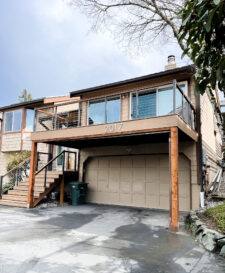
What Bellingham's Weather Does to a Deck Over Time
Three things drive almost every deck failure or premature replacement we see in this area, and they compound each other.
Salt Air
Proximity to Bellingham Bay and the greater Salish Sea means airborne salt is a constant, low-level presence, even a few miles inland. Salt accelerates corrosion on any exposed metal — fasteners, joist hangers, railing hardware, post bases. Once corrosion starts on a structural fastener, it's not cosmetic; it's a slow loss of holding strength in the connections that keep the deck attached to the house and the ground.
Driving Rain
Rain here doesn't just fall straight down — wind-driven rain gets pushed sideways into ledger connections, under railing posts, and into any gap in flashing or fastener sealing. A deck built assuming rain only hits the top surface will end up with water intrusion at the house connection, which is the single most common source of rot and structural damage in older decks we're asked to repair or replace.
Moss and Organic Growth
Shade, moisture, and mild temperatures are exactly what moss and algae need to thrive, and a north-facing or tree-covered deck in Bellingham can develop a slick green coating within a season if the surface material and drainage don't account for it. Beyond looking bad, a mossy deck surface is a real slip hazard, especially on stairs.
Choosing the Right Decking Material for the Pacific Northwest
There's no single "best" decking material — the right choice depends on your budget, how much upkeep you're willing to do, and how the deck is used. Here's how the common options actually perform under Whatcom County conditions.
Pressure-Treated Wood
The lowest upfront cost and still a solid choice if you're willing to stay on top of maintenance. Pressure-treated lumber resists rot better than untreated wood, but it still needs to be sealed or stained on a regular cycle in a climate this wet, and it's the material most prone to visible moss growth if that maintenance slips.
Cedar
A regional favorite for good reason — cedar has natural rot and insect resistance and weathers to an attractive silver-gray if left unfinished, or can be stained to keep its warm tone. It costs more than pressure-treated lumber and still requires periodic attention, but it handles our rain cycle well when properly installed with good airflow underneath.
Composite Decking
Engineered from wood fiber and plastic, composite boards don't absorb water the way solid wood does, which matters a great deal here. Quality composite resists rot and doesn't need staining or sealing. It costs more upfront than wood, and lower-quality or uncapped composite products can still be susceptible to moisture wicking at cut ends and mold growth on the surface, so the specific product matters as much as the category.
PVC Decking
Fully synthetic, PVC decking is essentially waterproof and the most resistant to moss and mildew staining of the common options, since it has no organic material for growth to take hold on. It's the highest upfront cost and can have a different look and feel underfoot than wood-based products, which is a matter of preference.
| Material | Upfront Cost | Moisture Behavior | Maintenance | Moss/Mildew Resistance |
|---|---|---|---|---|
| Pressure-Treated Wood | Lowest | Absorbs water; needs sealing | Annual stain/seal recommended | Lower — needs regular cleaning |
| Cedar | Moderate | Naturally rot-resistant, still absorbs some moisture | Periodic stain or let weather naturally | Moderate |
| Composite | Moderate-High | Low absorption; cut ends need sealing | Occasional washing, no staining | Good, varies by product quality |
| PVC | Highest | Essentially waterproof | Occasional washing | Best |
What a Correctly Built Deck Requires Underneath
The decking boards are the part everyone sees, but the framing, fasteners, and flashing underneath are what determine whether a deck lasts fifteen years or forty in a climate like this. A correct build in Bellingham includes:
- Footings sized and set below frost depth and bearing on stable, undisturbed soil — Whatcom County's mix of clay and glacial till means footing depth and soil prep can vary block to block.
- Proper ledger board flashing where the deck attaches to the house, including flashing tape and a drip edge that directs water away from the house sheathing, not into it.
- Corrosion-resistant, code-rated fasteners and structural connectors throughout — this is not the place to save money given the salt content in the air here.
- Joist spacing and beam sizing engineered for the actual span and load, not just "what's usually done."
- Ventilation and clearance beneath the decking surface so air can circulate and framing can dry out between rain events instead of staying wet.
- Proper slope and gapping on the decking surface itself so water sheds off rather than pooling.
Skipping or shortcutting any one of these is usually invisible on the day the deck is finished. It shows up two, five, or ten years later as soft framing, a failing ledger connection, or fasteners that have rusted enough to lose their grip — problems that are far more expensive to fix than they would have been to build correctly the first time.
Design Considerations for Bellingham Properties
Bellingham's terrain includes a lot of sloped lots, view properties, and mature tree cover, all of which shape what a deck design should actually do for a given home.
Covered vs. Open Decks
A partial or full roof over a deck meaningfully changes how much maintenance it needs. Covered decks stay drier, resist moss better, and extend usable outdoor time during our wetter months — worth serious consideration if the deck is meant to be used year-round rather than just in summer.
Multi-Level and Sloped-Lot Decks
Many Bellingham lots aren't flat, and a deck that steps down with the grade — rather than fighting it with one massive elevated structure — is often both more structurally sound and more affordable. It also tends to look more intentional against the natural landscape than a single flat platform bolted onto a hillside.
Railings and Guard Systems
Elevated decks need code-compliant guardrails, and the railing material matters for the same moisture and salt-air reasons as the decking itself. Metal railing systems need corrosion-resistant hardware and finishes; wood railings need the same maintenance commitment as wood decking.
Our Deck-Building Process
Every custom deck we build in the Bellingham area follows the same disciplined sequence, whether it's a modest ground-level platform or a multi-tier design with a covered section.
- On-site assessment. We walk the property, evaluate the soil, grade, sun and shade exposure, and how the deck will connect to the house.
- Design and material selection. We talk through material options honestly, including the maintenance trade-offs, so you're choosing based on real long-term costs, not just the sticker price.
- Permitting. We handle the permit application and coordinate any required inspections with the local jurisdiction.
- Footings and framing. This is where the deck's lifespan is actually determined — proper footing depth, structural framing, and ledger flashing before any decking goes down.
- Decking, railings, and finish work. Surface installation, railing systems, stairs, and any trim or fascia work.
- Final walkthrough. We go over the finished deck with you, including what maintenance (if any) the material you chose will need going forward.
Here's a quick checklist worth keeping in mind whether you hire us or anyone else for a deck project in this area:
- Ask whether footings will be inspected before decking is installed — you shouldn't have to take it on faith.
- Confirm what fastener and hardware grade will be used, and ask specifically about corrosion resistance.
- Ask how ledger flashing will be handled at the house connection.
- Get a clear answer on projected maintenance for the material you're choosing — not just "low maintenance," but what that actually means year to year.
- Confirm the permit is pulled and inspections are scheduled, not skipped.
Moss, Mildew, and Long-Term Deck Maintenance in Whatcom County
No decking material here is entirely maintenance-free, whatever the marketing says — even PVC decking benefits from an occasional rinse to keep organic buildup from getting a foothold in shaded corners. Wood and composite decks need more regular attention: periodic washing to remove pollen and organic debris before it turns into a moss base, prompt clearing of leaves and needles (especially under trees, which is common on Bellingham lots), and keeping gutters and downspouts near the deck clear so water isn't dumping directly onto or under the structure. Building the deck with proper drainage, gapping, and airflow from the start makes all of this maintenance easier and less frequent — it's far cheaper to design moss resistance in than to fight it after the fact.
Permits and Building Considerations
Deck construction in Whatcom County generally requires a permit once you're above certain size or height thresholds, and elevated decks always need code-compliant guardrails and stair specifications. Requirements can vary depending on your specific jurisdiction within the county and the details of your property, which is part of why we handle the permitting process directly rather than leaving it to the homeowner to sort out — it's one less thing to get wrong on a project that's supposed to last for decades.
Why Hire a Crew That Already Works in Bellingham
A deck built by someone unfamiliar with this region's conditions might follow a generic framing spec that works fine in a dry climate and predictably underperforms here. We build decks in Whatcom County's marine climate as a matter of routine, not exception — the footing depths, the flashing details, the fastener grades, and the material trade-offs discussed on this page aren't theoretical to us, they're what we account for on every project because Bellingham's salt air, driving rain, and moss season don't take a season off. That familiarity shows up in fewer callbacks, fewer surprises, and a deck that's still solid well past the point a shortcut-built one would need major repairs.
If you're planning a new deck or replacing one that's failing, we're happy to take a look and give you an honest read on what it needs. Reach out for a free, no-pressure estimate using the form below.