 Blaine Siding
 Why Semiahmoo Decks Wear Out Faster Than Decks Inland
Semiahmoo sits right on the water, and that location is exactly what makes it a tough spot for an exterior deck. The salt air coming off the bay accelerates corrosion on anything metal — nails, screws, joist hangers, railing brackets — long before the visible wood shows real damage. By the time a homeowner notices rust streaks bleeding through the decking or a railing post that feels loose, the fasteners underneath have often been failing quietly for years.
Add in Blaine's driving rain, which comes in sideways off the strait more often than most inland Whatcom County neighborhoods experience, and you get water pushed into joints and end grain that a standard deck design doesn't always account for. Then there's the moss and algae season, which in this part of Washington can run most of the year on shaded or north-facing decks. Moss holds moisture against the wood surface, and that constant dampness is what actually rots boards from the top down, not just from underneath.
None of this means a deck in Semiahmoo is doomed — it just means the build has to be planned for these specific conditions, not treated like a generic backyard project.
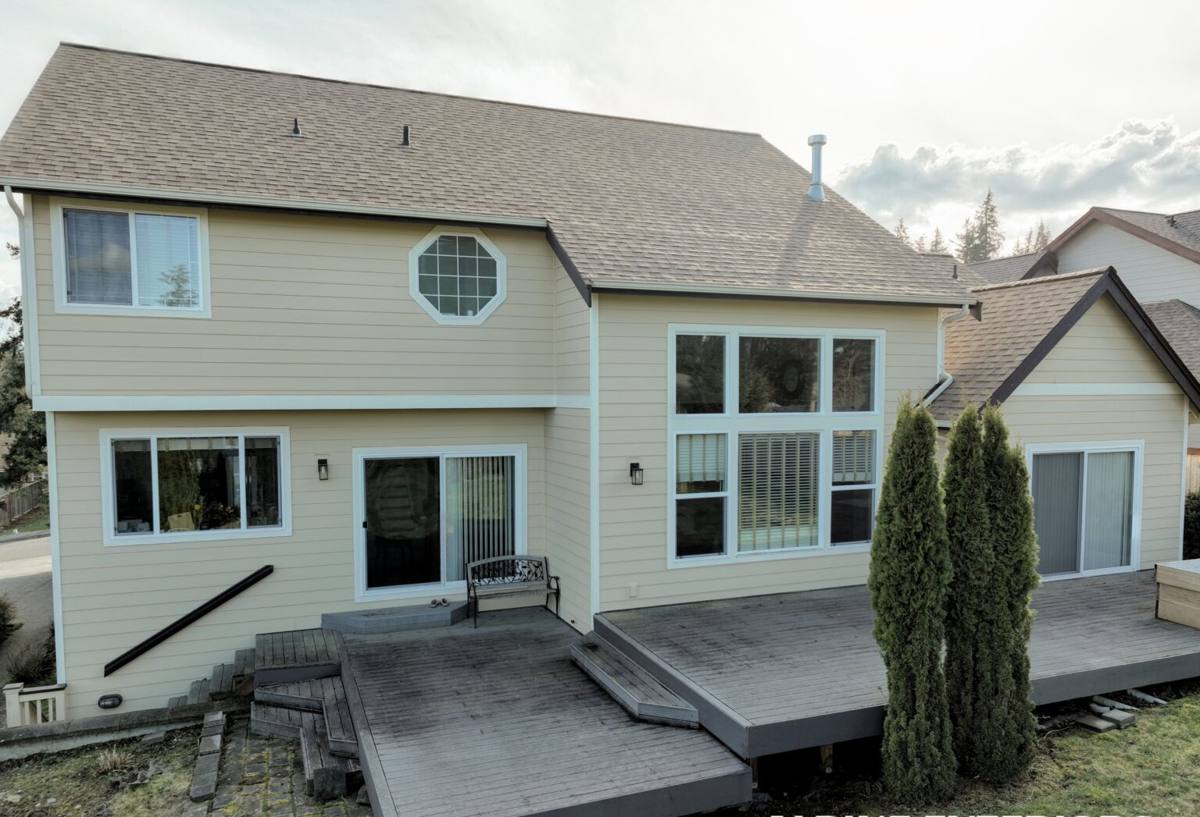
Signs Your Deck Needs Replacing, Not Just Repairing
Homeowners often ask whether a deck can be patched instead of rebuilt. Sometimes it can. But there's a point where repair work is just delaying the inevitable and spending money that should have gone toward a full replacement. Here's what we look for:
- Soft or spongy spots in the decking boards, especially near the house or in shaded corners
- Rust stains bleeding out around fastener heads or joist hanger locations
- A ledger board (where the deck attaches to the house) that shows water staining, gaps, or soft wood behind flashing
- Railing posts that flex or feel loose when pushed — often a sign the post base or blocking has decayed
- Visible mold, moss buildup, or a persistently damp smell under the deck even in dry weather
- Footings that have shifted, cracked, or sunk, causing the deck frame to be out of level
If the issues are limited to a few boards and the structure underneath is sound, repair makes sense. If the ledger, joists, or footings are compromised, replacement is the honest recommendation — patching over structural decay just hides the problem until it becomes a safety issue.
What a Correct Deck Replacement Actually Involves
Starting With the Structure, Not the Surface
A deck replacement done right starts below the decking boards. The ledger board attachment to the house gets new flashing — this is the single most common failure point on older decks in wet climates, because the original builder often relied on caulk alone instead of proper metal flashing and a water-resistive barrier behind it. We check joist spacing and sizing against current span tables, not just whatever was there before, since older decks are sometimes under-built by today's standards.
Footings and Framing
Footings get inspected or replaced to make sure they're set to proper frost depth and bearing on solid, undisturbed soil — this matters more in areas with the freeze-thaw and saturated ground conditions common around Blaine's wetter months. Joists and beams are sized for the actual load, and we use joist tape or a similar barrier on top of the framing to keep water from sitting on the wood under the decking, which is one of the biggest upgrades over how decks were commonly built years ago.
Railings and Stairs
Railings and stair stringers are structural components too, not just trim. Post attachment needs to resist real lateral force, and stair stringers need solid footing contact — both areas where corrosion-prone fasteners in a marine environment can quietly become a safety problem over time.
Decking Material Options for a Waterfront-Adjacent Climate
There's no single "best" material for every Semiahmoo deck — it depends on sun exposure, budget, and how much maintenance a homeowner actually wants to do. Here's an honest breakdown:
| Material | Salt Air Performance | Moss Resistance | Maintenance |
|---|---|---|---|
| Pressure-treated wood | Good if fasteners are stainless or coated | Needs regular cleaning/sealing | Annual cleaning and periodic sealing |
| Cedar | Naturally decay-resistant but fasteners still critical | Moderate — greys and can hold moss without care | Sealing or staining every 1-2 years |
| Composite decking | Excellent — doesn't corrode or rot | Good, but surface algae can still grow in shade | Periodic washing, no sealing needed |
| PVC/capped composite | Excellent, most moisture-resistant option | Best resistance to staining and moss growth | Lowest maintenance, occasional washing |
We don't push one brand or product line as a blanket answer. Composite and capped boards cost more upfront but make sense for homeowners who want to spend less time maintaining a deck that's exposed to constant marine moisture. Wood costs less initially but demands real upkeep — skipping that upkeep is what leads to premature replacement in this climate, not a flaw in the material itself.
Fasteners and Hardware — Where Salt Air Does the Most Damage
This is the detail that separates a deck that lasts from one that fails early in a location like Semiahmoo. Standard galvanized fasteners are rated for general outdoor use, but in direct marine air exposure they corrode faster than their rating suggests. We use stainless steel or marine-grade coated fasteners and connectors on decks in this area as a standard practice, not an upsell — it's the difference between hardware that holds for decades and hardware that starts rusting within a few seasons.
The same logic applies to joist hangers, post bases, and any structural connector. A deck can look fine on the surface while the hidden hardware underneath is corroding away, which is exactly why structural inspections during replacement matter more here than in a drier, inland location.
Our Process for a Semiahmoo Deck Replacement
- On-site assessment — we check the ledger, framing, footings, and existing hardware condition, not just the visible decking surface
- Honest scope proposal — full replacement, partial rebuild, or repair, based on what we actually find, explained in plain terms
- Permit handling — we pull the required Whatcom County or City of Blaine permits when the project calls for it, so the homeowner isn't left navigating that alone
- Demo and structural rebuild — old decking, framing, and any compromised ledger flashing removed and replaced to current standards
- Decking, railing, and stair install — using the material the homeowner chooses, with marine-grade fasteners throughout
- Final walkthrough — we go over basic maintenance expectations for the specific material installed
Because we already work in Semiahmoo and the surrounding Blaine waterfront areas, we're familiar with the kind of exposure these homes deal with and don't have to relearn the local conditions on your project's dime.
Permits and Local Considerations
Deck replacements that involve structural changes, height above a certain threshold, or work near property lines typically require a permit through Whatcom County or the City of Blaine, depending on exactly where the property falls. Some homes in and around Semiahmoo are also part of a homeowners' association with its own architectural or exterior guidelines — if that applies to your property, it's worth checking with the association before finalizing material or color choices. We factor permit and approval steps into the project timeline upfront rather than treating them as an afterthought.
Maintaining a New Deck in This Climate
A properly built deck still needs some ongoing attention in a salt-air, high-moisture environment. A little routine care goes a long way toward avoiding another premature replacement down the road:
- Sweep off leaves, needles, and debris regularly — trapped organic material holds moisture against the surface
- Rinse salt residue and grime off the decking a few times a year, especially after storms
- Keep gutters and downspouts clear so runoff isn't draining directly onto or under the deck
- Check railing posts and stair connections annually for movement or looseness
- Re-seal or re-stain wood decking on the schedule appropriate for that species — don't wait until it's visibly greying and cracked
- Address moss growth promptly rather than letting it establish, since it's much easier to prevent than remove
Cost Factors to Understand
Every deck replacement is different, and we won't quote a number without seeing the site, but these are the main variables that drive cost up or down:
| Factor | Impact on Cost |
|---|---|
| Deck size and footprint | Larger square footage means more material and labor |
| Height and stair complexity | Multi-level or elevated decks require more structural work |
| Material choice | Pressure-treated is the lowest upfront cost; composite and PVC cost more but need less upkeep |
| Extent of structural damage | Ledger, joist, or footing repairs add cost beyond a simple resurface |
| Railing style | Cable, glass, or custom railing systems cost more than standard wood or metal balusters |
| Permit requirements | Structural or setback-related permits add time and fees to the project |
The honest answer is that a deck facing this kind of marine exposure is rarely the place to cut corners on hardware or flashing just to save a little upfront — those are the components that determine whether the deck lasts fifteen years or thirty.
Why a Local Crew Matters for This Job
A contractor who mainly works inland, drier parts of Whatcom County may not automatically build in the corrosion-resistant hardware, extra flashing detail, or moisture barriers that a Semiahmoo deck actually needs — not because they're careless, but because it's not what their typical job site demands. A crew that regularly works Blaine's waterfront neighborhoods treats those details as standard practice, because we've seen what happens to decks that skip them.
If your deck is showing signs of wear, or you're just not sure whether it's a repair or a full replacement situation, we're happy to take a look and give you a straight answer. Reach out for a free, no-pressure estimate using the form below.