 Blaine Siding
 Why Blaine Harbor Siding Takes More Punishment Than Most
Blaine Harbor sits right where Semiahmoo Bay meets Drayton Harbor, and that waterfront position changes what a house needs from its exterior. Homes here deal with a combination that inland Whatcom County properties don't see nearly as much of: near-constant salt-laden air coming off the water, wind-driven rain that hits siding at an angle instead of falling straight down, and a moss and algae season that, given the shade and moisture in this corner of the county, can run nearly year-round rather than just through the wet months.
Each of those factors attacks siding differently. Salt air accelerates corrosion on fasteners, trim, and any metal flashing that isn't properly rated or protected. Driving rain finds its way behind siding through gaps, poor laps, and undersized reveals, then sits there instead of draining. Moss and algae hold moisture against the surface long after a storm has passed, which is exactly the condition that rots wood-based products and delaminates poorly made composites. None of this is unique to any one house in Blaine Harbor — it's the baseline condition the whole area lives with, and it's why we treat siding here differently than we would on a dry-side property.
What Fiber Cement Has to Do Right in This Environment
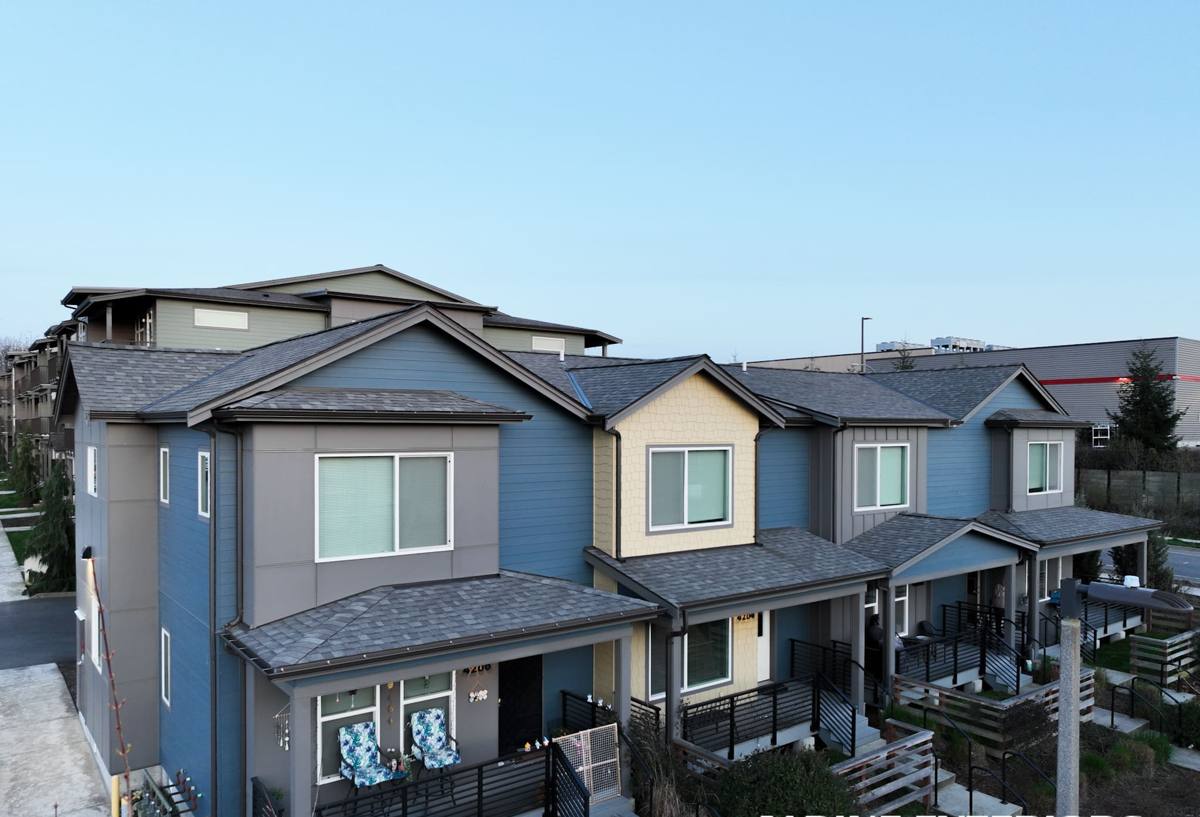
James Hardie fiber cement is a cement-and-cellulose composite, not wood and not vinyl, and that matters directly for a harbor-adjacent house. It doesn't rot, it doesn't feed moss and mildew the way wood fiber does, and it holds up to sustained moisture exposure without swelling or cupping. But "fiber cement" alone isn't a guarantee — the product line and the installation both have to match the exposure the house actually gets.
Product Line Matters
James Hardie engineers its siding by climate zone under its HardieZone system. Western Washington, including Blaine and the rest of Whatcom County, falls into the HZ5 zone, which is built around exactly this kind of wet, marine-influenced weather. HZ5 products are formulated for higher moisture exposure than the HZ10 line sold in drier, hotter regions. On a harbor-facing home, using the correct zone-matched product isn't a technicality — it's the difference between siding that's designed for this weather and siding that just happens to be installed here.
The Factory Finish Does Real Work
James Hardie's ColorPlus finish is baked on in a controlled factory setting, not brushed on at the jobsite. That finish is what stands between the substrate and years of salt air and UV exposure. A factory finish adheres more consistently than field-applied paint and resists the fading and chalking that site-painted siding tends to show first, particularly on a west- or water-facing elevation that gets full weather exposure.
Why We Only Install James Hardie
We don't install LP SmartSide, vinyl, Cemplank, Allura, or bare cedar or spruce siding, and on a property like this the reasoning is straightforward. Wood-based products need active maintenance to resist moisture and pests, and a harbor environment doesn't give you much margin for a missed re-coat or a cracked caulk joint. Vinyl expands and contracts with temperature swings and can warp or crack under the kind of wind exposure open water frontage produces. Other fiber cement brands may look similar on a spec sheet, but we've standardized on James Hardie because of its climate-specific engineering, the depth of its warranty backing, and a long track record of holding up when installed correctly. That last part — installed correctly — is doing a lot of work in that sentence, and it's the next section.
What a Correct Installation Actually Involves Here
Fiber cement siding fails prematurely almost exclusively because of installation mistakes, not product defects. On a Blaine Harbor home, a few details matter more than they would somewhere drier and calmer.
- Rainscreen gap: A drainage gap behind the siding lets any moisture that does get past the surface drain and dry instead of sitting against the wall sheathing — important when driving rain is a regular event, not an occasional one.
- Flashing and metal hardware: Around every window, door, and penetration, flashing needs to be installed to shed water outward and rated to resist salt-air corrosion, not just standard-grade material that will pit and stain over a few winters.
- Fastener choice and placement: Corrosion-resistant fasteners, driven at the manufacturer's specified location and depth, prevent both rust streaking and the loosened boards that let wind-driven rain get behind the plank.
- Proper laps and clearances: Correct overlap at horizontal joints, and the right gap at the bottom of the siding above grade, decks, and roof lines, keeps water moving down and off rather than wicking upward into the board.
- Caulking at the right joints, not every joint: James Hardie's own installation guidance calls for caulking at specific locations, not sealing every seam solid — over-caulking traps moisture instead of letting the system breathe and drain as designed.
Skip any one of these and you get the same siding material behaving very differently — trapping moisture instead of shedding it, corroding instead of holding, and needing repair years before it should.
Our Process for a Blaine Harbor Job
Assessment
We start by walking the property and looking specifically at exposure: which elevations take the most direct wind and rain off the water, where moss and algae are already established, where existing trim or flashing shows corrosion, and what the current siding's failures — if any — tell us about how water has been moving around the house.
Prep and Moisture Check
Before new siding goes up, we check the wall sheathing and framing underneath for any hidden water damage from the old siding system. Covering up a wet wall with new siding just delays a bigger problem, and on a harbor lot that risk is higher than average.
Installation to Spec
We install James Hardie products to the manufacturer's published requirements for this HardieZone — correct fastener schedule, rainscreen where the wall assembly calls for it, proper flashing at every penetration, and factory-finished ColorPlus boards and trim so the color and coating match across the whole job.
Final Detailing
Caulking, touch-up, and a walk-through where we point out anything the homeowner should keep an eye on — including basic moss and algae upkeep, which is a maintenance item, not a defect, in this part of the county.
Cost Factors on a Harbor-Area Home
Every project is different, and we won't quote a number without seeing the house, but a few things consistently move the price on Blaine Harbor jobs specifically.
| Factor | Why It Affects Cost Here |
|---|---|
| Wall exposure to wind/water | Elevations facing the bay may need additional flashing detail and rainscreen work beyond a standard install |
| Condition of existing sheathing | Salt-air and moisture-related hidden damage sometimes requires repair before new siding goes on |
| Trim and detail complexity | Homes with more windows, dormers, and roof intersections need more flashing and trim labor |
| Access and staging | Waterfront lots and tighter harbor-area properties can affect scaffolding and material staging |
| Product line and profile | HZ5-rated planks, trim profile choice, and ColorPlus color selection affect material cost |
A Practical Checklist Before You Hire Anyone
- Ask what HardieZone product line they're quoting and whether it's rated for this climate zone
- Ask specifically whether a rainscreen gap is included in the installation
- Ask what flashing material they use around windows and doors, and whether it's rated for salt-air exposure
- Ask to see their fastener schedule and spacing plan, not just a verbal assurance it'll be "done right"
- Confirm the crew has worked on homes in Blaine or similarly exposed waterfront areas before, not just inland projects
Why a Crew That Already Works Blaine Harbor Makes a Difference
Siding crews that mostly work drier, more sheltered parts of Whatcom County don't always adjust their approach for a harbor-facing lot — they may use the same flashing, the same fastener spec, and the same rainscreen decisions everywhere, whether the wall faces open water or a sheltered inland yard. A crew that regularly works in and around Blaine sees how salt air, wind-driven rain, and moss actually play out on real houses here over time, and builds that into how the job gets done, not as an afterthought but as the starting assumption. Familiarity with local weather windows also matters practically — knowing when a stretch of dry, workable weather is likely to hold long enough to get a wall properly closed in is part of doing this job well in this location.
Let's Look at Your Home
If you're weighing a siding project on a Blaine Harbor property, we're glad to come take a look, walk the exposure with you, and give you a straightforward, no-pressure estimate for James Hardie fiber cement siding done to spec for this climate. Use the form below to get started.