 Blaine Siding
 Blaine Harbor's Roofs Work Harder Than Most
Houses close to the water in Blaine Harbor take a different kind of beating than homes even a few miles inland. The combination of salt-laden marine air, wind-driven rain coming off Semiahmoo Bay and the Strait, and a moss season that can run most of the year in Whatcom County means a roof here is doing double duty: shedding water fast and standing up to slow corrosion at the same time. A roofing product that performs fine in a drier, inland climate can struggle here — fasteners rust early, coatings chalk out faster, and moss gets a foothold in valleys and under-eave shade that never fully dries out. Metal roofing, installed correctly for this specific environment, is one of the more durable answers to that combination.
This page is about metal roofing specifically for Blaine Harbor properties — what the salt air and moss actually do to a roof over time, what a correct installation looks like here, and how we approach the job on homes in this part of Blaine.
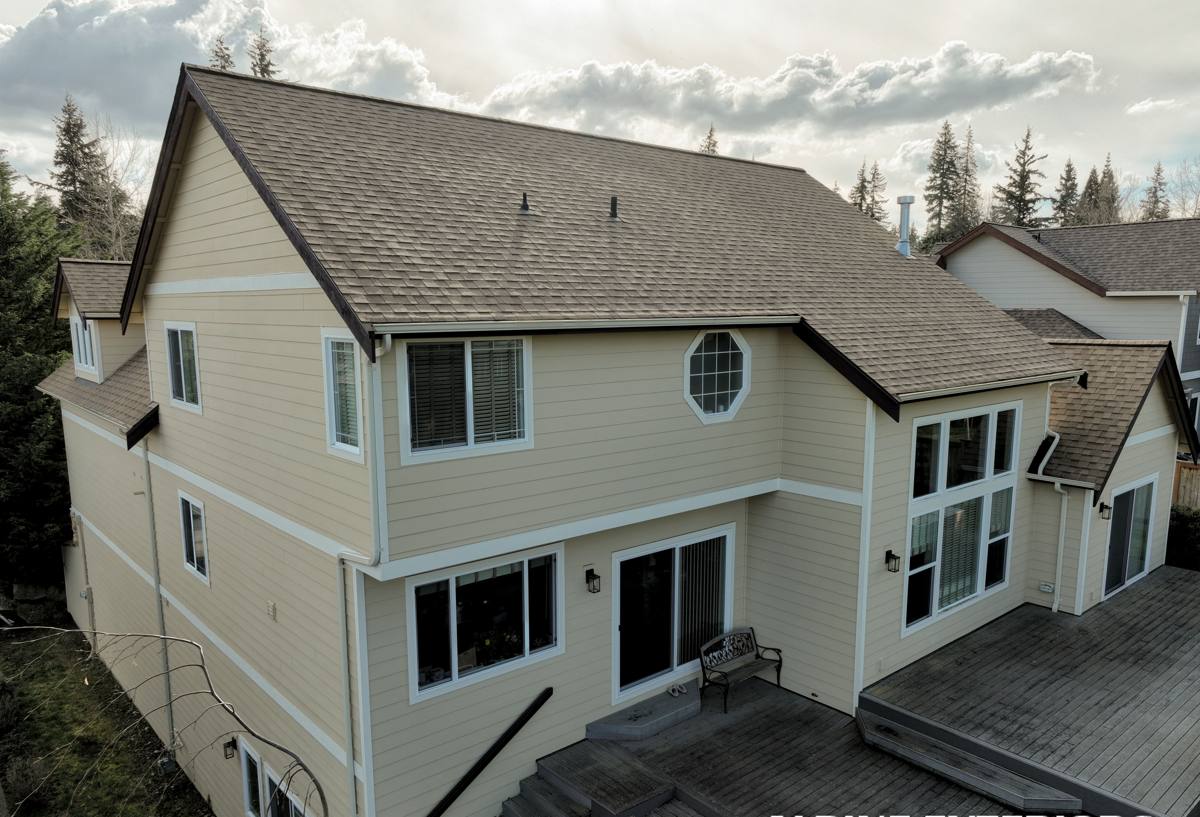
What the Local Climate Actually Does to a Roof
Salt Air and Corrosion
Airborne salt from the Strait of Georgia and Semiahmoo Bay settles on every exterior surface, roofs included. On uncoated or poorly coated metal, that salt accelerates oxidation — you'll see it first at cut edges, fastener heads, and anywhere the protective finish has been scratched or worn thin. It's a slow process, but it's constant, and it's the main reason coastal metal roofing has to be spec'd differently than the same product installed twenty miles inland.
Driving Rain
Storms coming off the water in Blaine tend to bring rain sideways, not straight down. That matters for a roof because wind-driven rain can find its way under laps, around penetrations, and into fastener holes that would stay dry in a calmer climate. Seam design, fastener placement, and underlayment all have to account for water moving uphill under pressure, not just gravity.
Moss and Moisture Retention
Whatcom County's long wet season gives moss and lichen plenty of time to establish, especially on north-facing slopes and shaded roof sections that stay damp between storms. Moss holds moisture against the roof surface, which on the wrong material accelerates decay or corrosion and can lift shingles or seams over time. Metal sheds moss more readily than most roofing types because of its smooth, low-friction surface, but panel profile, slope, and gutter design still make a real difference in how much moss actually takes hold.
Why Metal Roofing Fits This Environment
Metal isn't the right choice for every home or budget, and we'll say so plainly if it isn't right for yours. But for Blaine Harbor's conditions specifically, it has some real advantages:
- Smooth, steep-shed panel surfaces give moss and lichen less to grip than a shingle's textured surface
- Properly coated steel or aluminum resists the surface oxidation that salt air accelerates
- Standing seam systems have fewer exposed fastener points for wind-driven rain to exploit
- Long service life reduces how often the roof is reopened and re-flashed, which is when leaks most often start
- Lighter weight than many other durable roofing options, which is a factor on some older Blaine Harbor framing
Choosing the Right Metal System
Not all metal roofing is built the same, and the differences matter more here than they would in a mild inland climate. The two main categories homeowners choose between are standing seam and exposed-fastener panel systems.
| Feature | Standing Seam | Exposed Fastener |
|---|---|---|
| Fasteners | Hidden, attached via concealed clips | Visible screws through the panel face |
| Salt air performance | Fewer penetration points for corrosion to start | Screw heads and washers are the first failure point |
| Wind-driven rain resistance | Interlocking seams shed water under pressure well | Relies on gasketed screws staying sealed over time |
| Typical lifespan (coastal use) | Longer, with less maintenance | Shorter, needs periodic fastener inspection |
| Upfront cost | Higher | Lower |
Exposed-fastener panels aren't a bad product — they're used successfully across the region — but in a marine environment like Blaine Harbor, the screw gaskets are doing a lot of the work keeping water out, and they don't last forever. We're upfront with homeowners about that maintenance burden versus the higher upfront cost of standing seam. It's a real trade-off, not a sales pitch either direction.
Materials and Coatings That Matter Near Salt Water
The base metal and the finish on top of it are separate decisions, and both affect how the roof handles this climate.
Steel vs. Aluminum
Galvanized or Galvalume steel is the more common and more affordable option, and with a good factory finish it holds up well. Aluminum costs more but doesn't rust at all — it can still corrode in salt air, but differently and generally more slowly, which is why some homeowners closest to the water opt for it despite the higher price.
Factory Finishes
A quality PVDF (fluoropolymer) factory coating resists chalking and fading far better than a basic painted finish, and it's worth the difference in a climate that's UV-exposed in summer and salt-exposed year-round. We won't install a bare or minimally coated panel on a home this close to the water — it's a maintenance headache we'd rather you not inherit a few years in.
Fasteners and Flashing
Fastener and flashing metal should match or be compatible with the panel metal to avoid galvanic corrosion, where two dissimilar metals in contact accelerate each other's breakdown. This is an easy detail to get wrong and a hard one to fix after the fact, so it's something we check on every job regardless of who manufactured the panels.
What's Under the Panels Matters as Much as the Panels
A metal roof is only as good as what's beneath it. On Blaine Harbor homes we pay particular attention to:
- Underlayment: a high-temperature synthetic or self-adhered underlayment at valleys, eaves, and penetrations gives a backup barrier if wind-driven rain ever gets past the panel seams
- Ventilation: proper intake and exhaust airflow keeps the roof deck dry from the inside, which matters in a climate where the outside is rarely fully dry either
- Ice and water protection at eaves: Whatcom County doesn't get heavy ice damming like colder inland areas, but eave protection still guards against wind-driven rain backing up under the first courses
- Flashing at every penetration: chimneys, vents, and skylights are where most roof leaks start, metal or otherwise, and they get the same attention as the field of the roof
How We Approach a Metal Roofing Job in Blaine Harbor
Our process is the same fundamentals every time, applied with this area's conditions in mind:
- On-site assessment: we look at slope, sun and shade exposure, existing moss growth, and how exposed the roof is to wind off the water before recommending a system
- System and material selection: we walk through standing seam versus exposed fastener, steel versus aluminum, and coating options against your budget and how close the home sits to salt water
- Tear-off and deck inspection: we check the decking for existing moisture damage before anything new goes down — no roof, metal or otherwise, performs well over a compromised deck
- Underlayment and flashing installation: done to the standard described above, not the minimum required to pass inspection
- Panel installation: proper seam engagement, fastener spacing, and thermal movement allowance, since metal expands and contracts more than other roofing materials
- Final walkthrough: we go over the finished roof and basic care with the homeowner before we consider the job done
Maintenance in a Moss-Heavy, Salt-Air Climate
Metal roofing is low-maintenance compared to most alternatives, but "low" isn't "none," especially in Blaine Harbor's conditions. A simple annual routine goes a long way:
- Clear gutters and valleys of needles and debris before the wet season builds up
- Rinse off moss or algae buildup gently — avoid pressure washing directly at seams or fastener points
- Check fastener heads and washers on exposed-fastener systems for early rust or gasket wear
- Look at flashing around chimneys, vents, and skylights for lifting or sealant breakdown
- Trim back overhanging branches that keep sections of roof shaded and slow to dry
What Affects the Cost
| Factor | Why It Matters Here |
|---|---|
| Panel system type | Standing seam costs more upfront but needs less coastal maintenance over time |
| Base metal | Aluminum costs more than steel but resists rust differently in salt air |
| Coating grade | Better factory finishes cost more but hold color and resist chalking longer |
| Roof complexity | Valleys, dormers, and multiple penetrations add labor and flashing detail |
| Existing deck condition | Moisture-damaged decking found during tear-off adds repair cost |
| Roof pitch and access | Steeper or harder-to-access roofs increase labor time |
We give honest, itemized numbers based on your actual roof, not a rough per-square estimate that changes once we're up there — especially since the right coastal spec for a Blaine Harbor home isn't always the cheapest option on paper.
Why a Crew That Knows Blaine Harbor Matters
A lot of what makes a metal roof succeed or fail in this specific pocket of Whatcom County isn't in a manufacturer's install manual — it's knowing which slopes hold moss longest, how exposed a given lot is to wind off the bay, and what flashing details actually hold up to salt air over years, not just the warranty period. A crew that installs roofs across a wide range of inland climates can still do competent general work, but a crew that's worked this specific stretch of coastline has already seen which shortcuts fail here and which details are worth the extra time. That's the standard we hold every metal roofing job to in Blaine Harbor.
If you're weighing a metal roof for a home in Blaine Harbor, we're glad to take a look and walk you through what makes sense for your specific roof — no pressure, no obligation. The form below gets you a free estimate.