 Blaine Siding
 Why Cherry Point Siding Takes a Different Approach
Cherry Point sits on the water in Whatcom County, and that location shapes almost every decision that goes into a good siding job here. Homes get a steady dose of salt-laden wind off the Salish Sea, rain that doesn't fall straight down but drives sideways into walls and trim, and — on the shaded, tree-covered lots common in this part of the county — long stretches of the year where surfaces simply never fully dry out. That combination is hard on siding in ways that a drier, more inland part of Washington never has to deal with.
A siding material or installation detail that holds up fine forty-five minutes inland can fail years early right on the water. That's why a Cherry Point siding job isn't just "install siding" — it's a set of decisions about material, flashing, ventilation, and fastening that are specific to a marine, moss-prone climate. This page walks through what that actually means for fiber cement siding, since it's the product we install on every home we work on here.
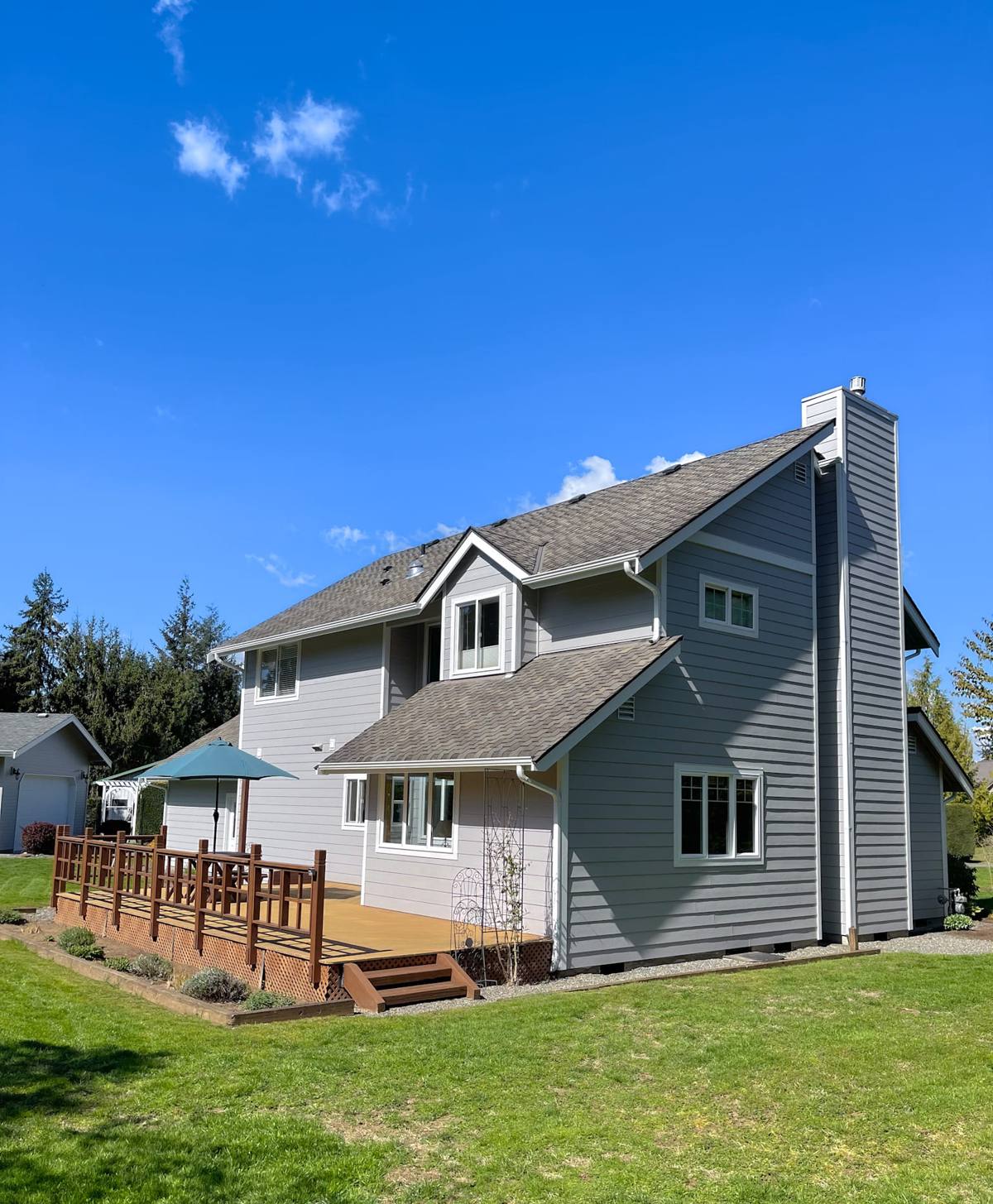
What the Marine Climate Does to the Wrong Siding Material or a Sloppy Install
Salt Air and Fasteners
Airborne salt doesn't just sit on the surface of a wall — it works into every joint, fastener head, and piece of exposed hardware. Over years, that accelerates corrosion on anything that isn't correctly rated or protected, and it slowly breaks down finishes that weren't engineered to shed salt residue. Siding installed with the wrong fastener type, or with fasteners left exposed instead of properly seated and sealed, ages faster near the water than it would three miles inland.
Wind-Driven Rain and Lap Seams
Rain that comes in at an angle finds its way into gaps that vertical rain never would. Lap siding with too little overlap, panels butted without proper flashing, or trim installed without a drainage path behind it will eventually let water track behind the siding. Once moisture gets behind the cladding, it's the sheathing and framing that pay the price — not just the siding itself.
Shade, Moss, and Trapped Moisture
Many Cherry Point lots hold shade well into the day, and that shade keeps siding surfaces damp longer after every rain. Moss and lichen take hold readily in that environment, and once established they hold even more moisture against the wall. Siding that can't handle sustained dampness — or that was installed without airflow behind it — will show rot, staining, and finish failure well ahead of schedule.
Why We Install Only James Hardie Fiber Cement Here
We standardized on James Hardie fiber cement siding, and Cherry Point is exactly the kind of climate that decision was made for. Fiber cement is non-combustible, dimensionally stable, and doesn't absorb and swell with moisture the way wood-based siding products do. That matters directly in a place where surfaces stay wet for extended periods every winter.
HardieZone HZ5: Engineered for the Pacific Northwest
James Hardie engineers its products by climate zone, and the HZ5 formulation used across the Pacific Northwest is built to perform in exactly the conditions Cherry Point sees — sustained moisture exposure, freeze-thaw cycling, and coastal air. That's a meaningfully different product than fiber cement built for a hot, dry climate, and it's one of the core reasons we don't treat "fiber cement" as a single interchangeable category.
ColorPlus Factory Finish
Most of the color-related failures we see on older siding come down to field-applied paint breaking down under UV and moisture stress. Hardie's ColorPlus finish is baked on at the factory under controlled conditions, and it carries its own finish warranty separate from the substrate warranty. In a salt-air environment where paint failure shows up early, that factory-cured finish is worth the difference.
| Hardie Product | Typical Use on a Cherry Point Home | Look |
|---|---|---|
| HardiePlank Lap Siding | Full walls, most common choice on homes here | Traditional horizontal lap, several profiles |
| HardiePanel Vertical Siding | Accent walls, gables, modern facades | Clean vertical lines, often paired with battens |
| HardieShingle | Accent sections, dormers, decorative bands | Staggered or straight-edge shingle profiles |
| HardieTrim | Corners, window and door surrounds, fascia | Smooth or textured trim board |
What a Correct Fiber Cement Install Involves in This Climate
Fiber cement is only as good as the details behind it. In a wind-driven-rain environment like Cherry Point, the flashing, gaps, and fastening pattern matter as much as the siding material itself. A rushed or by-the-numbers install can still let water behind the wall even with a top-tier product on the outside.
- Weather-resistive barrier installed and lapped correctly before any siding goes up
- Proper drainage gap behind the siding so any moisture that does get in can escape
- Correct lap overlap and clearance at the bottom starter course
- Flashing at every window, door, and roofline penetration — not just caulk alone
- Kick-out flashing where rooflines meet walls, to direct roof runoff away from the siding face
- Fasteners driven to manufacturer spec — right type, right depth, right spacing
- Field-cut edges sealed per manufacturer instructions, since raw cut edges are a moisture entry point
- Caulking limited to where it belongs — flashing does the real work, caulk is a backup, not the primary defense
Skipping any one of these doesn't show up as a problem on day one. It shows up two, five, or ten years later as staining, soft trim, or siding that has to come off early — which is a far more expensive fix than doing it right the first time.
Our Process for a Cherry Point Home
We start with a walk-around of the home to look at existing siding condition, moisture staining, trim and flashing details, and which elevations take the worst of the wind and rain — that's usually the water-facing side and any shaded walls that stay damp longest. If there's existing siding to remove, we check the sheathing underneath for hidden moisture damage before anything new goes on, since covering up a wet or rotted substrate just hides the problem.
From there, installation follows James Hardie's published specifications for the HZ5 zone — house wrap, drainage gap, flashing sequence, fastening, and cut-edge sealing, in that order, on every elevation. We don't shortcut the water-side walls just because they're harder to access. Once the siding, trim, and any accent sections are complete, we do a final walkthrough to check seams, flashing, and finish before calling the job done.
Cost Factors on a Cherry Point Siding Project
| Factor | Why It Affects Cost |
|---|---|
| Home size and number of stories | More surface area and higher elevations mean more material and labor time |
| Existing siding removal | Tear-off, disposal, and any sheathing repair add time before new siding goes up |
| Trim and accent complexity | Multiple Hardie profiles, vertical accents, or shingle sections take more detail work than a single lap profile |
| Site access | Waterfront lots, slopes, or tight setbacks can slow staging and scaffolding |
| Moisture or rot repair | Damaged sheathing or framing found during tear-off has to be repaired before siding can go on correctly |
| Color and finish selection | ColorPlus factory finish options vs. field-painted trim can shift material cost |
We don't quote a Cherry Point project off a national average — every estimate is based on what we actually find on that specific home, including any moisture damage that only shows up once old siding comes off.
Maintenance in a Moss-Prone, Salt-Air Environment
Fiber cement is low-maintenance compared to wood, but "low-maintenance" doesn't mean "no maintenance" — especially this close to the water. A periodic rinse-down keeps salt residue and organic buildup from accumulating on the surface, and keeping gutters and downspouts clear keeps roof runoff from sheeting down the wall face instead of draining away from it. Trim and caulk joints are worth a visual check once a year, since those are the points most likely to need attention before a problem develops.
Because ColorPlus is a factory-cured finish rather than field-applied paint, most Cherry Point homeowners go far longer between repaints than they would with site-painted siding — one of the more practical, day-to-day benefits of the product in a climate this hard on exterior finishes.
Why Hiring a Crew That Already Works Cherry Point Matters
A contractor who mostly works drier, inland jobs doesn't necessarily think about kick-out flashing, drainage gaps, or which elevation of a house takes the worst weather — because most of their projects don't demand it. Working this stretch of Whatcom County regularly means those details aren't an afterthought; they're standard practice on every job. That includes knowing how local permitting and inspection expectations run in the county, and building in the extra flashing and drainage attention that a shoreline, moss-heavy climate actually requires.
It also means we're not learning on your house. The install sequence, the fastening pattern, the flashing details — all of it gets applied the same way, correctly, whether it's your first estimate or our fiftieth job in this area.
If you're considering fiber cement siding for a Cherry Point home, we're glad to walk the property, look at what's there now, and put together a straightforward, no-pressure estimate — use the form below to get started.