 Blaine Siding
 Building Decks for Custer Homes
Custer sits inland from the water but still gets the full weather package that defines this corner of Whatcom County: long wet stretches through fall and winter, salt-tinged air pushing in off the Strait, and a moss season that seems to start earlier every year. A deck built here has to handle all of it at once — not just rain, but the freeze-thaw swings, the UV bursts in July and August, and the constant low-grade moisture that never fully dries out between storms. We build and repair decks for Custer homeowners with that reality in mind, not a generic spec sheet.
A deck is one of the few home improvements that lives entirely outside, fully exposed, year-round. Unlike siding or roofing, it doesn't get help from an overhang or a drainage plane behind it — the surface takes direct weather every single day. That's why deck framing, fastener choice, and board selection matter more here than in drier climates, and why a lot of decks we get called to repair were built to a warm-climate standard that never accounted for what a Whatcom County winter actually does to wood.
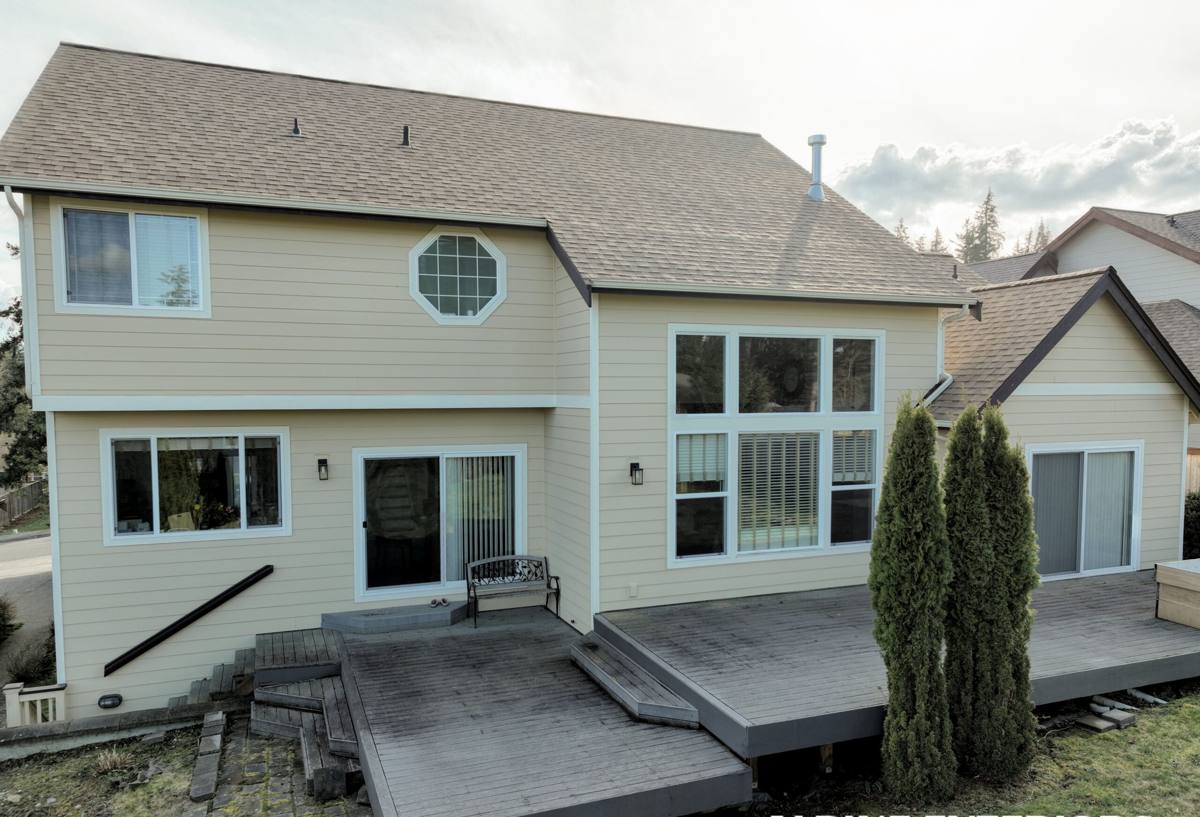
What Custer's Climate Does to a Deck
Moisture That Doesn't Let Up
The biggest threat to any deck in this area isn't a single big storm — it's the cumulative effect of months of damp air and standing moisture. Ledger boards, joist hangers, and the framing tucked underneath the decking are the parts homeowners never see, and they're exactly where rot starts. If flashing at the house connection is missing or installed wrong, water tracks behind the ledger and works into the rim joist for years before anyone notices a soft spot.
Moss and Algae Growth
Anywhere shade and moisture overlap — under trees, on the north side of a house, in gaps between boards — moss and algae get a foothold. Beyond looking bad, moss holds water against the wood surface and makes boards slick and dangerous underfoot. Deck spacing, board orientation, and surface material all affect how much moss you'll be fighting long-term.
Salt Air and Metal Fasteners
Custer is close enough to the water that airborne salt is a real factor, especially on decks with any western or northwestern exposure. Standard fasteners and hardware corrode faster here than they would further inland. Using the wrong grade of screw or joist hanger is a slow failure — it looks fine for a couple of years, then starts staining the decking and weakening connections right when you'd least expect it.
Freeze-Thaw Swings
Whatcom County doesn't get brutal winters, but it does get repeated freeze-thaw cycling — wet wood that freezes overnight and thaws by midday. That cycle is hard on any wood fiber that's already holding moisture, and it's part of why proper drainage and airflow under the deck matter as much as the decking material itself.
What a Correctly Built Deck Includes
A deck that's going to last in this climate isn't about buying the most expensive board — it's about getting the details right that you can't see once the project's done.
- Proper ledger board flashing and house-side waterproofing, isolated from the siding or trim above it
- Corrosion-resistant, coastal-rated fasteners and structural hardware throughout — not just at the ledger
- Joist spacing and blocking sized to the decking material and expected snow/live load, not the minimum code allows
- Adequate slope away from the house and clear drainage paths so water doesn't pool under or against the structure
- Ventilation gaps and clearance under low decks so framing can actually dry out between rain events
- Board spacing calibrated to the material — composite, cedar, and pressure-treated lumber all move differently with moisture
- Stair and railing connections built to hold up to repeated wet-dry cycling, not just pass initial inspection
Choosing Decking Material for This Climate
There's no single "best" decking material — there's a best fit for how a homeowner uses the deck, what maintenance they're willing to do, and their budget. We walk Custer homeowners through the real trade-offs rather than pushing one product.
| Material | How It Handles Local Climate | Maintenance Reality |
|---|---|---|
| Pressure-treated lumber | Holds up well structurally when properly sealed; needs consistent upkeep to resist moss and graying | Annual cleaning and re-sealing recommended; lowest upfront cost |
| Cedar | Naturally moisture- and insect-resistant, ages well if maintained; softer surface can show wear | Periodic staining or sealing to preserve color and moisture resistance |
| Composite | Very stable in wet climates, resists rot and moss buildup on the surface itself | Low maintenance — occasional washing; framing underneath still needs to be built and protected correctly |
| PVC/synthetic decking | Fully impervious to moisture absorption in the board itself; performs consistently in salt air | Lowest ongoing maintenance; higher upfront material cost |
Composite and PVC decking have become popular around Whatcom County for good reason — they take moss, rain, and salt air better than any wood product without constant upkeep. But we're honest that the framing underneath still has to be built to the same standard regardless of what's on top. A composite deck built over poorly flashed, poorly ventilated framing will still develop hidden rot — the surface just hides it longer, which can actually make the eventual repair worse.
Our Process for a Custer Deck Project
1. On-Site Assessment
We look at the house connection point, existing grade and drainage, sun/shade exposure, and how the deck will actually be used before recommending anything. For repair or replacement work, we also check the framing and ledger connection for hidden moisture damage.
2. Design and Material Selection
We walk through decking, railing, and hardware options with real cost and maintenance trade-offs — no upselling toward whatever has the best margin. If a lower-maintenance material fits the budget and the way the space will be used, we say so.
3. Permitting
Deck projects in Whatcom County typically require permits depending on height, size, and attachment to the structure. We handle that process so the project is built to code and won't cause problems at resale.
4. Build
Framing first, with full attention to flashing, fastener grade, and drainage — the parts that determine whether the deck is still solid in fifteen years. Decking, railing, and finish work follow once the structure is right.
5. Walkthrough
We go over the finished deck together, including basic care guidance specific to the material installed, so it's clear what upkeep (if any) is needed going forward.
New Builds vs. Repairs and Replacements
A lot of our Custer deck calls aren't new builds — they're homeowners dealing with a deck that's starting to feel soft, spongy, or unstable in spots. Common issues we find:
- Rot at the ledger board connection from missing or failed flashing
- Corroded or undersized fasteners causing loose railings and stair connections
- Moss buildup trapping moisture against boards, accelerating decay
- Inadequate under-deck drainage leading to standing water and framing rot
- Boards installed too tight, preventing the expansion/contraction movement wet climates require
Sometimes a repair is genuinely enough — replacing a section of decking or re-flashing a ledger board doesn't always mean starting over. Other times, once we're into the framing, it's clear the structure has been compromised long enough that a full rebuild is the more honest recommendation. We tell homeowners which situation they're in before any work starts, not after.
Why Hire a Crew That Already Works in This Area
Deck-building standards written for a national audience don't account for Pacific Northwest coastal conditions. A crew that mainly works drier climates may not think twice about standard fasteners, minimal ledger flashing, or tight board spacing — details that are fine in Arizona and a real liability in Whatcom County. We build decks for this specific climate: the driving rain, the salt air, and the moss season that never fully goes away. That's not a marketing line — it's the difference between a deck that needs major repair in five years and one that's still solid in twenty.
We also know the local permitting process and inspection expectations, which keeps projects moving instead of stalling on avoidable paperwork issues.
Get a Free Estimate
If you're planning a new deck in Custer or dealing with one that's showing its age, we're happy to take a look and give you a straight assessment — what's actually needed, what it will cost, and what your material options are. Reach out for a free, no-pressure estimate using the form below.