 Blaine Siding
 Deck Replacement Built for Custer's Coastal Climate
Custer sits close enough to the water that salt air is part of daily life, and that changes how a deck ages. Homeowners here don't just deal with rain — they deal with rain that arrives sideways off the Strait, humidity that never fully clears, and a moss season that can run from October through April. A deck that would hold up fine in a drier inland climate can fail early out here if it wasn't built, or replaced, with those conditions in mind. When we talk about deck replacement in Custer, we're not describing a generic remodeling job. We're describing a structure that has to shed water fast, resist fastener corrosion from salt exposure, and stay walkable when it's covered in moss and dew half the year.
This page covers what actually goes into a correct deck replacement for this area — the failure points we see most often on older Custer decks, what a proper rebuild involves structurally and materially, and how our process works from the first look at your deck to the final walkthrough.
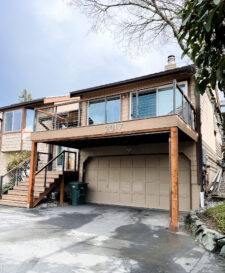
Why Decks Fail Faster Near Blaine and Custer
Every deck eventually needs replacing, but the timeline and failure pattern here in Whatcom County looks different from a deck built fifty miles inland. A few things are working against wood and hardware near the water:
- Salt air corrosion — even galvanized fasteners and hardware can start showing rust years earlier than manufacturer ratings suggest when they're within a few miles of saltwater exposure.
- Driving rain — wind-driven rain gets pushed under railings, into ledger connections, and behind fascia boards in ways vertical rain never would. Flashing details that are "good enough" elsewhere often aren't good enough here.
- Extended moss season — moss holds moisture against decking boards for months at a time. On wood decks, that's a direct path to rot. On composite, it's a slip hazard and a maintenance headache if the board profile doesn't shed water well.
- Freeze-thaw cycling — Whatcom County gets enough cold snaps that trapped moisture in a ledger board or post base can freeze, expand, and accelerate structural damage that started as a small leak.
Individually, none of these are dramatic. Together, over ten or fifteen years, they're why so many decks in this area need full replacement rather than a simple resurfacing — the framing underneath has usually taken as much damage as the visible boards.
What We Look For When a Deck Has Reached the End of Its Life
Not every tired-looking deck needs to be torn out. But a few signs consistently mean repair isn't the honest answer anymore:
- Soft or spongy spots in the decking, especially near the house or around post bases
- Rust staining bleeding out from fastener heads or structural hardware
- A ledger board connection that's separating, staining, or has visible gaps at the house wall
- Persistent moss or algae growth that comes back within weeks of cleaning
- Railings that flex or posts that wiggle at the base
- Visible daylight or rot at joist ends, especially where they meet beams or the ledger
If you're seeing two or more of these, it's worth having someone look underneath, not just at the surface.
What a Correct Deck Replacement Involves
A deck replacement is a structural project first and a finish project second. The visible decking boards get most of the attention, but the parts that determine whether the deck lasts fifteen years or thirty are mostly hidden once the job is done.
Structural Framing
This is where most of the long-term performance is decided. Ledger board attachment to the house has to be properly flashed and through-bolted — not just nailed — with flashing detailed to shed water away from the house wall, not toward it. Joists, beams, and posts need to be sized correctly for the deck's span and load, and connected with hardware rated for exterior, coastal-exposure use. In an area like Custer, we lean toward stainless or heavy-duty coated structural connectors rather than standard galvanized where budget allows, because the salt-air corrosion clock runs faster here.
Footings and Post Bases
Post bases that sit directly on or near grade are one of the most common points of early rot on older decks in this region, because they hold moisture against the wood and don't dry out between rain events. A proper replacement uses elevated post bases that keep wood off concrete and off standing water, with footings set to the frost depth appropriate for the site.
Decking Material
Board choice is a real trade-off, not a simple upgrade path. We'll walk through the options honestly rather than push whatever has the best margin.
| Material | Moss/Moisture Behavior | Maintenance | Typical Lifespan |
|---|---|---|---|
| Pressure-treated wood | Absorbs moisture; needs sealing to resist moss staining | Annual cleaning, periodic re-sealing | 10–15 years |
| Cedar | Naturally moisture-resistant but still needs upkeep in wet shade | Regular cleaning and re-staining | 15–20 years |
| Composite decking | Sheds surface moisture well; profile and gapping matter for drainage | Occasional washing, no sealing/staining | 25–30 years |
| PVC/capped composite | Best moisture resistance; minimal absorption | Lowest ongoing maintenance | 25–30+ years |
Composite and capped composite boards tend to make the most sense for Custer's climate specifically because moss and standing moisture are the enemy here, and those materials don't feed rot the way untreated or under-maintained wood does. That said, wood is still a legitimate choice for homeowners who prefer the look and are willing to keep up with sealing — we'll install either correctly, but we'll tell you upfront what the maintenance commitment looks like for each.
Fasteners and Hardware
This is the detail that gets skipped most often on lower-end jobs, and it's the one that matters most near the water. Standard exterior screws and galvanized hardware can start corroding visibly within a handful of years in a coastal-influenced climate. We use fasteners and structural connectors rated for coastal or marine-grade exposure on Custer and Blaine jobs, because replacing a deck's boards twice as often as necessary because of rusted-out fasteners isn't a good use of anyone's money.
Railings and Guards
Railing systems take direct wind-driven rain and need posts that are properly through-bolted to the framing, not just toe-screwed into a rim joist. Baluster spacing and railing height need to meet current code, which matters both for safety and for resale — an out-of-code railing is a common point of failure on a home inspection.
Drainage and Moss Management by Design
Given how long the wet season runs in Whatcom County, drainage isn't an afterthought on a Custer deck — it has to be designed in from the start:
- Decking board gapping and orientation set to let water pass through and off, not pool
- Ledger and rim joist flashing that directs water away from the house and away from end grain
- Post bases elevated off grade and off standing water
- Where a deck sits under trees or in shade for most of the day, wider board spacing or a more open joist layout to reduce the conditions moss needs to take hold
None of this eliminates moss entirely — nothing does, in this climate — but it slows regrowth significantly and keeps the structure drying out between storms instead of staying damp for weeks.
Our Deck Replacement Process
We keep this straightforward because most homeowners have been through a remodel that wasn't:
- On-site assessment. We look at the existing deck from underneath as well as on the surface — framing condition, ledger attachment, post bases, and any signs of the moisture and corrosion issues common in this area.
- Honest scope and material discussion. We tell you what's actually failing versus what's cosmetic, walk through material options and their trade-offs, and give you a written estimate before any demo starts.
- Removal and disposal. Old decking, railings, and any compromised framing are removed and hauled off. We flag anything structural we find once boards come up, before proceeding.
- Framing and structural work. Ledger, joists, beams, posts, and footings are installed or repaired to current code, with attention to the flashing and fastener details this climate demands.
- Decking, railing, and finish work. Boards and railings go in per the material and layout we agreed on, with drainage-conscious spacing and orientation.
- Final walkthrough. We go over the finished deck with you, cover any maintenance recommendations specific to the material you chose, and make sure everything's been addressed before we call it done.
Why Hire a Crew That Already Works in Custer
A deck replacement crew that mostly works drier, inland jobs will build a technically fine deck by general standards — and then watch it underperform here because it wasn't detailed for salt air, driving rain, and a long moss season. We work Custer and the greater Blaine area regularly, which means we're not guessing at how this climate treats decking materials, fasteners, and framing over time — we're building based on what we've actually seen fail and what's held up. That local pattern recognition is the difference between a deck that needs attention again in eight years and one that gets close to its full rated lifespan.
We're also permitted and familiar with Whatcom County's requirements for deck construction, so inspections and code compliance aren't a scramble at the end of the project — they're built into the plan from the start.
Cost Factors Worth Understanding
We won't quote a number without seeing the deck, but a few factors consistently move the price more than homeowners expect:
| Factor | Why It Matters |
|---|---|
| Framing condition | Rotted joists, beams, or a failed ledger connection add structural repair cost beyond surface decking |
| Decking material | Composite and PVC cost more upfront than wood but reduce long-term maintenance spend |
| Deck size and height | Larger decks and multi-level or elevated decks require more framing, footings, and railing |
| Access | Difficult site access can add labor time for demo and material staging |
| Railing and stair scope | Code-compliant railings and stairs add material and labor beyond flat decking |
Get a Straightforward Estimate
If your deck in Custer is showing soft spots, rust streaks, persistent moss, or a railing that doesn't feel solid anymore, it's worth getting a real look at what's underneath before deciding between repair and replacement. We'll give you an honest assessment, a clear written estimate, and material recommendations suited to this specific climate — no pressure, no upsell. Use the form below to request a free estimate and we'll get back to you to schedule a time to take a look.