 Blaine Siding
 Decking Built for Ferndale's Weather, Not Just Its Views
Ferndale sits close enough to the water and low enough in Whatcom County's rain shadow that a deck here takes a different kind of beating than one thirty miles inland. Salt-laden air off the Strait works its way into fasteners and connectors year-round. Driving rain off the water hits decks at an angle, not straight down, which pushes moisture into joints and gaps that a purely vertical rain never would. And the long gray stretch from late fall through spring means moss, algae, and general grime have months to establish themselves on any surface that doesn't shed water and dry out fast. A deck that looks great in July can be slick, stained, and structurally suspect by the following March if it wasn't built with this specific climate in mind.
That's the case for composite decking in Ferndale specifically — not composite decking in general. The material choice matters, but so does the substructure underneath it, the fasteners holding it together, and the drainage path water takes once it lands. Get any one of those wrong and you've built a deck that fights the climate instead of shrugging it off.
What "Composite" Actually Means
Composite decking is a manufactured board made from a blend of wood fiber and plastic, formed under heat and pressure into a plank that doesn't behave like solid lumber. The ratio and process vary by manufacturer and product line, which is why composite boards range widely in price, density, and how they hold up over time. Some are capped on all four sides with a protective polymer shell; others are capped only on the visible faces, leaving the underside more exposed to moisture. That distinction matters a lot in a climate like ours, where boards sit over damp crawlspaces or low-clearance framing for months at a stretch.
We don't push one brand over another as a matter of loyalty — we spec composite decking because, installed correctly, it holds up to this region's moisture and salt exposure better than untreated or minimally treated wood, without the annual sanding, staining, and sealing that keeps a wood deck looking decent. That's a maintenance and longevity trade-off we're willing to explain honestly, not a claim that any one product is flawless.
Where Composite Still Has Trade-Offs
- Higher upfront material cost than pressure-treated lumber, offset over time by lower maintenance
- Heat retention — dark-colored boards get noticeably warmer underfoot in direct summer sun than lighter colors
- Installation is less forgiving of error than wood; gapping, fastening, and substructure spacing have to match the manufacturer's spec or the warranty is at risk
- Cut ends and drilled holes need to be sealed or capped on some product lines to prevent moisture wicking
What a Correct Installation Involves
The composite boards get the attention because they're what you see and stand on, but most of what determines whether a deck lasts is invisible once the job is done.
Substructure First
Joists, beams, and posts need to be sized and spaced for the specific composite product going on top — composite boards often require tighter joist spacing than solid wood to prevent flex and long-term sagging between supports. We use fasteners and hardware rated for coastal exposure, since standard galvanized connectors can corrode faster than expected in salt-influenced air. Anywhere the deck ties into the house, proper ledger board flashing is non-negotiable — this is the single most common point of hidden rot we find on older decks in this area, composite or otherwise.
Drainage and Airflow
Water has to have somewhere to go. That means correct board spacing for expansion and drainage, a substructure that doesn't trap standing water against framing, and, where the deck sits low to grade, enough clearance and ventilation underneath to let things actually dry between storms. A deck that traps moisture underneath it will grow mold and mildew in the crawlspace even if the surface above looks fine.
Fastening
Hidden fastener systems keep the deck surface clean and free of exposed screw heads, which also removes hundreds of small penetration points where water could otherwise work into the board. Where face-fastening is unavoidable — stair treads, picture-frame borders — we use fasteners matched to the product line and pre-drill to manufacturer spec rather than driving screws freehand.
Our Process
- Site visit and assessment — we look at existing framing (if replacing a deck), drainage, sun and rain exposure, and how the space will actually be used before recommending a board.
- Material selection — we walk through composite lines and cap types based on your budget, sun exposure, and how much upkeep you're realistically willing to do.
- Written estimate — a clear scope, material list, and price, with the trade-offs of any options laid out plainly rather than upsold.
- Demo and substructure work — old decking and, where needed, old framing comes out; new substructure is built or upgraded to code and to the new material's spec.
- Decking installation — boards, fascia, and any railing or stair work installed per manufacturer fastening and spacing requirements.
- Final walkthrough — we check fastening, gaps, drainage, and finish details with you before calling the job done.
Composite vs. Wood vs. PVC
| Material | Upfront Cost | Maintenance | Moisture Behavior | Typical Lifespan |
|---|---|---|---|---|
| Pressure-treated wood | Lowest | Annual cleaning, periodic staining/sealing | Absorbs moisture; prone to splintering, warping, rot without upkeep | 10–15 years with consistent maintenance |
| Composite (capped) | Mid to high | Periodic washing; no staining or sealing | Resists moisture absorption when properly installed and sealed at cuts | 25–30+ years, per most manufacturer warranties |
| PVC / cellular vinyl | Highest | Low; occasional washing | Fully synthetic, essentially moisture-proof | 25–30+ years |
Wood remains the lowest upfront cost and some homeowners prefer the look and the ability to refinish it themselves. The trade-off in this climate is that wood needs real annual attention — cleaning, brightening, and resealing — to keep moisture from working into the grain during our wet months. Skip a year or two and the deck starts showing it. Composite and PVC cost more up front but shift that maintenance burden from "annual project" to "occasional wash."
What Drives Cost
| Factor | Why It Matters |
|---|---|
| Deck size and shape | Square footage plus complexity — angles, curves, multiple levels — drives both material and labor |
| Substructure condition | Replacing rotted or undersized framing adds cost but is not optional if we find it |
| Board line and cap type | Fully capped, higher-density boards cost more than lightly capped or uncapped lines |
| Fastening method | Hidden-fastener systems add labor and hardware cost versus face-screwing |
| Railing and stairs | Composite or metal railing systems vary widely in price versus basic wood rail |
| Site access | Difficult access for material delivery or demo removal adds labor time |
We don't quote a flat per-square-foot number over the phone, because the substructure condition alone can swing a project significantly once we're actually under the old deck. What we will do is give you a written, itemized estimate after a real site visit, so you know exactly what you're paying for and why.
Maintenance in a Wet, Salt-Air Climate
Low-maintenance doesn't mean no-maintenance. A composite deck in Ferndale still needs a bit of seasonal attention, especially through the moss season, to stay looking and performing the way it should.
- Sweep or blow off debris regularly — trapped leaves and needles hold moisture against the board surface
- Wash the deck surface a couple of times a year with a soft-bristle brush and mild soap and water; avoid pressure washing directly into board grooves or fastener channels
- Check and clear drainage gaps between boards, especially after fall leaf drop
- Rinse salt residue off railings, hardware, and board surfaces after storms if the deck faces prevailing wind off the water
- Inspect fasteners and railing connections annually for corrosion, particularly in coastal-exposed hardware
- Address any moss or algae growth early with a composite-safe cleaner — letting it establish makes surfaces slick and harder to fully remove
Common Problems We See on Existing Decks
A lot of our composite decking calls in this area aren't first installs — they're fixes or full replacements of decks that were built without this climate in mind. The patterns repeat:
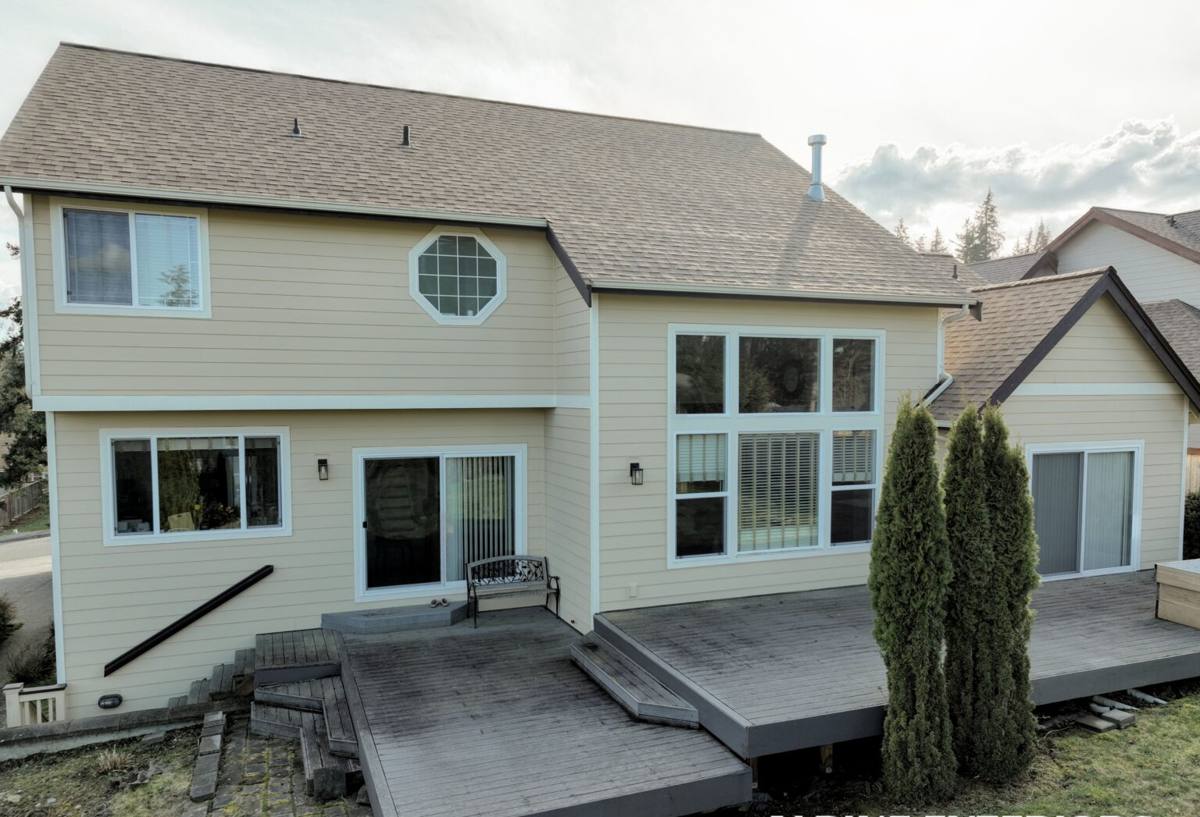
Moss and algae buildup in shaded, north-facing sections that never fully dry between rains, especially where trees or the house itself block sun for most of the day. Left alone, this makes the surface genuinely slippery and, over years, can stain lighter-colored boards.
Corroded fasteners and connectors where standard, non-coastal-rated hardware was used. This shows up as rust streaking down the board face and, eventually, loosened connections at stair stringers or railing posts.
Hidden ledger rot where the deck attaches to the house, from missing or inadequate flashing at the original build. This is a structural issue, not a cosmetic one, and it's the reason we treat ledger flashing as a fixed step, not an upsell.
Standing water under low-clearance decks from insufficient grading or drainage planning, which keeps the crawlspace damp long after a storm has passed and can affect framing over time.
Why Hire a Crew That Already Works Ferndale
Building codes, typical soil and drainage conditions, and the specific way weather moves through this part of Whatcom County all factor into how a deck should actually be built here — not in a generic coastal town, but in Ferndale specifically. A crew that already works this area knows which board caps hold up to the salt exposure closer to the water, how much drainage clearance actually matters given local rainfall patterns, and what inspectors here expect to see on ledger flashing and footing depth. That local familiarity shows up in fewer surprises during the build and a deck that's actually sized and detailed for the conditions it'll sit in, not a one-size-fits-all spec pulled from a national installation manual.
If you're weighing a new composite deck or replacing one that's showing its age, we're glad to come take a look and talk through honest options — no pressure, no hard sell. Reach out using the form below for a free estimate.