 Blaine Siding
 Why Sumas Homes Take a Different Kind of Beating
Sumas sits up against the Canadian border in Whatcom County, close enough to the Salish Sea that homes still catch salt-laden air on top of the valley's own weather pattern. That's a rougher combination than it sounds. Salt air accelerates corrosion on fasteners and trim, driving rain off the Strait pushes moisture sideways into seams and laps that a calmer climate would never test, and the long gray stretch from fall through spring gives moss and algae months to establish themselves on anything that stays damp. Add in the freeze-thaw swings that hit this part of Whatcom County harder than the immediate coastline, and you've got a siding system that has to handle wet-dry cycling, biological growth, and cold snaps all in the same season.
Most siding failures we get called out for in this area aren't dramatic. They're slow: a caulk line that gave out two winters ago, a bottom course that's been wicking moisture since a gutter started overflowing, moss that's been holding water against the wall since last November. By the time it's visible, the damage underneath has usually been building for a while. That's the case for choosing a siding material and installation approach that's engineered for exactly this kind of exposure, not just a coastal Pacific Northwest average.
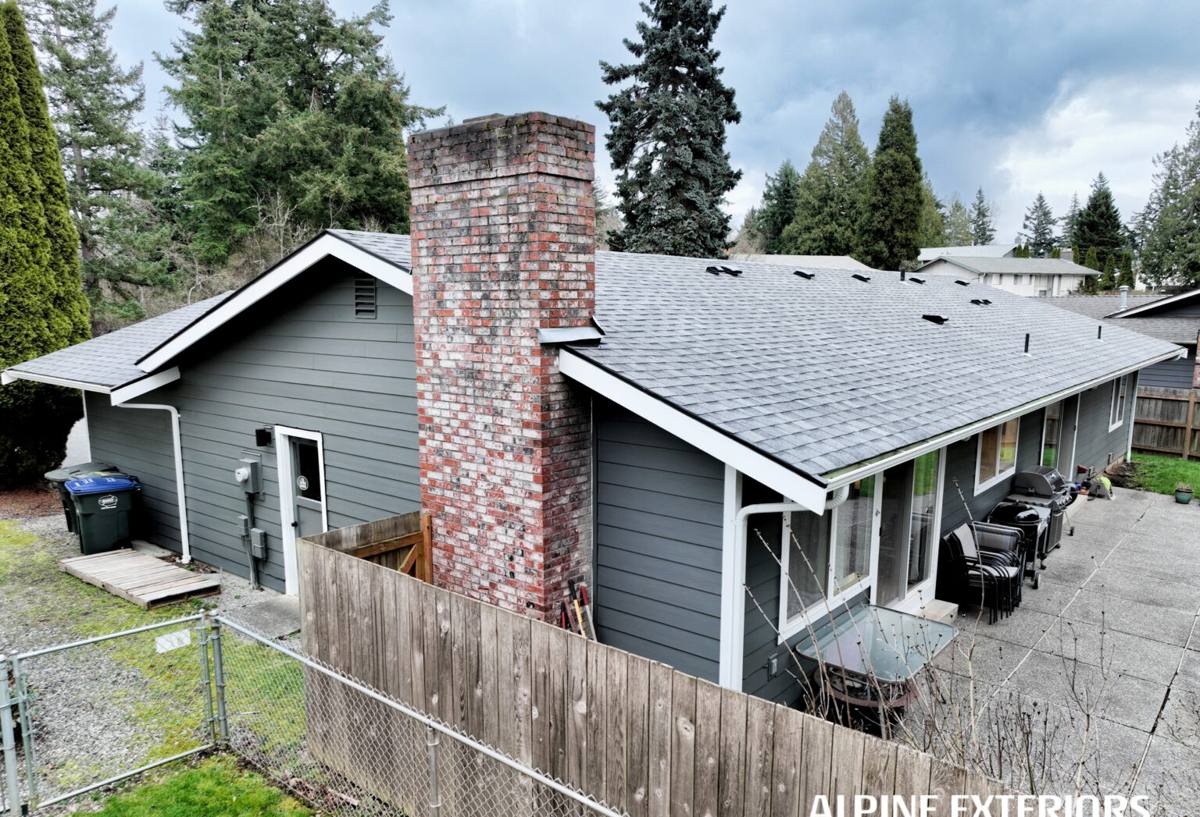
Why We Install Fiber Cement — and Only One Brand of It
This crew installs James Hardie fiber cement siding exclusively. We don't install vinyl, LP SmartSide, Cemplank, Allura, or primed wood siding, and that's a deliberate standard, not a sales pitch. Vinyl expands and contracts with temperature swings and can crack in a hard freeze; engineered wood products carry an organic wood-strand core that depends entirely on flawless caulking and flashing to keep water out over decades; primed cedar or spruce needs a maintenance commitment most homeowners don't sign up for once they see the real schedule. Fiber cement solves the problem at the material level: it's non-combustible, it doesn't feed rot or insects because there's no wood fiber to feed on, and it holds paint and factory finish far longer than wood-based alternatives because it doesn't move the way wood does with humidity.
James Hardie's ColorPlus factory-applied finish is baked on and backs it with a long finish warranty, which matters a lot in a climate that spends half the year damp. A site-painted finish starts breaking down at seams and cut edges faster than a factory finish cured under controlled conditions. For a Sumas or Blaine home taking direct weather off open fields and water, that difference shows up years earlier than it would somewhere drier.
The HZ5 Product Line
James Hardie makes climate-specific product lines, and the HZ5 line is engineered for the wetter, more freeze-prone parts of the country — which includes this stretch of Whatcom County. It's formulated to resist moisture absorption and hold up to freeze-thaw cycling better than the standard national product. We spec HZ5 as the default here, not an upsell.
What a Correct Installation Actually Involves
Fiber cement siding is only as good as the water management system behind it. Most of the siding failures we inspect on older homes trace back to installation shortcuts, not the material itself. A correct install includes:
- A drainage plane — housewrap or building paper installed shingle-style so any water that gets behind the siding has somewhere to go besides your sheathing
- Flashing at every horizontal transition: window and door heads, deck ledgers, roof-to-wall intersections, and the bottom starter course
- Proper fastener placement and spacing, driven to manufacturer spec — not just "close enough" — because over- or under-driven nails are one of the most common causes of premature cracking
- Correct minimum clearance from grade, decks, patios, and roof lines so the siding isn't sitting in a splash zone or trapping moisture against the bottom edge
- Caulking only where James Hardie's install guide specifies it — over-caulking traps moisture just as badly as under-caulking lets it in
- Field-cut edges sealed to protect the exposed core from moisture intrusion
Any one of those steps done wrong won't show up on day one. It shows up in year four or five as a soft spot, a stain, or a section that's failing while the rest of the wall looks fine. That's why we treat the installation detailing as equal in importance to the product choice itself.
Our Process on a Sumas Job
Assessment
We start by walking the exterior and looking at what's actually happening on your walls now — where moss is holding, where paint or old siding is failing first, where gutters or grading are pushing water toward the foundation. That tells us where the water management system needs the most attention, not just where the old siding looks worn.
Product and Trim Selection
We spec HZ5 panel or lap siding based on your home's exposure, and match trim, soffit, and accessory profiles so the whole system is consistent — mismatched trim systems are a common source of gaps and failure points down the road.
Tear-Off and Sheathing Check
Old siding comes off and we inspect the sheathing underneath before anything new goes up. This is the point where hidden rot or moisture damage from years of small leaks gets caught and repaired, rather than sealed behind new siding.
Install to Spec
Drainage plane, flashing, fastening, and clearances all follow James Hardie's published installation requirements, not shortcuts. This is also what keeps the manufacturer's warranty intact — installations that skip steps can void warranty coverage even on a good product.
Final Walkthrough and Cleanup
We walk the finished job with you, check every elevation, and clear the site of old material and debris before we call it done.
What Drives Cost on a Job Like This
Every home is different, but the same handful of factors move the price up or down on most Sumas and Blaine projects:
| Factor | Why It Matters |
|---|---|
| Tear-off complexity | Removing old vinyl is quick; removing old wood or stucco with hidden rot takes longer and can reveal repair work |
| Sheathing repair | Water-damaged sheathing found during tear-off adds material and labor before new siding can go up |
| Home size and wall complexity | Multiple gables, dormers, and cut-in windows mean more flashing detail and more cut edges to seal |
| Panel vs. lap profile | Lap siding involves more individual pieces and fastening than large-format panel systems |
| Trim and accessory scope | Full trim package replacement (corners, fascia, soffit) costs more than siding alone but keeps the whole system consistent |
| Site access | Fencing, landscaping, decks, and grade changes affect how efficiently a crew can stage and work each elevation |
We give a real number after walking your specific home — broad estimates without seeing the walls tend to be wrong in one direction or the other, and we'd rather give you an accurate figure than a fast guess.
Fiber Cement vs. the Alternatives
Homeowners in this area often ask why we won't quote vinyl or engineered wood alongside Hardie. Here's the honest comparison, side by side:
| Material | How It Handles This Climate |
|---|---|
| James Hardie fiber cement | Resists moisture, doesn't feed rot, factory finish holds up under sustained damp and salt-air exposure |
| Vinyl | Won't rot, but can crack in hard freezes and fade or warp with sustained UV and temperature swings |
| LP SmartSide / engineered wood | Wood-strand core depends entirely on intact caulking and flashing; a single failure point can lead to swelling |
| Primed cedar or spruce | Natural material, but needs a real repainting and sealing schedule to keep moisture out long-term |
Every one of those products has legitimate uses and reasonable manufacturers behind it. Our decision to install only Hardie is about matching a product's real-world behavior to what this specific climate does to a wall over 20 or 30 years, and fiber cement's track record is what we're willing to stand behind.
Living With It: Moss Season and Ongoing Care
Fiber cement is low-maintenance compared to wood, but "low" isn't "none," especially with a moss season as long as this region's. A few habits keep siding performing the way it's designed to:
- Keep gutters clear so overflow doesn't run down the wall face during heavy rain
- Trim back shrubs and trees that keep siding shaded and damp — moss needs standing moisture to take hold
- Rinse visible moss or algae buildup with a garden hose and soft brush rather than a pressure washer, which can force water behind laps
- Watch caulk lines at trim and window edges for cracking or gaps and have them resealed before they open further
- Check the bottom clearance near decks, patios, and grade periodically to make sure nothing has closed that gap over time
None of this is heavy upkeep — it's the difference between a wall that sheds water the way it was built to and one that slowly stops doing that without anyone noticing.
Why a Crew That Already Works This Area Matters
Siding installation is detail work, and the details that matter most in Sumas and Blaine are specific to this climate — flashing at every transition, correct fastener spacing for freeze-thaw movement, and drainage details that actually move water off the wall instead of trapping it. A crew that installs across a wide range of climates has to relearn those details every time conditions change. A crew that works this stretch of Whatcom County regularly already knows what fails here and builds against it from the first course.
That local familiarity also shows up in smaller ways — knowing how local permitting works, understanding how a given home's orientation to weather affects where problems show up first, and having a realistic sense of what a job actually takes on a home built for this climate rather than a national average.
If you're thinking about replacing siding on a Sumas or Blaine home, we're happy to take a look and give you a straightforward, no-pressure estimate — no obligation, just an honest read on what your home actually needs. The form below gets you started.