 Blaine Siding
 Why Decks Near Lynden and Blaine Wear Out Faster Than the Manual Says
Every deck manufacturer publishes a service life for their product, and almost none of those numbers were tested in a Whatcom County winter. Out here, a deck isn't just dealing with sun and foot traffic — it's dealing with salt-laden air rolling in off the Strait of Georgia, long stretches of driving rain that can last for days, and a moss season that starts earlier and ends later than most homeowners expect. That combination is hard on fasteners, hard on framing, and hard on any decking surface that wasn't chosen with moisture in mind.
We work decks throughout the greater Blaine area, including homes in and around Lynden, and the failure patterns we see are consistent. It's rarely one dramatic problem — it's years of small ones compounding: a ledger board that stayed damp too long, joists that never got proper flashing tape, fasteners that started corroding from the inside out. By the time it shows up as a soft board or a wobble in the railing, the damage underneath is usually further along than it looks.
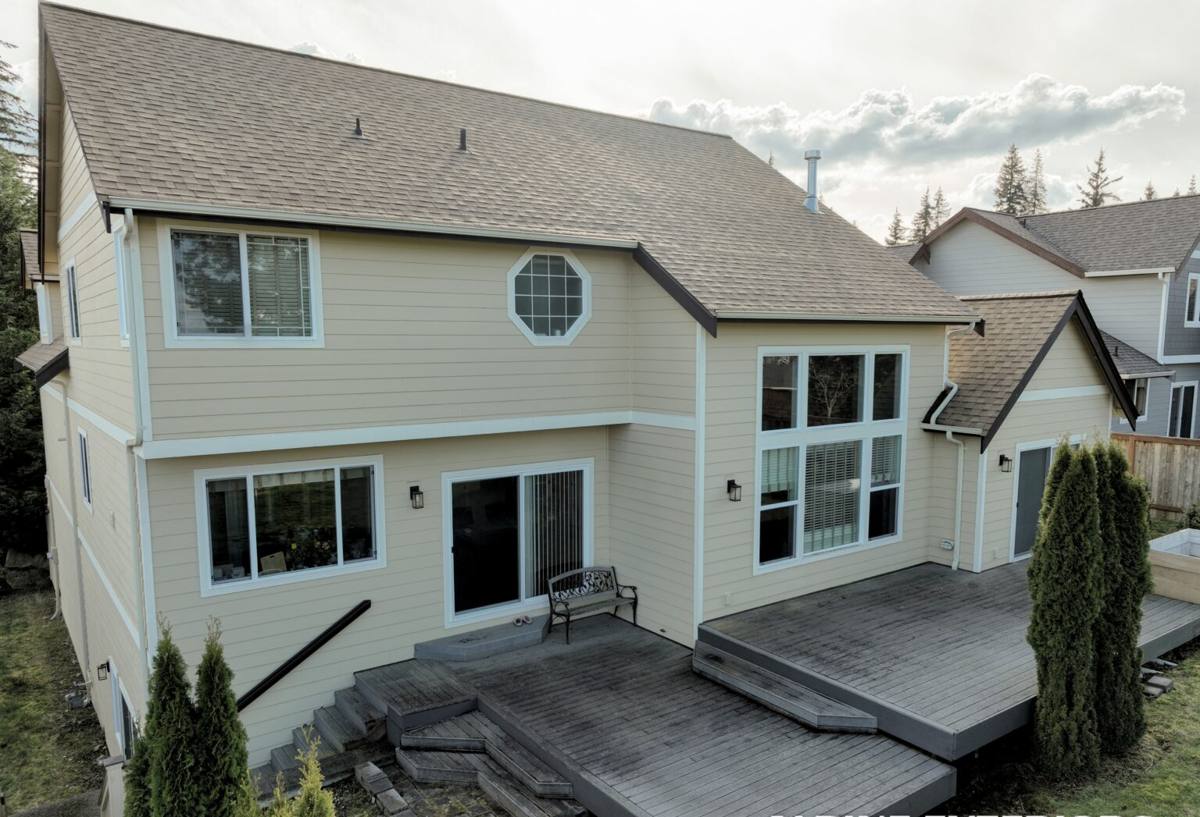
Repair or Replace? How to Tell the Difference
Not every tired deck needs a full teardown. But there's a point where patching individual boards is just delaying a bigger job and spending money twice. Here's how we evaluate it on-site.
Signs a Repair Can Still Work
- Surface boards are cupping or graying but the frame underneath is solid and dry
- One or two isolated soft spots, not a spreading pattern
- Railings are loose at the connection points but the posts themselves are sound
- The deck is less than 10-12 years old and was built to code with proper flashing
Signs You're Looking at Replacement
- Soft or spongy decking in multiple areas, especially near the house
- Visible rot, staining, or moss growth at the ledger board where the deck meets the house
- Rust streaking around fastener heads or joist hangers
- Posts that move or footings that have shifted or heaved
- A structure built before current attachment and flashing standards were common practice
The honest answer is usually clear within the first 15 minutes of a walk-through. If we tell you it's a repair, we mean it — there's no upside for us in replacing a deck that doesn't need it.
What a Correct Deck Replacement Actually Involves
A deck that's going to hold up to Whatcom County weather for the long haul gets built differently than one going up in a dry climate. The visible decking boards are maybe a third of the job. The parts that determine whether the deck lasts are mostly underneath.
Ledger Attachment and Flashing
This is the single most common failure point on older decks in this region, and it's the one that does the most damage when it's wrong. The ledger board — where the deck ties into the house — has to be properly flashed to shed water away from the wall assembly, not into it. We treat this as non-negotiable regardless of what the original deck looked like.
Framing and Fasteners
Salt air accelerates corrosion on standard fasteners faster than most homeowners realize. We frame with corrosion-resistant hardware rated for the exposure this area actually sees, not the minimum the lumberyard stocks.
Footings and Posts
Wet, freeze-thaw-cycling soil moves footings over time if they weren't set deep enough or sized correctly for the load. Replacement is the right time to correct undersized or shallow footings rather than reusing them because they're already in the ground.
Drainage Beneath the Deck
Low decks especially need attention to grading and airflow underneath. A deck that traps moisture against the ground below it invites rot from the bottom up, which is invisible until it isn't.
Choosing a Decking Material for This Climate
This is where most of the long-term cost difference gets decided, and it's worth thinking through rather than defaulting to whatever's cheapest at the yard.
| Material | How It Handles Rain & Moss Season | Maintenance | Typical Lifespan |
|---|---|---|---|
| Pressure-treated wood | Absorbs moisture readily; needs consistent sealing to resist moss and graying | Annual cleaning and re-sealing recommended | 10-15 years with upkeep |
| Cedar | Naturally moisture-resistant but still needs upkeep in constant damp; can still host moss without cleaning | Periodic cleaning and oiling | 15-20 years with upkeep |
| Composite decking | Doesn't absorb water or rot, but can stay damp longer on the surface, which needs regular cleaning to prevent moss and algae film | Occasional washing, no sealing | 25-30 years |
| PVC / capped composite | Fully moisture-resistant surface, best resistance to staining and moss adhesion | Minimal — occasional washing | 25-30+ years |
We don't push one material on every job. A shaded, low-airflow deck under fir trees behaves differently than an open, sun-exposed one, and that changes which material actually makes sense. What we do push back on is any product installed without attention to ventilation and drainage underneath — that's what causes premature failure far more often than the decking material itself.
Our Replacement Process
- On-site assessment — we inspect the ledger, framing, footings, and drainage before quoting anything, so the estimate reflects what's actually there, not a guess from photos.
- Permit and planning — Whatcom County and local jurisdictions have specific requirements for deck attachment, guardrails, and footing depth; we handle the permit process so it's done right the first time.
- Demolition and disposal — full removal of the old structure, checking the house's rim joist and siding behind the old ledger for hidden damage before anything new goes up.
- Framing and flashing — corrosion-resistant hardware, properly flashed ledger connection, footings sized for this soil and climate.
- Decking, railing, and finish work — installed to the manufacturer's specifications, which matters for warranty coverage on composite and PVC products.
- Final walk-through — we go over the finished deck with you and explain what maintenance, if any, it needs going forward.
Why Hiring a Crew That Already Works the Lynden and Blaine Area Matters
A deck built without local experience often looks fine for the first year or two — the problems show up later, once a few wet seasons have had a chance to find every weak point in the flashing and framing. Crews that work this area regularly already know where moss tends to establish first, which sides of a house take the worst driving rain, and which fastener and flashing choices actually hold up here versus what's standard in a drier climate.
There's also a practical side to hiring local: warranty and service calls are easier when the crew that built your deck isn't a long drive away, and permit familiarity with local jurisdictions speeds up the front end of the project instead of adding delays.
What Drives the Cost of a Deck Replacement
| Cost Factor | Why It Matters |
|---|---|
| Deck size and footprint | Larger square footage means more decking, framing, and footings |
| Height off the ground | Elevated decks need more substantial framing, stairs, and guardrail work |
| Decking material chosen | Wood costs less upfront; composite and PVC cost more but reduce long-term maintenance |
| Condition of the ledger and framing behind old siding | Hidden rot found during demo can add scope that wasn't visible during the estimate |
| Railing style and stairs | Custom railing, glass panels, or multiple stair runs add labor and material |
| Permit and inspection requirements | Larger or higher decks typically require more inspection steps |
Most straightforward residential deck replacements in this region land somewhere in the low-to-mid five figures, with the range depending heavily on size, material, and what's found once the old structure comes off. We won't quote a firm number without seeing the deck in person — anyone who does is guessing.
A Quick Checklist Before You Hire Anyone
- Do they inspect the ledger board and framing in person before quoting, or just measure the footprint?
- Are they pulling the required local permit, or asking you to skip it?
- Do they explain flashing and fastener choices, or just talk about the decking surface?
- Can they tell you why they'd choose one decking material over another for your specific deck's sun and shade exposure?
- Are they licensed and insured, and willing to put that in writing?
- Do they give you a maintenance rundown after the job, or just walk away when the last board is down?
After the Build: Keeping a New Deck in Good Shape Through Moss Season
Even a well-built deck needs a little seasonal attention in this climate. Clearing leaves and debris before the wet season settles in keeps moisture from sitting on the surface. A periodic wash — more important for wood but still worthwhile on composite and PVC — keeps moss and algae from getting a foothold in shaded or low-airflow areas. Wood decks need a re-seal on a regular cycle; composite and PVC don't need sealing but still benefit from an annual cleaning to keep the surface from staining. We go over the specific schedule that fits your deck and site conditions at the end of every project.
If your deck is showing its age — or you're just not sure whether it's a repair or a replacement — we're happy to come take a look and give you a straight answer. Use the form below to request a free, no-pressure estimate.