 Blaine Siding
 Why Nooksack Roofs Wear Differently Than Roofs Inland
Nooksack sits close enough to the water and to Blaine's marine weather patterns that roofs here take a different kind of beating than roofs twenty or thirty miles inland. It isn't one dramatic storm that does the damage. It's the combination of salt-laden air moving in off the Strait, driving rain that comes in sideways more often than straight down, and a moss season that can run from early fall through late spring in a typical Whatcom County year. Individually, none of those factors is unusual for western Washington. Together, on the same roof, year after year, they shorten the useful life of a poorly built shingle roof and accelerate every weak point in a mediocre one.
Salt air is corrosive to exposed metal fasteners, flashing, and vent components long before most homeowners notice a problem with the shingles themselves. Driving rain finds gaps in flashing and underlayment that would never leak in a calmer climate. And moss doesn't just look bad — it holds moisture against the shingle surface for months at a time, which is exactly the condition that breaks down asphalt granules and rots decking underneath. A roof built without these three factors in mind will look fine for a few years and then fail faster than its warranty suggests it should.
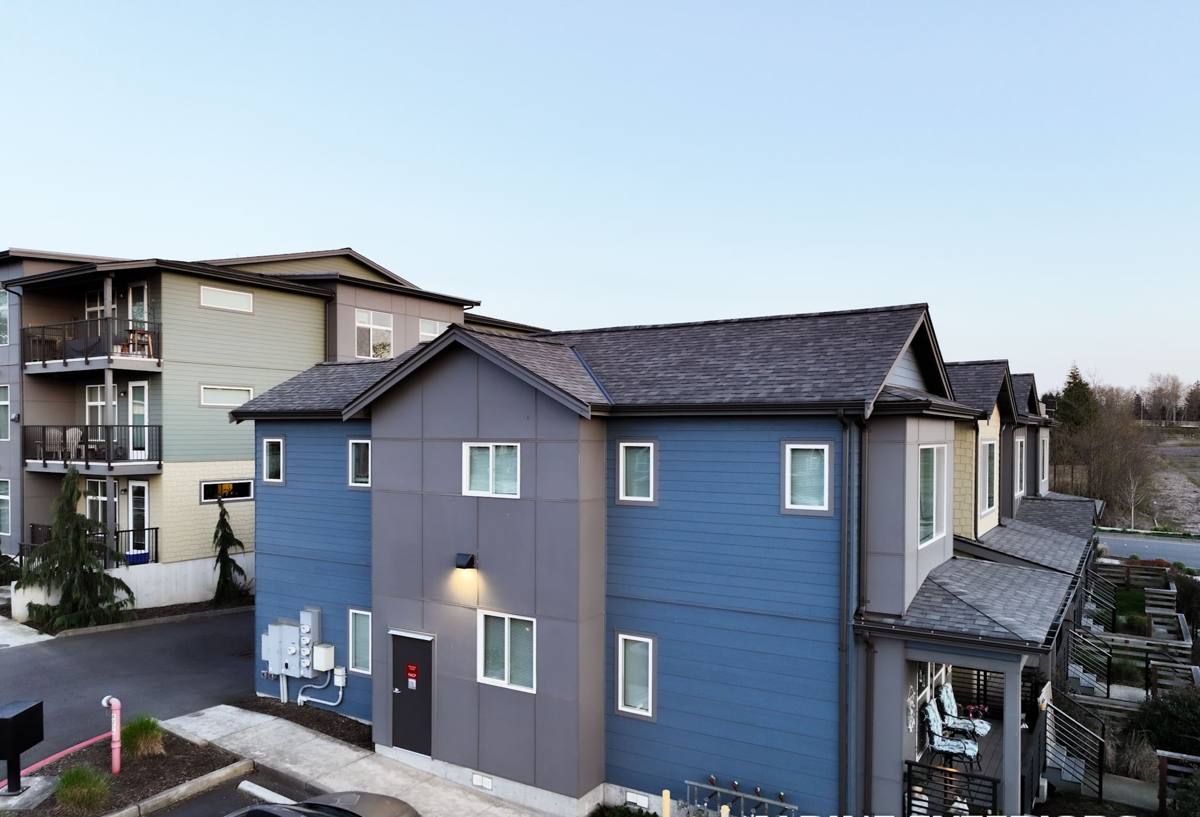
What a Correctly Built Shingle Roof Looks Like in This Climate
An asphalt shingle roof that's going to hold up in Nooksack isn't just shingles nailed to plywood. It's a system, and every layer of that system has to be right for the conditions here, not for a generic installation manual written for a drier region.
Underlayment and Water Protection
We install synthetic underlayment rated for high-moisture climates across the full roof deck, with self-adhered ice and water shield along eaves, valleys, and any roof-to-wall transitions — the places where driving rain and wind-blown water actually get pushed uphill under the shingle edge. In a drier climate this level of detail at the eaves is sometimes treated as optional. Here, it isn't.
Flashing That's Built to Outlast Salt Air
Flashing around chimneys, skylights, sidewalls, and roof penetrations is where most shingle roof leaks actually start, not in the field of the roof itself. We use corrosion-resistant flashing material and correct step-and-counter-flashing technique at every wall intersection, because standard galvanized flashing degrades faster near the coast than it does inland.
Nailing Pattern and Wind Exposure
Blaine and the surrounding area get real wind events, and a shingle roof is only as strong as its weakest nail. We follow manufacturer nailing specifications exactly — correct nail count, correct placement zone, correct fastener type — because underdriven, overdriven, or misplaced nails are one of the most common causes of shingle blow-off in coastal Whatcom County, and it's a problem you can't see from the ground.
Choosing the Right Shingle for Salt Air, Rain, and Moss
Not every asphalt shingle product is a good fit for this climate. The right choice depends on how much algae and moss resistance you want built into the shingle itself, how much wind rating you need for your exposure, and what kind of maintenance commitment you're realistically going to keep up with.
| Shingle Type | Typical Lifespan Here | Moss/Algae Resistance | Best Fit For |
|---|---|---|---|
| Standard 3-tab asphalt | Shorter end of the range in this climate | Low unless treated | Budget-driven projects, secondary structures |
| Architectural (laminate) asphalt | Solid mid-range performance | Moderate; better with algae-resistant granules | Most Nooksack homes — best balance of cost and durability |
| Algae-resistant architectural asphalt | Longest asphalt option for this climate | High — copper or zinc-infused granules | Shaded lots, tree cover, chronic moss history |
For most homes in this area, we recommend an architectural shingle with algae-resistant granules as a baseline, not an upgrade. It costs more up front than a basic 3-tab, but in a climate where moss and algae staining is close to guaranteed over time, it's the difference between a roof that still looks and performs well in year twelve and one that needs premature attention.
Cost Factors Homeowners Should Understand Up Front
| Factor | Why It Matters Here |
|---|---|
| Roof pitch and access | Steeper roofs and limited access increase labor time and safety requirements |
| Layers of existing roofing | Tear-off of old layers adds cost but is often necessary to properly inspect and repair decking |
| Deck condition underneath | Moisture-damaged decking found during tear-off requires repair before new shingles go down |
| Flashing scope | More chimneys, skylights, and wall intersections mean more flashing work — this is not an area to shortcut |
| Shingle tier selected | Algae-resistant and higher wind-rated products cost more per square but reduce long-term maintenance |
Moss, Algae, and Salt Air: The Ongoing Maintenance Reality
Even a well-built roof in Nooksack needs some ongoing attention, and it's worth being honest about that rather than pretending a new roof means zero maintenance. Moss season here is long, and depending on tree cover and roof orientation, some sections of a roof will stay shaded and damp far longer than others through fall, winter, and spring.
A few practices make a real difference over the life of the roof:
- Keep gutters and valleys clear of debris so water doesn't pool and encourage moss growth at the edges
- Have moss physically removed rather than pressure-washed, since pressure washing can strip protective granules off the shingle surface
- Consider zinc or copper strips near the ridge on moss-prone roofs, which release trace metals that inhibit moss growth as rain washes over them
- Trim back overhanging branches where possible to reduce shade and debris buildup
- Have flashing and vent boots visually checked every year or two, since salt air corrosion is often the first sign of trouble before a leak ever shows up inside
None of this replaces a correctly built roof — it supplements one. A poorly installed roof with perfect maintenance will still fail early. A well-built roof with reasonable maintenance is what actually holds up here.
Our Process, From Estimate to Cleanup
We keep the process straightforward because homeowners deserve to know exactly what's happening on their own roof.
- On-site inspection. We walk the roof and the attic space where accessible, checking deck condition, ventilation, flashing, and the extent of any moss or algae staining.
- Honest scope and estimate. We explain what's actually needed — tear-off versus overlay where applicable, decking repair if found, flashing replacement, and shingle options — with a written estimate before any work begins.
- Tear-off and deck inspection. Old roofing comes off and the deck is inspected directly, since this is the only reliable way to catch hidden moisture damage before it's covered up again.
- Underlayment and flashing installation. Ice and water shield at vulnerable areas, synthetic underlayment across the field, and corrosion-resistant flashing at every penetration and wall intersection.
- Shingle installation to manufacturer spec. Correct nailing pattern, correct exposure, correct ventilation components, matched to the wind and moisture conditions of your specific property.
- Cleanup and final walk-through. Magnetic sweep for stray fasteners, full site cleanup, and a walk-through so you know exactly what was done and what to watch for going forward.
Ventilation and Moisture: The Part Homeowners Don't See
A shingle roof's biggest enemy in this climate often isn't the weather hitting it from outside — it's moisture trapped underneath from inside the attic. Without proper intake and exhaust ventilation, warm moist air from the living space condenses against the underside of the roof deck, which rots plywood, degrades insulation, and shortens shingle life from below at the same time salt air and rain are working on it from above.
Correct ventilation balances intake (usually at the eaves) with exhaust (usually at or near the ridge), sized appropriately for the attic's square footage. On many older Nooksack-area homes, ventilation was undersized or blocked over the years by insulation upgrades that didn't account for airflow. Part of a proper roofing job is checking that this balance is actually correct, not just replacing the shingles on top of a ventilation problem that will keep causing damage underneath.
Signs Your Roof Needs Attention Sooner Rather Than Later
Because moss and moisture damage often develop slowly, many homeowners don't realize how much trouble a roof is in until a leak shows up inside. A few warning signs are worth catching earlier:
- Granules collecting in gutters or at the base of downspouts
- Shingles that look curled, cupped, or cracked, especially on south- or west-facing slopes
- Dark streaking or thick moss growth concentrated on shaded sections of the roof
- Soft spots or noticeable sagging anywhere on the roof plane
- Rust staining or visible corrosion around flashing, vents, or fasteners
- Daylight visible through the roof deck from inside the attic
- Any interior ceiling staining, even faint or intermittent
Catching any of these early usually means a repair. Waiting on them usually means a full replacement, plus repair of whatever the moisture reached on the way in.
Why a Crew That Already Works Nooksack Matters
Roofing crews that work primarily in drier or more sheltered parts of the state don't always build for the conditions that define this stretch of Whatcom County. A roof detailed correctly for Nooksack accounts for the salt air's effect on metal components, the wind exposure that comes with proximity to the water, and a moss season long enough that it has to be designed around rather than treated as an afterthought. That's not a different skill set — it's the same trade applied with the right priorities for where the roof actually sits.
We work on homes throughout the Nooksack area and greater Blaine on a regular basis, which means we're familiar with how roofs in this specific pocket of the county tend to age and where they tend to fail first. That familiarity shapes decisions on every job, from which shingle tier we recommend to how much attention a given flashing detail gets.
Get a Free, No-Pressure Estimate
If your roof is showing early warning signs, coming up on the end of its expected life, or you're simply planning ahead, we're happy to take a look and give you an honest assessment — no pressure, no obligation. Use the form below to request a free estimate for your Nooksack property.