 Blaine Siding
 Building Decks for the Nooksack Area, Not for a Catalog Photo
A deck built for a dry climate doesn't hold up the same way out here. In the Nooksack area, decks deal with driving rain off the Strait of Georgia, salt-tinged marine air that drifts in with the weather systems, and a moss season that can stretch from October into May in shaded or wooded yards. None of that is exotic — it's just what Whatcom County does to exterior wood and hardware year after year. A deck that's framed, fastened, and finished for this climate lasts. One that isn't starts showing soft spots, rust streaks, and slick green film within a few seasons, no matter how good it looked on installation day.
This page covers what we actually check and build differently for decks in this part of the county, what a correct job looks like from the footings up, and what tends to go wrong when a deck was built without accounting for the local weather.
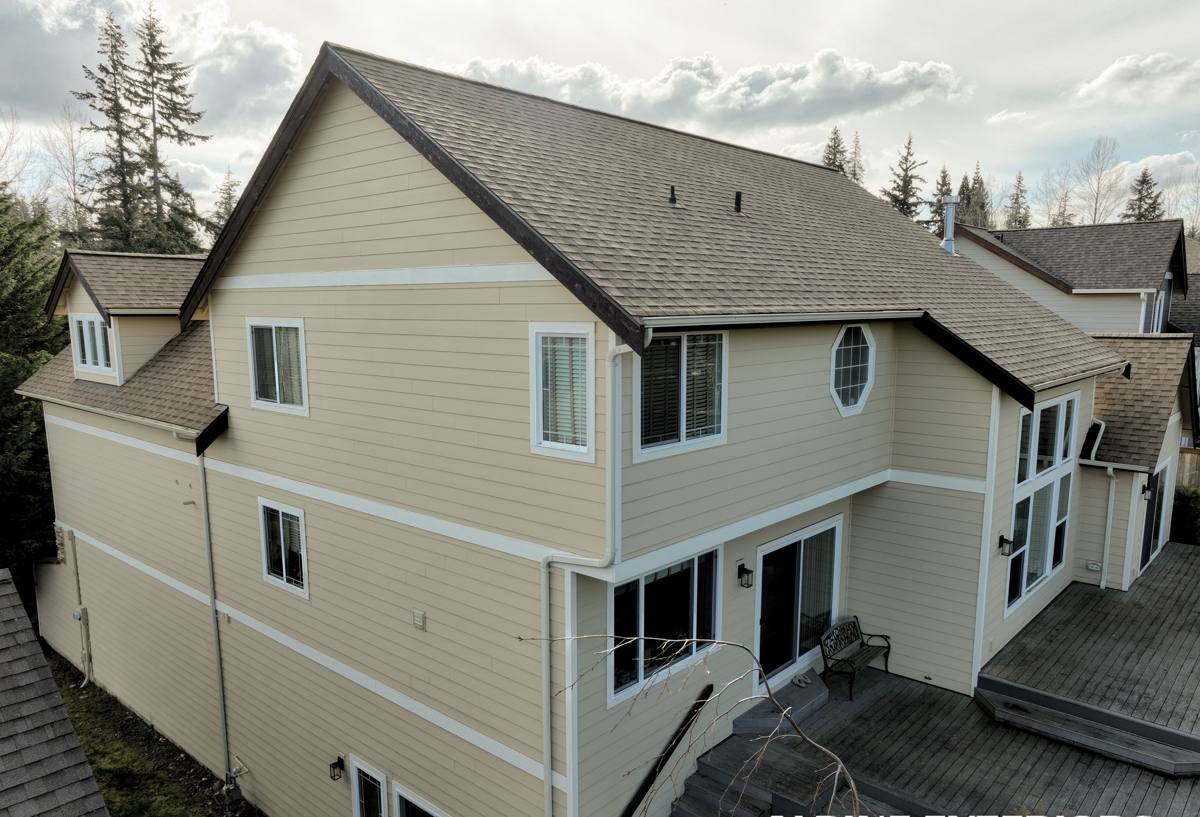
What This Climate Actually Demands From a Deck
Ledger Attachment and Framing
Where a deck attaches to the house — the ledger board — is the single most common failure point we see in this region, and it's almost always a moisture problem, not a structural one. Water gets behind the ledger, the framing stays wet longer than it should because it never fully dries between storms, and rot sets in where nobody's looking until the deck starts to feel spongy near the house. Correct flashing, a drainage gap, and proper fasteners at that connection matter more here than in drier parts of the state, because the wood simply doesn't get the dry stretches to recover.
Fasteners and Hardware
Standard coated deck screws and joist hangers hold up fine in a lot of climates. In marine air, they corrode faster, streak the decking with rust stains, and lose holding strength years before the wood around them fails. We spec hot-dip galvanized or stainless hardware for structural connections, especially on decks with any exposure to salt-laden air, and we don't cut corners here — hardware is a small fraction of a deck's total cost but it's what the whole structure depends on.
Airflow and Drainage Underneath
A deck built low to the ground, over poorly graded soil, with no gap for air movement, stays damp underneath almost permanently in this climate. That damp zone is where rot starts, where moss gets a foothold on the undersides of joists, and where insects find easy access. Proper clearance, grading that moves water away from the structure, and in some cases a vapor barrier or gravel bed underneath make a real difference over the life of the deck.
Decking Material Comparison for This Climate
There's no single "best" decking material — it depends on budget, how much upkeep you want to do, and how shaded the site is. Here's how the common options actually perform under Whatcom County's wet, mossy conditions:
| Material | Upfront Cost | Moss & Mildew Resistance | Maintenance | Realistic Lifespan Here |
|---|---|---|---|---|
| Cedar / wood | Lowest | Fair — moss grows readily if not cleaned | Annual cleaning, periodic staining/sealing | 10–15 years with upkeep |
| Pressure-treated fir/pine | Low | Fair — same moss exposure as cedar | Regular sealing to prevent checking and rot | 10–15 years with upkeep |
| Capped composite | Mid to high | Good — sheds moisture, still needs washing | Occasional washing, no staining/sealing | 20–25+ years |
| PVC decking | Highest | Best — doesn't absorb moisture | Occasional washing only | 25+ years |
Wood costs less to install but asks more of the homeowner every year. Composite and PVC cost more upfront but shrug off the moss-and-moisture cycle that wears wood down. We'll walk through the honest trade-offs for your specific site — shade, budget, and how much maintenance you actually want to do — rather than push one material across the board.
The Moss Season Problem, and Why It's Worse Than It Looks
Moss on a deck isn't just cosmetic. It holds moisture against the board surface long after the rain stops, which accelerates rot in wood decking and can stain or degrade the surface film on lower-grade composite products. It's also genuinely slippery — a moss-covered stair tread or landing is a real fall hazard, especially through the wetter months when it's least likely to dry out between rains.
Shaded, tree-lined lots in the Nooksack area tend to hold onto moss longer into the spring than open, sun-exposed sites closer to the water. A few things reduce how bad it gets:
- Proper board spacing so water drains through instead of pooling
- Keeping overhanging branches trimmed back to let sun and air reach the surface
- Cleaning boards at least once a year, more often on shaded decks
- Choosing a decking material with a rating for mold and mildew resistance if the site is heavily shaded
- Grading and drainage that keeps standing water away from the deck footprint
None of this eliminates moss entirely — it's a fact of life in this part of Washington — but it keeps it from becoming a structural or safety problem.
How We Build a Deck for This Area
Our process is the same whether it's a new deck or a full rebuild:
- Site walk and assessment — we look at drainage, shade, existing structure (if it's a rebuild), and how the deck ties into the house.
- Design and material selection — layout, railing style, stairs, and an honest conversation about wood versus composite versus PVC for your site and budget.
- Permitting — we handle the paperwork with the local jurisdiction where required.
- Footings and framing — footings set below frost depth, framing built with corrosion-resistant hardware throughout.
- Ledger flashing and waterproofing — the connection to the house gets flashed and sealed correctly before decking goes down.
- Decking, railing, and stairs installed — proper spacing for drainage and airflow from the start.
- Final walkthrough — we go over the finished deck with you, including basic care specific to your material choice.
Deck Problems We See Most Often in This Area
When we're called out to look at an existing deck near Nooksack, the same handful of issues come up repeatedly:
- Soft or spongy decking near the house, usually tracing back to a poorly flashed ledger
- Rust streaking from standard fasteners that weren't rated for this climate
- Moss buildup thick enough to hide rot or splitting underneath
- Undersized or shallow footings that have shifted with seasonal ground moisture
- Warped or cupped boards from moisture trapped by tight spacing or poor airflow
- Railings that have loosened at the posts from years of wet-dry cycling
Most of these are fixable without a full rebuild if they're caught early — which is part of why regular inspection matters more here than in a drier climate.
Permits and Local Code Basics
Deck permitting requirements depend on the size, height, and attachment method of the deck, and on whether the property falls under city or county jurisdiction. In general, decks attached to a house and elevated above a certain height require a building permit, along with guardrails at a minimum height once the deck reaches a certain elevation off grade, and footings set to the required frost depth for this region. Requirements can vary by jurisdiction, so we confirm the specifics for your property before design work locks in rather than assuming a blanket answer applies everywhere.
Why a Crew That Already Works This Area Matters
A contractor who works this stretch of Whatcom County regularly already knows how the ground drains on wooded lots, which fastener specs actually hold up against the marine air, and how the moss cycle plays out from fall through spring. That's not something you get from a general contractor passing through once. It also means faster response if something needs attention after the fact — warranty work, an unexpected drainage issue after a wet winter, or just a question about how your specific decking material is holding up.
Questions Worth Asking Before You Hire
- Are you licensed and insured to do deck construction in Washington State?
- What fastener and hardware grade do you use for structural connections?
- How do you flash and waterproof the ledger board connection?
- Will you pull the required permit, or is that left to me?
- What's your footing depth, and does it account for local frost depth?
- Can you walk me through material trade-offs for a shaded, moss-prone site?
If a contractor can't answer these clearly, that's worth noticing before any contract gets signed.
If you're planning a new deck or dealing with an aging one near Nooksack, we're happy to take a look and give you a straightforward, no-pressure estimate — just fill out the form below.