 Blaine Siding
 Building Decks for Peace Arch's Border-Town Climate
Peace Arch sits right at the edge of the Salish Sea, a stone's throw from the international border, which means homes here get a specific combination of weather that a lot of composite decking never gets designed for: salt-laden air off the water, long stretches of driving rain, and a moss season that can run from October through May. A deck built to a generic spec sheet does fine in a dry climate. Out here, the same board and the same fastener schedule can fail years early if the substructure and drainage weren't built for this exact environment.
We install composite decking for homeowners in the Peace Arch area regularly, and most of what separates a deck that looks good for two years from one that looks good for twenty comes down to decisions made before a single board goes down: framing material, fastener choice, ledger flashing, and airflow underneath. This page walks through what actually matters for a composite deck built here, not a generic list of decking pros and cons.
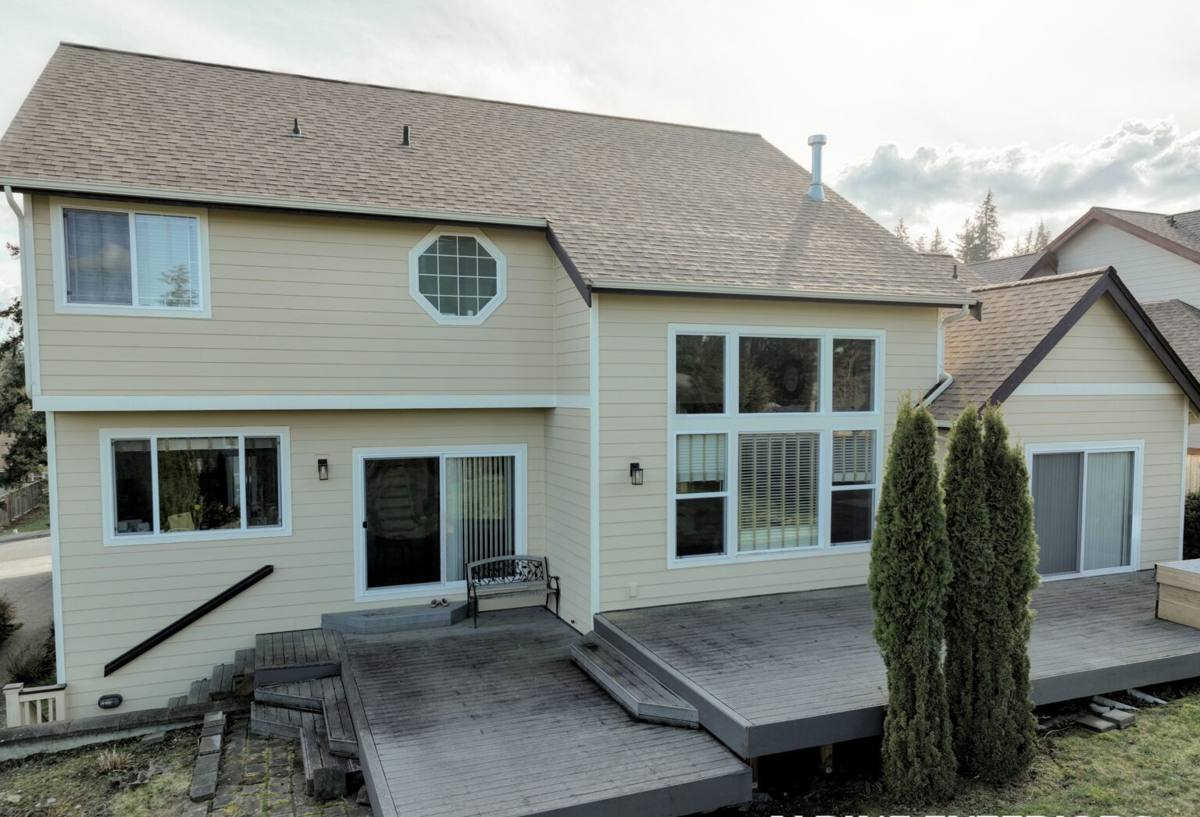
What Blaine's Salt Air and Rain Actually Do to a Deck
Salt Air and Fastener Corrosion
Homes within a mile or two of Semiahmoo Bay and Drayton Harbor deal with airborne salt that settles on metal surfaces year-round, not just during storms. Standard zinc-coated screws and joist hangers corrode faster here than they would twenty miles inland. Once a fastener starts rusting, it weakens exactly where the deck depends on it most — at the ledger board, at joist hangers, and at any structural connection hidden under the decking. The composite boards themselves shrug off salt air fine; it's the metal holding everything together that needs upgrading.
Driving Rain and Ledger and Substructure Rot
Whatcom County gets plenty of rain that comes in sideways, driven by wind off the water. That matters most at the ledger board — the point where a deck attaches to the house — because wind-driven rain gets pushed up and behind the decking surface in ways vertical rain never would. A ledger that isn't properly flashed will let water track behind the siding and into the rim joist, and composite decking will hide that damage on top while it rots the framing underneath.
The Long Moss Season
From fall through spring, this part of Washington state stays damp enough, long enough, that moss and algae get a real foothold on any horizontal surface that doesn't drain and dry quickly. Composite decking resists rot, but it doesn't resist moss growing on top of it if water sits in low spots, in the grooves between boards, or in areas shaded by the house or by trees. A deck built with the right slope and gap spacing sheds water fast enough that moss never gets a chance to establish. A deck built without that in mind turns green by the second winter, regardless of how good the boards are.
Why Composite Decking Fits This Job
What Composite Decking Is (and Isn't)
Composite decking is a blend of wood fiber and plastic, formed into boards that look like wood but don't absorb water, splinter, or rot the way solid wood does. Capped composite adds a plastic shell around that core, which is what actually stops moisture from getting into the board in the first place. That distinction matters a lot in a climate like this one — an uncapped composite board can still take on water at cut ends and through the surface over years of exposure to driving rain, while a capped board keeps water out almost entirely.
We don't treat composite as a magic material that solves every problem on its own. It's one part of a system that includes the framing, the fasteners, the flashing, and the drainage plan underneath. Get those right and composite decking is one of the lowest-maintenance surfaces you can put on a home in this climate. Skip any of them and you've just built an expensive-looking deck with the same failure points as a cheap one.
| Decking Material | Moisture Behavior | Moss Resistance | Maintenance | Typical Lifespan |
|---|---|---|---|---|
| Pressure-treated wood | Absorbs water, swells and shrinks seasonally | Needs regular cleaning and sealing to resist moss | Annual staining or sealing recommended | 10-15 years in this climate |
| Uncapped composite | Resists rot but can absorb some moisture at cut ends and surface over time | Better than wood, but low spots still grow moss | Periodic cleaning, no staining or sealing | 15-20 years |
| Capped composite / PVC | Sheds water at the surface, minimal absorption | Best resistance when properly sloped and gapped | Occasional washing | 25-30+ years |
What a Correctly Built Composite Deck Involves
Substructure and Framing
Everything a composite deck's warranty covers is above the framing. The framing itself is on us to get right. In this climate, that means pressure-treated joists rated for ground contact where relevant, joist tape or a comparable moisture barrier on top of every joist to keep water from wicking into the wood through fastener holes, and stainless or heavily coated hardware at every connection exposed to salt air.
Hidden Fasteners, Flashing, and Ledger Attachment
Most composite decking today uses a hidden fastener system that clips boards together without face screws, which looks cleaner and eliminates hundreds of small holes where water could otherwise sit. The ledger board gets its own flashing detail — typically a metal flashing that directs water out and away from the house rather than letting it track down behind the siding. This is the single most common shortcut we see on decks that were built quickly, and it's the one most likely to cause a rot problem that isn't visible until the deck is pulled apart.
Drainage and Airflow Underneath
A deck needs a slight slope away from the house and enough clearance underneath for air to move. Without that, moisture gets trapped below the decking surface and never fully dries between rain events, which speeds up corrosion on fasteners and creates the damp, shaded conditions moss needs. Low decks close to grade need extra attention here, since they have the least natural airflow to begin with.
- Joists protected with tape or a moisture barrier, not bare pressure-treated wood exposed at every screw hole
- Ledger board flashed to direct water away from the house framing, not just caulked
- Stainless steel or heavy-coating fasteners and joist hangers, given the salt air near the water
- Consistent slope across the deck surface so water actually runs off instead of pooling
- Enough clearance underneath for air to circulate and the substructure to dry between storms
- Board gaps sized correctly for composite's expansion and contraction across wet winters and dry summers
Our Process for Peace Arch Composite Decking Projects
- On-site visit and measurement — we look at the existing deck or build site, check drainage patterns, sun and shade exposure, and how close the property sits to salt air and prevailing wind-driven rain.
- Product selection — we walk through capped versus uncapped options, board colors, and railing systems based on your budget and how the deck will actually be used.
- Permitting — most deck projects in Whatcom County require a permit; we handle that paperwork so it doesn't fall on you.
- Tear-out and structural assessment — if we're replacing an existing deck, we check the ledger, rim joist, and any posts for rot before building on top of them.
- Framing and flashing — new or reinforced framing goes in with corrosion-resistant hardware and proper ledger flashing.
- Decking installation — boards go down with a hidden fastener system, correct gap spacing, and attention to slope.
- Railings, fascia, and trim — finished to match the composite decking and the style of the house.
- Final walkthrough — we go over the finished deck with you, including basic care and what to watch for over the first year.
Choosing the Right Composite Board for This Neighborhood
Capped vs. Uncapped Composite
For a property exposed to salt air and regular driving rain, we generally recommend capped composite over uncapped. The extra upfront cost is usually worth it here specifically because the surface actually sheds water instead of gradually taking it on, which matters more in this climate than in a drier one. Uncapped composite still has a place — it's a reasonable option on covered or partially protected decks where direct rain exposure is limited.
Color and Heat Considerations
Darker composite boards absorb more heat on the rare sunny days but also tend to hide moss and water staining better than very light colors, which show every bit of discoloration. Given the amount of grey, damp weather here, we usually steer homeowners toward mid-tone colors that balance heat absorption with how well they hide the inevitable seasonal grime between cleanings.
Cost Factors for Composite Decking in Blaine
Composite decking costs more upfront than pressure-treated wood and less than most hardwoods, but the real cost swing on any given project comes from the condition of what's already there and the scope of the substructure work, not the boards themselves.
| Cost Factor | Why It Moves the Price |
|---|---|
| Deck size and shape | Square footage and the number of angles, stairs, or level changes directly affect labor and material |
| Existing substructure condition | Rotted joists, ledger, or posts found during tear-out need to be replaced before decking goes down |
| Board tier (uncapped vs. capped) | Capped composite costs more per square foot but needs less long-term attention in this climate |
| Railing type | Composite or metal railing systems cost more than basic wood but hold up better to salt air and rain |
| Height and accessibility | Elevated decks and difficult site access add labor time |
| Permit and inspection requirements | Structural work tied to permits adds time but protects you if the deck is ever inspected for a sale |
Maintenance in a Moss-Prone Climate
One of the real advantages of composite decking here is how little maintenance it needs compared to wood, but "low maintenance" doesn't mean "no maintenance" in a climate with a moss season this long. A seasonal rinse with a garden hose and a soft brush, paying attention to shaded corners and the gaps between boards, keeps most composite surfaces looking clean year-round. Avoid pressure washers on the highest settings, since they can etch the surface of some composite products, and skip bleach-based cleaners that aren't labeled safe for composite. If moss does get a foothold, an oxygen bleach cleaner formulated for decking handles it without damaging the boards.
Why Local Experience in Peace Arch Matters
A crew that mostly builds decks in drier parts of the state will default to standard details — standard flashing, standard fasteners, standard framing — because that's what works where they usually work. Those same standard details are exactly what causes early failures on a deck exposed to salt air and driving rain near the water. Building decks in and around Blaine and Whatcom County means we spec ledger flashing, fastener grade, and drainage slope for this specific environment as a default, not as an upgrade someone has to ask for.
If you're weighing a new composite deck or replacing an aging one in the Peace Arch area, we're happy to take a look and give you a straight assessment of what your project actually needs. Reach out for a free, no-pressure estimate using the form below.