 Blaine Siding
 Building Decks for a Place That's Its Own World
Point Roberts sits in a strange spot geographically — separated from the rest of Whatcom County by water and from the rest of Washington by the U.S.-Canada border. If you live there, you already know what that means for getting contractors, materials, and service out to your property: it takes planning, and it rules out a lot of companies who simply won't make the trip or don't want to deal with the border crossing for a single job. We do. Point Roberts is part of our regular service area, not a special exception, and that matters when you're picking who builds something as exposed to the weather as an outdoor deck.
Composite decking has become the go-to choice for homeowners here, and for good reason. But "composite decking" covers a wide range of products and installation quality, and what works on a covered deck in a drier inland climate doesn't always hold up the same way on an open, wind-exposed lot a few hundred feet from Boundary Bay or the Strait of Georgia.
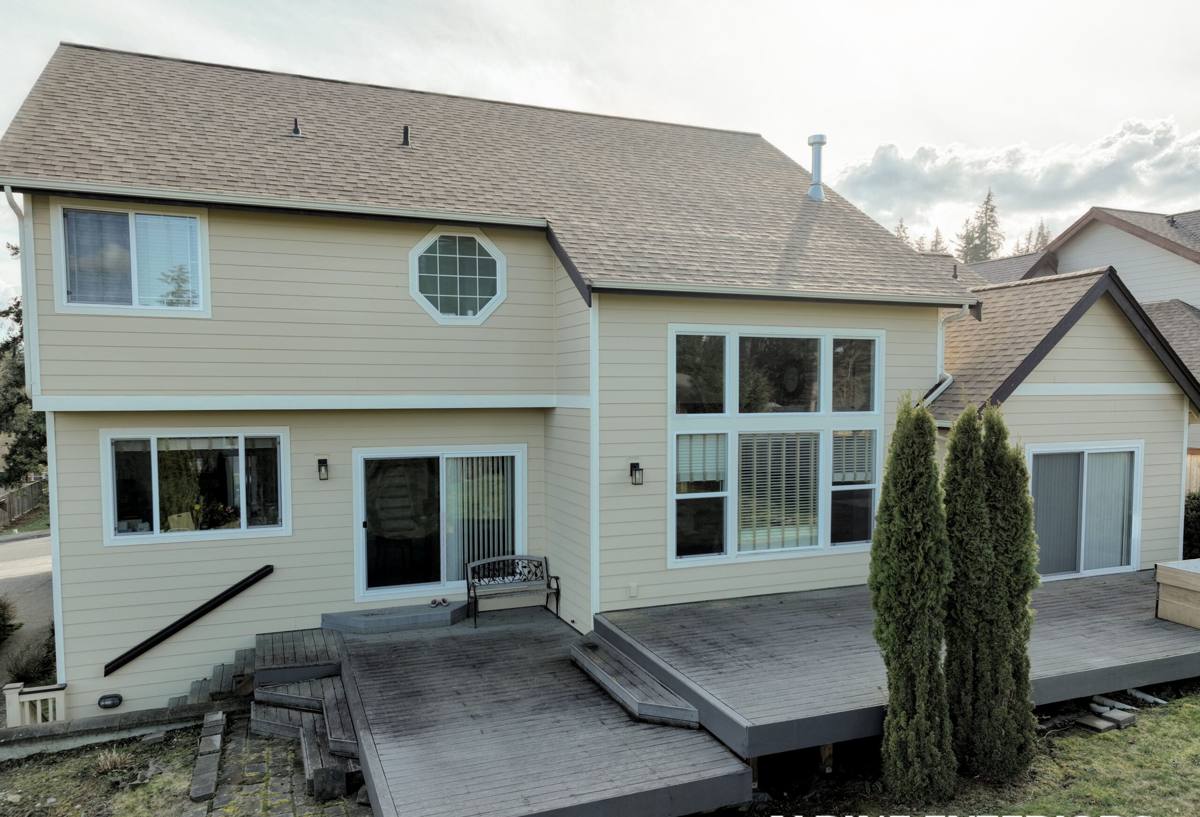
What Point Roberts' Climate Actually Does to a Deck
Point Roberts gets the full package of marine Pacific Northwest weather, concentrated by its exposure on all sides to open water. That combination creates specific stress points that a deck built here has to be designed around, not just tolerate.
Salt Air and Metal Fasteners
Airborne salt from the surrounding water accelerates corrosion on any exposed metal — screw heads, joist hangers, railing brackets, post bases. On a lot of decks we get called to repair, the boards are fine but the hidden hardware has failed underneath. That's a hardware and fastener selection issue, not a composite decking issue, and it's one of the first things we account for differently on a Point Roberts build than we would inland.
Driving Rain and Standing Water
Wind-driven rain here doesn't just fall on a deck, it gets pushed sideways into railing posts, ledger connections, and any spot where two materials meet. Standing water at low points, clogged gaps between boards, and moisture trapped against the house wall are where rot and mold problems start — even with a composite deck surface that itself won't rot.
Moss and Algae Season
Whatcom County's long wet season, roughly October through May, gives moss and algae months of shaded, damp surface to colonize. Composite boards vary a lot in how well their surface texture and cap layer resist this. Cheaper or older-generation composite products can go green and slick within a season or two if they're under tree cover or on the shaded side of the house.
Why Composite Makes Sense Here — With Caveats
Composite decking exists specifically to solve wood's biggest weakness: rot from sustained moisture exposure. In a climate like Point Roberts', that's a real advantage. Good composite doesn't need annual staining or sealing, doesn't splinter, and holds its structural integrity even when it's damp for months at a time.
That said, composite is not maintenance-free, and we tell every customer that up front. It still needs periodic washing to keep moss and pollen film from building up, and the substructure underneath it — joists, beams, posts, footings — is almost always still wood or metal, which absolutely can rot or corrode if it's not detailed correctly. A composite deck surface over a poorly built or poorly ventilated substructure just hides the problem longer before it gets expensive.
Where the Real Differences Show Up Between Composite Lines
| Factor | Why It Matters in Point Roberts |
|---|---|
| Cap layer quality | A full-wrap capped board resists moisture wicking at cut ends and edges far better than uncapped or partially capped boards, especially where boards get cut for stair returns or picture-frame borders. |
| Surface texture | Deeper wood-grain texture holds algae film more than a smoother, tighter-grain finish — worth weighing against how shaded your lot is. |
| Color | Darker boards show less green/black moss staining visually but run hotter in direct summer sun; lighter boards show staining sooner but stay cooler underfoot. |
| Fastening system | Hidden clip systems reduce surface fastener corrosion points; face-screwed systems are more repairable board-by-board but expose more metal. |
| Warranty structure | Check whether the warranty covers staining/mold specifically, not just structural failure — this is the clause that actually matters in a wet coastal climate. |
What a Correct Installation Looks Like Out Here
The board itself is maybe half the equation. The other half is how the frame underneath is built and ventilated, and that's where we see the most corner-cutting from crews who don't build regularly in marine climates.
- Joist tape or flashing on every joist top, so fasteners driving into the board seat into a sealed surface instead of bare wood.
- Proper board gapping sized for the specific product and local humidity swings, so water sheets through instead of pooling.
- Ledger board flashing where the deck meets the house — this is the single most common point of hidden water intrusion on decks we've opened up for repair.
- Corrosion-resistant hardware rated for coastal/marine exposure, not standard exterior-grade fasteners.
- Adequate under-deck ventilation and clearance from grade, so airflow can actually dry the substructure between rain events.
- Post bases set above grade with a standoff, keeping wood posts from sitting in standing water or wet soil contact.
None of this is visible once the deck is finished, which is exactly why it's worth asking a contractor directly how they handle each of these points before work starts.
Our Process for a Point Roberts Deck Project
Because of the border crossing and limited local trade access, we plan Point Roberts jobs a little differently than jobs closer to our Blaine base — mainly around scheduling material delivery and crew days so we're not making unnecessary back-and-forth trips.
- On-site assessment. We look at sun/shade exposure, wind direction relative to the house, existing substructure condition if this is a replacement, and drainage around the deck footprint.
- Product selection walkthrough. We go over composite lines and price tiers honestly, including which ones we've had good long-term results with in this specific climate versus ones we'd steer you away from for a shaded or heavily wind-exposed lot.
- Permit and setback check. Whatcom County and Point Roberts-specific requirements get confirmed before material orders go in, so there are no surprises mid-build.
- Substructure build or inspection. New framing, or a full evaluation and repair of existing framing if we're resurfacing over it.
- Decking installation. Fastening system, board layout, and gapping specified to the product and site conditions.
- Railing, stairs, and trim. Matched hardware and fascia detailing, with the same corrosion-resistant standard applied throughout.
- Final walkthrough. We cover basic maintenance — cleaning cadence, what to watch for, how to keep drainage clear — so the deck actually gets the lifespan the material is capable of.
Why a Local Crew Matters More Here Than Almost Anywhere Else
A lot of contractors treat Point Roberts as too much hassle for one job — the border crossing, the logistics of getting a crew and materials out and back in a single day, the limited local supply access. That reputation is earned, and it means some homeowners here end up with whoever will show up, rather than whoever builds it right.
We work in Point Roberts regularly enough that the crossing, the scheduling, and the local permitting process aren't friction for us — they're routine. That matters for warranty follow-up too. A deck issue that shows up two years later needs a contractor who's still going to make that drive without treating it as a special favor.
Maintenance That Actually Fits This Climate
Composite is low-maintenance, not no-maintenance, and the maintenance that matters most here is specific to the moisture and moss issue rather than generic "keep it clean" advice.
- Sweep debris and organic buildup out of board gaps a few times a year, especially going into the wet season.
- Rinse or lightly wash the surface periodically to prevent algae film from establishing — it's far easier to prevent than to strip off once it's set in.
- Check railing post bases and any visible hardware annually for early corrosion signs.
- Keep gutters and downspouts near the deck clear so runoff isn't dumping directly onto the deck surface or ledger connection.
- Trim back overhanging vegetation that keeps sections of the deck shaded and damp longer than the rest.
Getting a Straight Answer on Cost
Composite decking cost depends heavily on square footage, substructure condition, railing style, and which product tier you choose — general ranges swing widely enough that a number without seeing your site isn't a useful one. What we can tell you upfront is that the biggest cost differences between quotes usually come down to what's happening underneath the boards, not the boards themselves. A quote that looks low because it skips flashing, proper fastener grade, or adequate ventilation isn't actually cheaper — it's a deck that needs rework sooner.
If you're planning a new deck or replacing an aging one in Point Roberts, we're happy to come take a look and walk through options honestly, including what we would and wouldn't recommend for your specific lot. There's no pressure and no obligation — just a straight assessment from a crew that already knows this coastline. Use the form below to request your free estimate.