 Blaine Siding
 Siding on a Water-Bound Peninsula
Point Roberts sits on its own peninsula at the bottom of the Tsawwassen headland, cut off from the rest of Whatcom County by water and by the Canadian border in between. It's a small, quiet community of full-time residents and second-home owners, and the geography that makes it distinctive — bordered by water on most sides, reached by driving up through Canada or across on a passenger ferry from Blaine — is the same geography that puts real stress on a house's exterior. Homes here take weather from more directions than a typical inland Whatcom County property, and siding is usually the first system to show it. That matters even more on properties that sit empty for stretches at a time, since early signs of trouble don't get caught as quickly as they would on a house someone's in every day.
We're based in Blaine and do siding work throughout this stretch of the county, Point Roberts included. On siding specifically, we install James Hardie fiber cement and nothing else. That's not a brand we happened to land on — it's the product we settled on after seeing, repeatedly, which materials actually hold up on exposed, water-surrounded properties like the ones out on the point, and which ones start showing trouble within a handful of years.
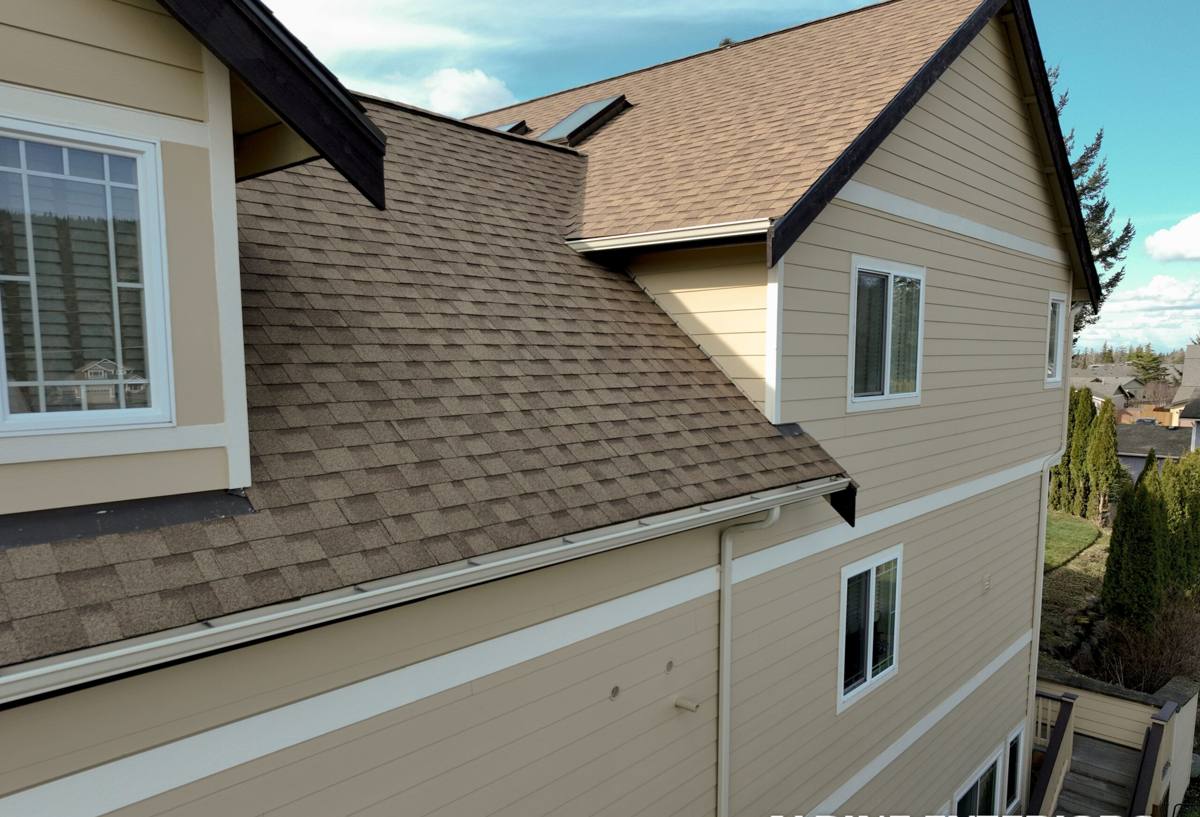
What Salt Air, Driving Rain, and a Long Moss Season Do to Siding Here
Salt Air From More Than One Direction
Because Point Roberts has water on most of its perimeter, siding here takes salt-laden air from a wider range of directions than a home set back a few miles inland. Salt speeds up corrosion in fasteners and flashing, and it breaks down lower-grade paints and finishes faster than a drier, more sheltered site would. A siding product has to hold its finish and its fastening system against that corrosion load, not just against rain.
Wind-Driven Rain Into Seams and Joints
With open water close on multiple sides and little in the way of a windbreak on much of the peninsula, rain here doesn't just fall — it gets driven sideways into lap joints, corner boards, and anywhere siding meets trim or a window. That sideways pressure finds gaps that straight-down rain never would. Siding and flashing details that hold up fine on a calmer, more sheltered lot can fail here specifically because the water is coming in at an angle, under laps and through joints that were never built to handle it.
A Moss and Mildew Season That Runs Most of the Year
Mild temperatures, near-constant humidity, and plenty of shaded, north-facing walls add up to a moss and mildew season that runs long across this part of Whatcom County, and Point Roberts' waterfront setting doesn't shorten it. Porous or moisture-holding siding materials are usually where it shows up first, especially on walls that don't get much direct sun through the day.
Why We Only Install James Hardie Fiber Cement Siding Here
We used to install a wider range of siding products. We stopped, and the reason was straightforward: repeated service calls and tear-offs on exposed, salt-air properties kept pointing to the same conclusion, regardless of brand or price point.
- Non-combustible core: fiber cement doesn't feed a fire the way wood-based siding can, which matters for safety and often for insurance underwriting.
- Factory-applied ColorPlus finish: the color is baked on under controlled factory conditions instead of brushed on in the field, and it holds up far longer against fading, chalking, and moisture intrusion than site-applied paint.
- Climate-engineered HZ5 formulation: Hardie builds this line specifically for regions with heavy moisture exposure and freeze-thaw cycling, which describes waterfront Whatcom County well.
- Dimensional stability: fiber cement doesn't swell, cup, or warp the way engineered wood products can after repeated wetting through a long wet season.
- A strong transferable warranty: Hardie backs its product with one of the more substantial warranty structures in the industry, provided installation follows their spec.
We won't install LP SmartSide, vinyl siding, Cemplank, Allura, primed spruce, or cedar. Every one of those products has a legitimate place in the market, and plenty of homeowners elsewhere are happy with them. But on an exposed, water-surrounded property out on the point, we've made a professional call that we'd rather stand fully behind one system than offer a cheaper option that quietly shifts long-term maintenance risk onto the homeowner.
What Correct Hardie Installation Requires
Fiber cement only performs the way it's engineered to when it's installed to Hardie's published specifications. That means the correct fastener type and spacing, proper clearance from grade and roof lines, drainage or rain-screen detailing behind the panels where the assembly calls for it, and factory-mitered or properly caulked joints at corners and trim. A Hardie product installed loosely will still develop moisture problems in a climate like this one — the material is only as good as the installation behind it.
James Hardie Product Lines That Fit Point Roberts Homes
| Product Line | Best For | Notes |
|---|---|---|
| HardiePlank Lap Siding | Most single-family and vacation homes | Smooth or cedar-textured finish; the most common choice on the point |
| HardiePanel Vertical Siding | Modern designs, accent walls | Often paired with lap siding for a mixed-material look |
| HardieShingle | Craftsman and cottage-style homes | Staggered or straight-edge shingle profiles |
| HardieTrim | Window, door, and corner trim | Fiber cement trim matched to the siding's durability and finish |
All of these come in Hardie's ColorPlus factory finish, and for this stretch of coastline we typically spec the HZ5 formulation rather than a standard national product, since it's built for exactly the kind of sustained moisture exposure a Point Roberts home deals with.
Comparing Common Siding Materials in This Climate
| Material | Moisture Behavior | Maintenance in Salt Air | Typical Longevity Here |
|---|---|---|---|
| James Hardie fiber cement | Dimensionally stable; resists swelling and warping | Low; factory finish resists fading and chalking | 30+ years with correct installation |
| Vinyl siding | Can distort or become brittle with heat and age | Low upfront, but seams and fasteners are exposure points | Variable; often shorter on open, wind-exposed lots |
| LP SmartSide / engineered wood | Wood-strand core is vulnerable at cut edges and joints | Moderate; edge sealing and caulk upkeep matter | Depends heavily on installation and ongoing maintenance |
| Cedar / primed wood | Absorbs and releases moisture readily | High; regular refinishing needed in wet, salty air | Shorter without a consistent maintenance schedule |
What Drives the Cost of a Point Roberts Siding Job
Every siding estimate comes down to the same handful of factors, with one addition specific to this location. Home size and wall complexity set the baseline — more corners, dormers, and trim detail mean more labor and more cutting, regardless of material. How much of the existing siding has to come off versus what's sound enough to build over, whether there's hidden moisture or soft sheathing once the old material is removed, and which HardieTrim profiles the home calls for all shift the number from there. On top of that, a Point Roberts project carries a planning cost a mainland Blaine job doesn't: getting material, a dumpster, and equipment across the border takes advance scheduling, and we build that into the estimate up front rather than treating it as a surprise add-on once work is underway.
Our Process for a Point Roberts Siding Project
We start with an on-site assessment, walking the exterior and looking specifically at how the current siding has handled moisture and salt exposure over time — not just whether it looks tired from the road. From there we put together a clear, written scope and timeline before any work begins, including which walls or sections need full replacement versus targeted repair.
Because Point Roberts is reached by driving through Canada or by ferry, material staging and crew scheduling take a bit more planning than a job a few miles down the road in Blaine. We account for that up front — ordering Hardie product and trim in full before the crew crosses, and building the schedule around border and ferry timing rather than treating it as an afterthought that causes delays mid-project. Homeowners shouldn't have to absorb that logistical friction as extra downtime on their house, and it shouldn't show up as a change order halfway through the job either.
Why a Local Crew That Already Works Point Roberts Matters
Point Roberts is a small, tight-knit community, and it doesn't see the same volume of passing contractor traffic that a mainland neighborhood does — getting a crew and materials out here takes real planning, and not every siding company wants to bother with it. A crew that already works this area regularly has that logistics worked out, and just as important, has a feel for how salt air, wind-driven rain, and the long moss season behave on this specific piece of land. That shows up in the small decisions: how a corner joint gets caulked, which fastener grade gets used, where extra drainage detailing gets added. Those details are what decide whether a siding job lasts one wet season or several decades on a property this exposed, and a crew that's already done the work here before isn't guessing at any of it.
Signs Your Point Roberts Home's Siding Needs Attention
- Visible swelling, cupping, or soft spots, especially near the bottom courses close to grade
- Paint or finish that's chalking, peeling, or fading unevenly on walls facing the water
- Moss or dark streaking that keeps returning on shaded, north-facing sections after cleaning
- Cracked or lifting caulk at corner boards, trim, and window and door edges
- Soft drywall, staining, or a musty smell on interior walls near an exterior wall
What to Check Before Hiring for Siding Work Here
- Ask what siding material they install and why, and whether they back it with a written warranty
- Confirm they carry current Washington contractor licensing and active liability insurance
- Ask directly how they plan material delivery and crew scheduling for a Point Roberts job specifically
- Ask how they detail flashing and joints for wind-driven rain, not just which siding brand they carry
- Get a clear, written scope of work before signing anything
If you're weighing options for your Point Roberts home's siding, we're happy to come out, walk the exterior with you, and give an honest read on what it actually needs. Reach out below for a free, no-pressure estimate.