 Blaine Siding
 Why Ferndale Roofs Take More Punishment Than Most
Ferndale sits in a part of Whatcom County where the weather doesn't do anything halfway. Winter storms roll in off the water carrying salt-laden air, wind gusts strong enough to lift shingle tabs, and rain that doesn't just fall straight down — it drives sideways under eaves, around chimneys, and into any gap a roof gives it. Add in a moss season that can run eight or nine months out of the year, and you've got a roof that's under constant low-grade attack even between the big storms.
Most homeowners think of storm damage as something dramatic — a tree limb through the roof, missing shingles scattered across the lawn. Real storm damage in this part of Washington is usually quieter than that. It's a few lifted shingle tabs that let wind-driven rain sneak under the surface. It's a flashing seam that salt air has slowly corroded until it's no longer watertight. It's moss that's been holding moisture against the roof deck long enough to start rot nobody can see from the ground. By the time a stain shows up on a ceiling, the damage has usually been building for a while.
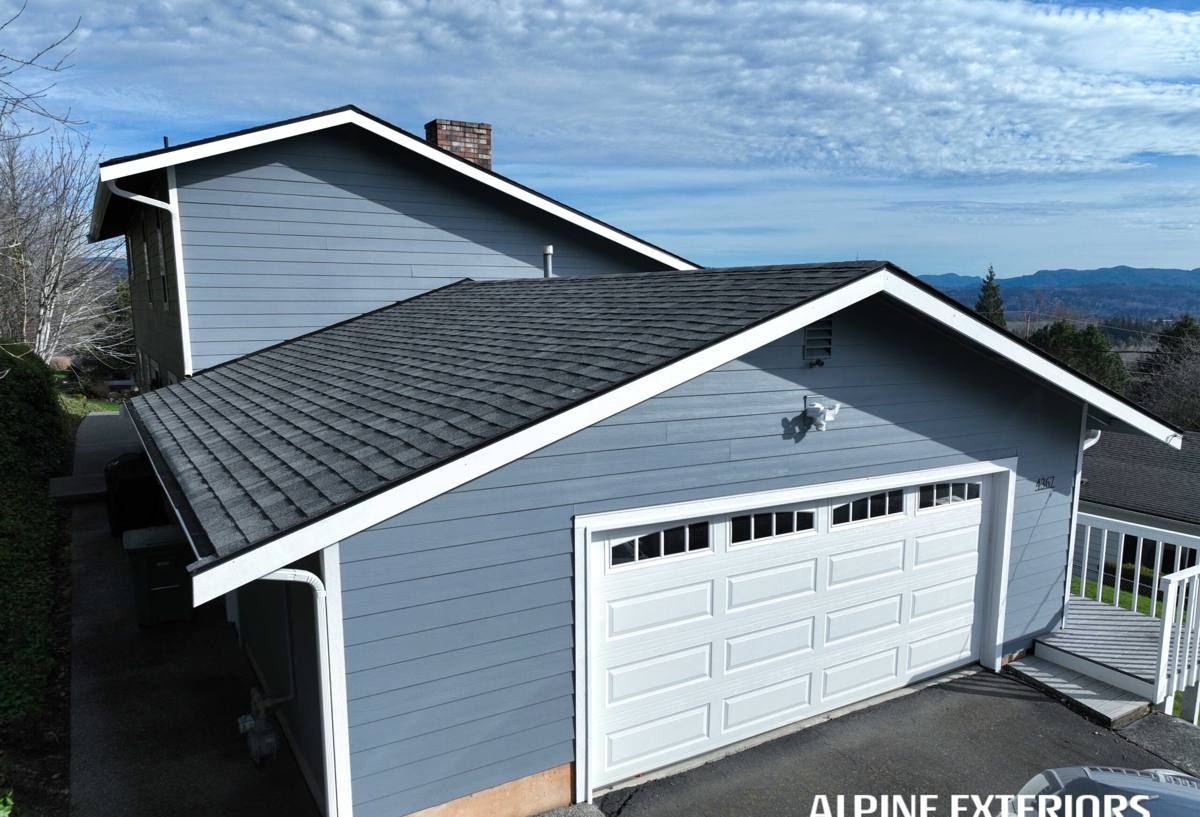
What Actually Counts as Storm Damage on a Ferndale Roof
Not every roof problem is storm-related, and not every storm leaves obvious marks. Here's how we sort it out when we're called out to a Ferndale property.
Wind Damage
Whatcom County doesn't see hurricanes, but it sees plenty of straight-line wind events during fall and winter frontal systems. Wind damage usually shows up as creased or lifted shingles, shingles missing entirely along a ridge or edge, or fasteners that have backed out enough to break the seal strip. Once a shingle's seal is broken, it can flap in every future wind event and let water underneath even on a calm, dry day.
Wind-Driven Rain and Water Intrusion
This is the one that catches homeowners off guard. Rain that hits a roof at an angle — instead of falling straight down — can work its way under shingle edges, around vent boots, and along flashing that would otherwise shed water fine in a normal shower. A roof doesn't need visible damage to leak in this kind of storm; it just needs one aging seal or one nail that's slightly proud of the deck.
Impact Damage
Fir and cedar limbs coming down in a windstorm are a real risk on wooded and semi-wooded lots around Ferndale. Even a small branch strike can crack a shingle or bruise the mat underneath in a way that isn't visible until the shingle starts to fail months later.
Moss and Long-Term Moisture Damage
Moss isn't a single storm event, but it's a direct product of this region's weather pattern — mild temperatures and near-constant dampness for most of the year. Left alone, moss lifts shingle edges, holds water against the roof deck, and accelerates granule loss. We treat established moss growth as a storm-adjacent problem because it weakens a roof's ability to handle the next real weather event.
Signs of Storm Damage by Roof Area
Some damage is visible from the ground with a pair of binoculars. Other damage only shows up once someone's actually on the roof or in the attic. Here's a general guide to what we look for and why it matters.
| Roof Area | What to Look For | Risk If Left Alone |
|---|---|---|
| Shingles / Composition Field | Lifted tabs, creases, bald spots (granule loss), cracked shingles | Broken water seal, accelerated wear, leaks during the next storm |
| Flashing (chimneys, valleys, walls) | Lifted edges, visible gaps, corrosion or rust streaking | Direct water entry at one of the roof's most vulnerable points |
| Gutters and Roof Edges | Sagging, pulling away from fascia, granule buildup in the gutter | Water backing up under the edge of the roof instead of draining |
| Attic / Ceiling (interior) | Water stains, musty smell, damp insulation, daylight through the deck | Hidden rot, mold growth, and repair costs that grow the longer they sit |
What a Correct Storm Damage Repair Actually Involves
A lot of storm repair work in this region gets done as a quick patch — a smear of sealant over a visible gap, a few replacement shingles nailed down without checking what's underneath. That kind of repair might hold for a season, but it doesn't address what actually let water in, and it doesn't account for the fact that the surrounding roofing has been exposed to the same weather and is often close behind in failing.
A correct repair starts with figuring out how the water got in, not just where it showed up. Water can travel several feet from an entry point before it stains a ceiling, so a leak over a bedroom might trace back to a flashing failure on the far side of the roof. We check the deck underneath damaged shingles for soft spots, confirm the underlayment is still doing its job, and match repair materials to what's already on the roof so the fix doesn't stand out or create a new weak seam down the line.
Emergency Response
When a storm has left a roof actively leaking or exposed, the first priority is stopping additional water intrusion — temporary tarping or board-up work that protects the interior of the home until a permanent repair can be scheduled and, if needed, coordinated with an insurance adjuster.
Full Inspection
Once the immediate risk is handled, we inspect the full roof, not just the damaged area. A storm that broke one shingle seal likely stressed several others. Catching those now is cheaper than a second service call after the next front comes through.
Targeted, Matched Repair
We replace what needs replacing, reseal and re-flash what needs it, and address any moss or debris that contributed to the failure — without pushing homeowners toward a full roof replacement when a proper repair will genuinely hold.
Repair or Replace? How We Actually Decide
This is the question every homeowner wants a straight answer to, and it deserves one. The honest answer depends on the roof's age, the extent of the damage, and whether the damage is isolated or scattered across multiple areas. Here's the general framework we use.
| Factor | Leans Toward Repair | Leans Toward Replacement |
|---|---|---|
| Roof Age | Well within its expected service life | Nearing or past the manufacturer's expected lifespan |
| Extent of Damage | Localized to one area or slope | Scattered across multiple slopes or the whole roof |
| Deck Condition | Solid, dry decking under the damaged shingles | Soft, rotted, or repeatedly saturated decking |
| Storm History | First significant damage event | Repeated repairs to the same areas over several seasons |
| Underlying Material Condition | Shingles elsewhere are still flexible and well-adhered | Widespread granule loss or brittle shingles nearby |
We'll always tell you when a repair is the right, honest call — and we'll tell you just as plainly when a repair would just be delaying an inevitable replacement. Neither answer benefits from guesswork.
Moss, Salt Air, and Why Maintenance Timing Matters Here
Ferndale's climate doesn't give roofs much of a break. The combination of salt-carrying coastal air and long stretches of damp weather means metal components — flashing, fasteners, gutter hardware — corrode faster here than they would in a drier inland climate, and moss and algae get a much longer growing window than most manufacturers' shingle warranties assume. That's part of why we treat moss removal and gutter maintenance as part of storm damage prevention, not a separate cosmetic service. A roof that's carrying a heavy moss mat into a windstorm is carrying extra weight and extra trapped moisture right at the moment it needs to be shedding water fastest.
We don't recommend pressure washing a roof — it strips granules and shortens shingle life for the sake of a quick clean look. Low-pressure moss treatment and manual removal, paired with keeping gutters and valleys clear, does more for a Ferndale roof's long-term durability than any one-time deep clean.
Working With Insurance on Storm Damage Claims
Most homeowners' insurance policies cover sudden storm damage — wind, impact, wind-driven rain intrusion — though coverage details and deductibles vary by policy. We're not the ones who decide what's covered, but we can make the claims process smoother by documenting what we find with clear photos and a written scope of damage before any repair work starts. That documentation is what an adjuster needs to see, and having it organized from day one tends to move a claim along faster than trying to reconstruct what happened after repairs are already done.
If you're not sure whether damage is significant enough to file a claim, that's a fair question to bring to us before you call your insurer. We'll give you a straight read on what we're seeing.
Why a Roofer Who Already Works Ferndale Makes a Difference
Storm damage repair isn't the kind of job where a generic, one-size-fits-all approach holds up. A crew that regularly works roofs in Ferndale and across Whatcom County has already seen how the local combination of salt air, driving rain, and extended moss season plays out on this area's roofing — which flashing details tend to fail first, which orientations catch the worst of the wind, and which repairs actually last through the next winter versus which ones are back on the schedule in a year.
There's also the practical side: when a storm comes through and multiple homes need attention at once, a crew already working the area can respond faster than one driving in from out of the county. And because we're not a storm-chasing outfit that shows up after a big event and disappears afterward, any repair we do is one we're still around to stand behind.
Storm Season Readiness Checklist for Ferndale Homeowners
A few minutes of ground-level checking before and after major storms can catch small problems while they're still cheap to fix.
- Look for shingle tabs that appear lifted, curled, or missing after any windstorm
- Check gutters and downspouts for granule buildup, sagging, or separation from the fascia
- Watch for moss buildup along ridges, valleys, and north-facing slopes where shade keeps things damp longer
- Inspect attic spaces after heavy rain for damp insulation, staining, or a musty smell
- Trim back tree limbs that overhang the roof or could reach it if they came down in high wind
- Note any change in how quickly water drains off the roof after a storm — pooling or slow runoff can signal a developing problem
- Have the roof looked at by a professional if it's more than a few years past its last full inspection
Get an Honest Read on Your Roof
If a recent storm has left you with a leak, missing shingles, or just a nagging feeling that something on the roof isn't right, we're happy to take a look. We'll give you a clear, no-pressure estimate and an honest assessment of whether you're looking at a repair or something bigger — no scare tactics, no upsell. Reach out using the form below to schedule a free storm damage inspection for your Ferndale home.