 Blaine Siding
 Birch Bay Sits Right at the Edge of the Weather
Birch Bay faces the water, and that changes what a deck has to put up with compared to a deck a mile or two inland. Wind off the bay carries salt spray onto railings and fascia. Driving rain comes in sideways during winter storms, not just straight down. And Whatcom County's long, damp shoulder seasons give moss and algae months at a time to get established on any surface that stays wet. A deck built without those specifics in mind will show it early — fading unevenly, staining at the fastener heads, or growing a green film in the shaded corners by the second winter.
This page is about composite decking specifically for Birch Bay properties — what the climate actually does to a deck here, what a correctly built one looks like, and how we approach the job as a crew that works this stretch of Blaine regularly rather than passing through once.
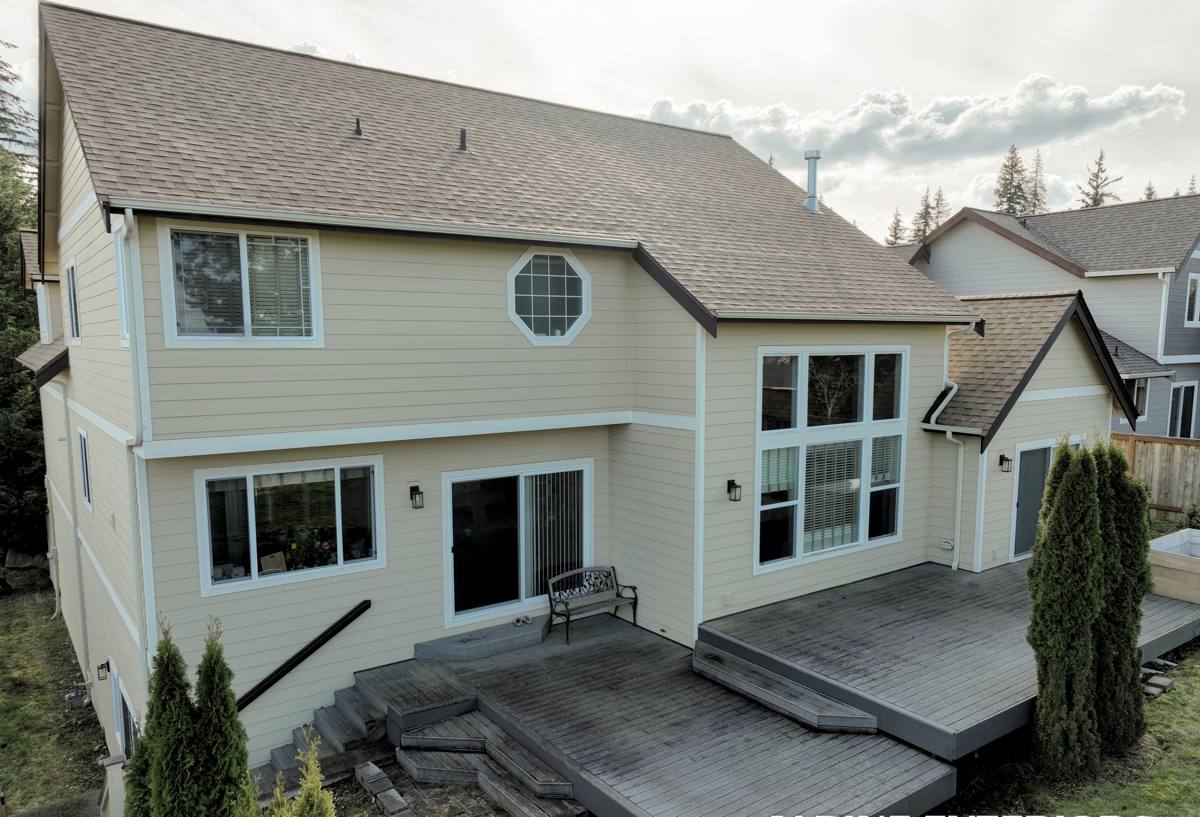
Why Composite Decking Makes Sense in This Climate
Composite decking is made from a blend of wood fiber and plastic, usually with a protective outer cap on higher-grade products. It doesn't need to be sanded, stained, or sealed the way wood does, and it doesn't absorb water the way solid wood boards do. That matters in a place where the decking sits under moisture load for a good chunk of the year.
The trade-off is that composite is less forgiving of a sloppy installation. A wood deck can hide some framing sins because wood flexes and can be re-sanded or re-coated later. Composite won't. If the substructure isn't square, if drainage under the boards isn't right, or if the wrong fasteners go in, those mistakes show up as cupping, staining, or squeaking within a season or two — and they're much harder to fix after the fact than with wood. So composite decking is a good fit for Birch Bay's climate, but only when the build underneath it is done right the first time.
What Salt Air Actually Does
Salt air doesn't damage composite boards the way it damages bare wood or untreated metal, but it does attack anything metallic in the system — fasteners, brackets, railing hardware, and any exposed screws. Over a few seasons, the wrong fastener grade will streak rust down the face of a light-colored board, which looks like the decking failed when it's actually the hardware that failed.
What a Correct Composite Deck Build Involves
A composite deck is really two systems: the framing underneath, which almost nobody sees, and the decking surface on top, which is all anyone notices until something goes wrong below it. Both have to be right for the deck to hold up in this climate.
Framing and Substructure
- Joist spacing tightened up from typical wood-deck spans — composite needs closer support than solid wood to avoid long-term sagging between joists.
- Ledger board attachment and flashing done correctly where the deck meets the house, so wind-driven rain can't work its way behind the siding.
- Joist tape or a comparable moisture barrier on top of the framing lumber, so the wood underneath isn't sitting in standing water every time it rains.
- Proper clearance from grade and adequate airflow underneath, which matters more here than in a drier climate because it's what keeps moss and mildew from colonizing the underside of the deck.
Fasteners and Hardware
This is where a lot of decks near the water go wrong. Standard coated deck screws are fine for an inland project, but this close to salt air we use fastener systems and hardware rated for coastal or marine-adjacent exposure — stainless steel or equivalent corrosion-resistant grades for anything exposed, and hidden fastener clip systems where the product allows it, which also gets rid of exposed screw heads as a rust point entirely.
Board Layout and Drainage
Board direction, gap spacing, and picture-frame border details all affect how well a deck sheds water and dries out between rain events. In a spot that gets as much sustained damp weather as Birch Bay, we pay close attention to end-gapping and drainage paths so water isn't sitting against board ends or pooling in low spots on the frame.
Composite Decking Options and What Drives the Cost
Not all composite decking is priced or built the same way, and the differences matter more in a wet, salty climate than they would somewhere drier. The table below is a general guide to how the main factors affect the estimate — actual numbers depend on deck size, height, railing style, and site access.
| Factor | Lower Cost | Higher Cost |
|---|---|---|
| Board type | Uncapped or capped-on-one-side composite | Fully capped composite with a longer stain/fade warranty |
| Substructure | Reusing sound existing framing | Full tear-out and new framing, joist tape, upgraded flashing |
| Fastener system | Standard coated screws, face-fastened | Hidden fastener clips with marine-grade hardware |
| Height and access | Ground-level, easy site access | Elevated deck, stairs, difficult material access |
| Railing | Basic composite or metal baluster rail | Glass panel, cable rail, or custom rail details |
Our estimate walks through each of these line by line so you know exactly what's driving the number, rather than a single lump figure.
How Our Process Works
- On-site assessment. We look at the existing deck or build site, check drainage and sun/shade exposure, and note anything specific to that property's exposure to wind and salt spray.
- Structural check. Ledger board condition, footing and post condition, and joist spacing get evaluated against current code and against what the composite manufacturer requires for warranty coverage.
- Tear-out, if needed. Old decking and, where necessary, old framing come out. This is also when we typically find and correct hidden moisture damage from a prior deck's flashing or drainage issues.
- Framing and moisture protection. New or reinforced joists, correct spacing, joist tape, and ledger flashing go in before any decking touches the frame.
- Decking installation. Boards go down with the fastener system and layout appropriate to the product and to this site's exposure.
- Railing, stairs, and trim. Fascia, stair stringers, and railing are installed and squared off.
- Final walkthrough. We go over the finished deck with you, including what maintenance it actually needs — and what it doesn't.
Salt, Moss, and Drainage: The Details That Actually Matter Here
Three things separate a deck that holds up in Birch Bay from one that doesn't, and none of them are visible once the project is finished.
Corrosion Control
Every piece of exposed metal — screws, post brackets, stair hardware, railing fasteners — is a potential rust streak waiting to happen this close to the water. We spec corrosion-resistant hardware throughout, not just on the top-facing boards, because it's the hidden brackets and fasteners that get missed and cause problems years later.
Airflow Underneath
Moss and algae need two things to take hold: moisture and shade. A deck built low to the ground with poor airflow underneath gives them both. Correct clearance and, where the site allows it, some form of ventilation gap keeps the underside of the deck drying out between storms instead of staying damp for weeks at a stretch through the wet season.
Water Path
Where does the water actually go once it hits the deck? Slope, gapping, and any picture-frame border details all affect this. A deck that traps water against the house, against posts, or in low spots on the framing will show problems at exactly those points first, regardless of how good the decking material itself is.
Maintenance: What a Birch Bay Composite Deck Actually Needs
One of the real advantages of composite over wood is a much shorter maintenance list — but "low maintenance" isn't "no maintenance," especially with salt air and moss pressure in the mix.
- Rinse or sweep off salt residue and organic debris (leaves, needles, pollen) a few times a year, more often near the waterline of the property.
- Keep gutters and downspouts clear so runoff isn't dumping directly onto or under the deck.
- Clean shaded, damp corners where moss is most likely to start before it spreads across a wider area.
- Check railing posts and stair connections periodically for any movement, which can signal a fastener or bracket issue underneath rather than a problem with the decking itself.
- Trim back vegetation that's shading or dripping directly onto deck sections, since that's usually where moss and staining show up first.
Why a Blaine-Based Crew That Already Works Birch Bay Matters
A lot of what protects a composite deck here is invisible in the finished product — the fastener grade, the flashing detail at the ledger, the airflow underneath. Those are exactly the details that get skipped by crews that don't build in this climate regularly and don't know what actually fails first in a Whatcom County waterfront setting. Working Birch Bay and the surrounding Blaine area consistently means we've seen what a few years of salt air and wet winters does to a deck that was built for a drier, more sheltered spot, and we build around that from the start instead of learning it from a callback.
It also means straightforward logistics — material staging, site access, and scheduling around the wetter months are things we're already used to managing on this part of the coast.
Get a Straightforward Estimate
If you're planning a new composite deck in Birch Bay or replacing one that's showing its age, we're happy to come take a look, walk the site with you, and put together a clear, no-pressure estimate. Use the form below to get started.