 Blaine Siding
 Siding Repair in Birch Bay Is a Different Job Than New Construction
Repairing siding is not a smaller version of installing it. A repair has to work with whatever is already on the wall, match a finish that has been weathering for years, and — most importantly — figure out why that section failed in the first place. On a lot of Birch Bay homes, sitting as close to the water as they do, that last part is the piece that gets skipped most often. A crew patches the visible damage, the homeowner is happy for a season or two, and the same spot fails again because nothing addressed the moisture path that caused it.
We work on siding throughout Birch Bay regularly, and we treat repair work with the same seriousness as a full installation. That means diagnosing the cause before touching a single board, using materials that actually match what is already on the house, and being straight with a homeowner about when a repair is the right call and when it is not. On the material side, our repair work is built around James Hardie fiber cement, which is the only siding system we install or repair. This page walks through what that looks like specifically for Birch Bay's shoreline conditions.
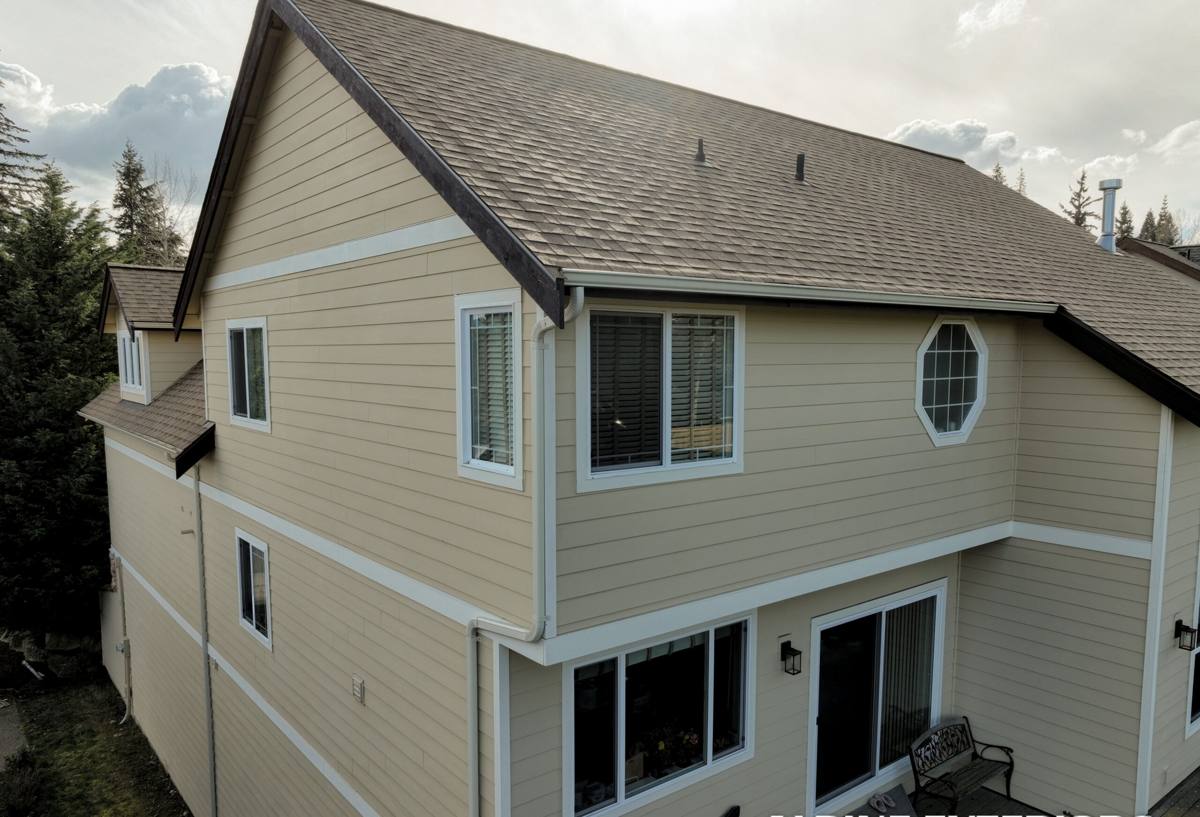
What Birch Bay's Climate Does to a Repair Job
Salt Air Directly Off the Bay
Homes close to the water in Birch Bay take on more sustained salt exposure than most of Whatcom County ever sees. Salt accelerates corrosion on fasteners, flashing, and any exposed metal trim, and it breaks down lower-grade paint and caulking faster than a drier climate would. When we open up a damaged section of siding here, corroded fasteners and degraded caulk joints are common findings, not the exception — and either one, left in place during a repair, guarantees the same failure comes back.
Wind-Driven Rain Finding Every Gap
Waterfront exposure means wind, and wind pushes rain sideways into siding joints, trim transitions, and anywhere a seal has started to fail. That sideways moisture load is exactly what turns a small cosmetic issue — a hairline crack, a slightly separated joint — into a soft, damaged section of wall a year or two later. A repair that only addresses the surface crack without checking how far water has already traveled behind it is not really solving the problem.
A Moss Season That Hides Real Damage
Mild temperatures and near-constant moisture give Birch Bay a moss and mildew season that can run most of the year on shaded, north-facing, or tree-covered walls. Moss holds moisture directly against the siding surface for extended periods, and it is very good at covering up staining, softness, or early rot until the damage underneath is more advanced than it looks from the ground. We check moss-covered sections carefully during any repair estimate, because what looks like a cleaning job on the surface is sometimes a repair job underneath.
Common Repair Issues We See on Birch Bay Homes
A handful of problems show up repeatedly on siding repair calls in this area, almost always tied back to the same combination of salt, wind, and sustained moisture:
- Soft or spongy siding low on the wall, where splash-back and standing moisture linger longest
- Cracked or separated caulk joints at trim, corners, and butt joints that have let water track behind the siding
- Rust staining running down from corroded fasteners or trim hardware
- Warped, cupped, or buckled panels on older wood-based or engineered wood siding
- Damage at the base of the wall near grade, where splash and standing water do the most repeated harm
- Impact damage from wind-blown debris during winter storms off the water
- Discoloration or soft spots hiding underneath moss or mildew growth on shaded walls
Repair or Replace? How We Make the Call
Not every damaged section needs a full re-side, and we are not going to tell a homeowner they need whole-house replacement when a targeted repair will genuinely hold up. The honest answer depends on how far the underlying moisture damage has spread, not just how the surface looks. A single cracked panel with dry, solid sheathing behind it is usually a straightforward repair. A wall with soft sheathing across multiple sections, moisture that has clearly been tracking behind the siding for a long time, or a pattern of failures across several walls is a different situation — patching one spot on a wall that is failing broadly just moves the next service call a year down the road, not off the calendar.
We probe and check behind damaged sections before giving a recommendation either way, and we explain what we find in plain terms. If a repair is the right call, we say so. If the damage is more widespread than the visible symptom suggests, we would rather tell a homeowner that up front than sell a patch job we already suspect will not hold.
What a Correct Siding Repair Actually Involves
A repair that actually solves the problem, rather than just covering it, follows a few consistent steps regardless of how small the damaged section looks:
- Remove enough surrounding material to see the real extent of damage — not just the piece that is visibly cracked or stained
- Check the sheathing and house wrap underneath for rot, softness, or gaps before anything new goes back up
- Correct the moisture path that caused the failure — re-lapping flashing, resealing a joint properly, or improving drainage at grade, depending on what is found
- Use fasteners and hardware rated for coastal, corrosive exposure, not whatever is on hand
- Match the replacement material and finish as closely as the original allows, so the repair does not stand out as an obvious patch
Skipping any one of these steps is how a "repair" ends up being a temporary cosmetic fix instead of an actual solution. In a climate that keeps testing every seam and joint the way Birch Bay's does, shortcuts on a repair show up again quickly.
Why We Repair Only with James Hardie Fiber Cement
We install James Hardie fiber cement exclusively, and that standard carries over into repair work. We do not patch a damaged section of Hardie siding with vinyl, engineered wood, or whatever offcut happens to be on the truck, and we do not recommend mixing materials on a wall where the goal is a repair that lasts. A few reasons that standard matters specifically for repair work:
- Factory-applied ColorPlus finish: Genuine Hardie replacement material takes ColorPlus color much closer to the existing wall than a field-painted patch ever will, which matters when a homeowner does not want a repair that is obvious from the street.
- Non-combustible core: Patching a section with a different, combustible material undermines the fire performance of the wall assembly as a whole, not just that one board.
- Dimensional stability: Fiber cement expands and contracts differently than wood-based products, so mixing materials at a repair joint tends to create a new stress point rather than a clean fix.
- Warranty integrity: Repairs done with the correct product and to spec generally preserve a homeowner's existing warranty coverage; patched-in substitute materials usually do not.
We do not install or repair with LP SmartSide, vinyl siding, Cemplank, Allura, primed spruce, or cedar. Each has homeowners who are satisfied with it elsewhere, but our professional position on a shoreline exposure like Birch Bay is that a repair is only worth doing if it is done with the same material standard as the rest of the wall.
Our Repair Process, Start to Finish
On-Site Diagnosis
We start by looking at the damaged area in person, probing behind it where needed, and checking nearby sections and walls with similar sun and wind exposure for early signs of the same problem. This is where we form the repair-or-replace recommendation.
Written Scope Before Work Begins
Once we know what we are dealing with, we put together a clear, written scope covering what will be repaired, what materials will be used, and roughly what it will cost, before any work starts.
Careful Removal and Substrate Check
We remove enough of the surrounding siding to expose the full extent of the damage and inspect the sheathing and weather barrier underneath, rather than covering a compromised substrate with new siding on top.
Correcting the Cause, Not Just the Symptom
Flashing gets re-lapped, joints get properly sealed, and drainage details get corrected where they contributed to the original failure — this is the step that determines whether the repair actually lasts through the next few wet seasons.
Matched Material Installation
New Hardie material goes in to the same installation spec as the rest of the house, with color and profile matched as closely as possible so the repair blends into the existing wall.
Final Check
We walk the finished repair with the homeowner, point out what was found and fixed, and flag any nearby areas worth keeping an eye on given the home's specific sun and wind exposure.
What Drives the Cost of a Siding Repair
| Factor | Why It Matters | Birch Bay Consideration |
|---|---|---|
| Extent of hidden damage | Sheathing repair adds cost beyond the visible siding fix | Wind-driven rain often travels further behind siding than the surface crack suggests |
| Color and profile matching | Closer matches to weathered ColorPlus finish take more sourcing care | Sun-faded, salt-exposed walls can shift color unevenly across a house |
| Access and wall height | Second-story or hard-to-reach sections take more setup time | Same as anywhere, but wind conditions on exposed walls can affect scheduling |
| Underlying cause correction | Re-flashing or re-sealing adds labor beyond a simple panel swap | Salt air corrosion on existing flashing often needs replacing, not just resealing |
These are general drivers, not a quote — every repair depends on what we actually find once a damaged section is opened up, which is why we assess in person rather than pricing a repair over the phone.
Why Hiring a Crew That Already Works Birch Bay Matters
A contractor who works this stretch of coastline regularly has already seen how salt air, wind-driven rain, and a long moss season behave on real Birch Bay walls, not just how a product is rated on a spec sheet. That shows up directly in repair work: knowing which walls on a waterfront lot take the worst of the wind, recognizing when moss-covered siding needs a closer look rather than just a cleaning, and understanding that a fast patch on this coastline rarely holds as long as it would somewhere more sheltered. It also means that if a repair needs a follow-up down the line, it is a call to a crew that is still working in the area, not one that has moved on.
If you have a section of siding on your Birch Bay home that needs attention — whether it is obvious damage or something you noticed under a patch of moss — we are glad to come take a look and give you an honest read on what it actually needs. Reach out using the form below for a free, no-pressure estimate.