 Blaine Siding
 Why Birch Bay Siding Wears Differently Than Siding Inland
Birch Bay sits right on the water, and that changes what siding has to survive. Homes a few blocks off the beach face a steady drift of salt air that settles on exterior surfaces year-round, driving rain that comes in sideways off Georgia Strait during winter storms, and a moss season that can run eight months or longer in the shaded, damp corners of a lot. None of these are exotic problems — they're just relentless. A siding product that would perform fine in a drier inland pocket of Whatcom County can show real wear in Birch Bay within a handful of years if it wasn't chosen and installed with this exposure in mind.
When we replace siding in Birch Bay, we're not treating it as a generic re-side job. We're accounting for wind-driven moisture at wall penetrations, salt exposure on fasteners and finishes, and the moss and algae growth that thrives in the marine humidity here. Getting those three things right is most of what separates a siding job that looks good for two years from one that looks good for twenty.
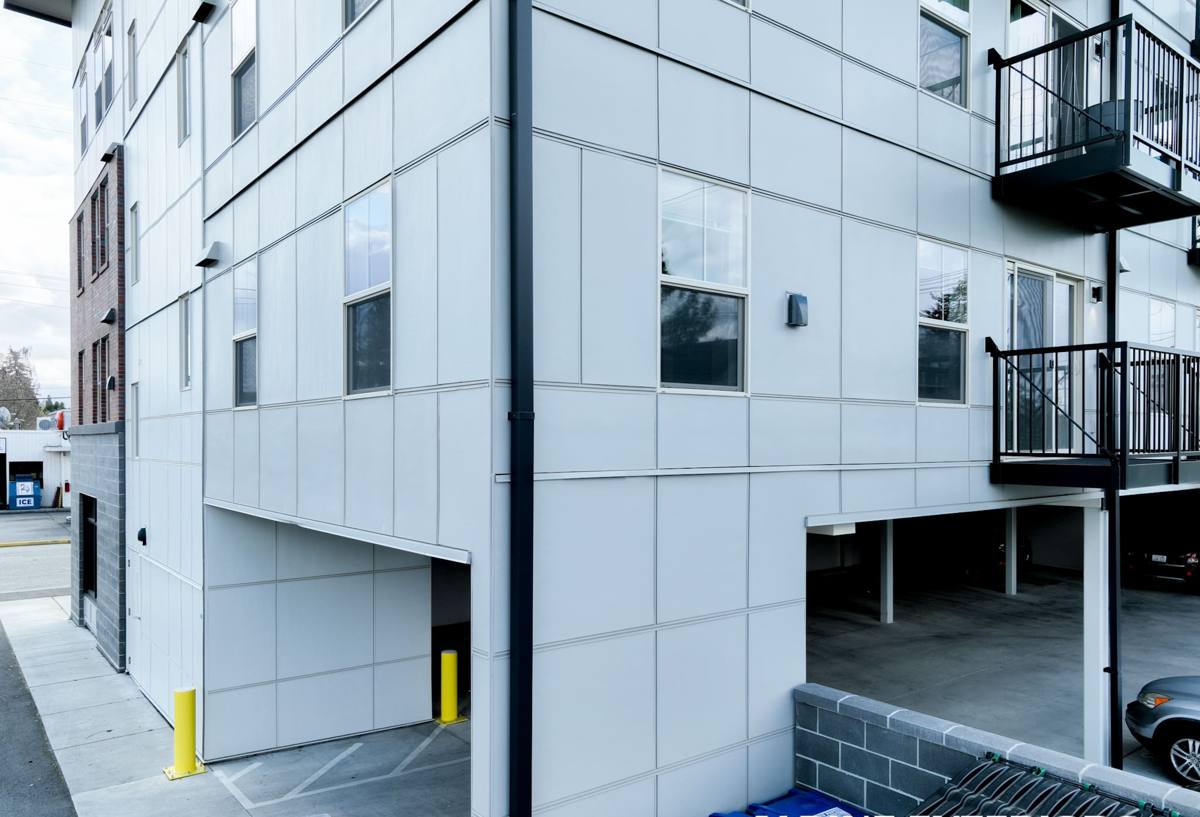
What Salt Air Actually Does to Siding Over Time
Salt air isn't just a coastal talking point — it has specific, measurable effects on exterior building materials. Airborne salt is hygroscopic, meaning it pulls moisture out of the air and holds it against whatever surface it lands on. On siding, that means more time spent damp, even on days that aren't rainy. Over years, this cycle can:
- Accelerate corrosion on exposed or under-protected fasteners, trim flashing, and hardware
- Break down lower-quality paint films faster, leading to chalking, fading, and peeling
- Contribute to swelling, delamination, or rot in wood-based and wood-composite siding products
- Leave a fine residue that, combined with moisture, feeds algae and mildew growth on the surface
This is a big part of why we standardized on James Hardie fiber cement siding rather than wood-based composites or vinyl. Fiber cement doesn't absorb moisture the way wood fiber products can, and it doesn't degrade under UV and salt exposure the way vinyl can become brittle. It's not immune to a harsh marine environment, but it's built to shrug off the specific things that environment throws at a wall.
Fasteners and Flashing Matter as Much as the Siding Itself
A lot of homeowners focus entirely on the siding panel and overlook the hardware holding it up. In a salt-air environment like Birch Bay, using the wrong fastener — one not rated for corrosion resistance — can cause staining and eventual failure at every nail point, even if the siding itself is holding up fine. Correct installation means corrosion-resistant fasteners, properly lapped flashing at every horizontal joint, and window and door flashing details that shed water outward rather than trapping it behind the cladding.
Driving Rain and Where Siding Jobs Actually Fail
Most siding failures in this part of Washington aren't failures of the siding material — they're failures of the details around it. Driving rain off the water finds any gap, and it doesn't take much: a poorly lapped joint, a caulked-instead-of-flashed window head, a missing kick-out flashing where a roofline meets a wall. Water gets behind the cladding, and from there it's a slow, hidden problem until it isn't.
A correct siding replacement addresses this with a water-resistive barrier installed and lapped correctly, drainage space where the siding system calls for it, and flashing at every horizontal transition — window and door heads, roof-to-wall intersections, deck ledgers, and butt joints between siding courses. This is unglamorous work that doesn't show up in a finished photo, but it's the difference between siding that protects the structure for decades and siding that looks fine until a wall cavity tells you otherwise.
Moss and Algae: The Slow, Constant Threat
Whatcom County's marine climate keeps humidity high for much of the year, and Birch Bay's tree cover and shaded lots make moss and algae growth on siding almost inevitable in the wrong spots — north-facing walls, areas under eaves that never get direct sun, and anywhere siding sits close to landscaping. Moss holds moisture against the surface, and over time that sustained dampness is harder on a siding system than the occasional heavy rain.
James Hardie's ColorPlus factory-applied finish is baked on under controlled conditions and is formulated to resist the fading and staining that comes with this kind of biological growth better than field-applied paint. It won't stop moss from landing on a shaded wall, but it holds up to periodic washing far better than a finish that's already thin or chalking from age.
| Climate Factor | What It Does to Siding | What a Correct Install Addresses |
|---|---|---|
| Salt air | Corrodes fasteners, breaks down weak finishes, feeds surface growth | Corrosion-resistant fasteners, durable factory finish, proper flashing |
| Driving rain | Forces water behind cladding at gaps and unflashed joints | Correctly lapped water-resistive barrier and flashing at every transition |
| Moss/algae season | Keeps surfaces damp longer, stains and degrades weaker finishes | Factory-cured finish, proper drainage plane, siding rated for moisture exposure |
Why We Install Only James Hardie Fiber Cement
We made a deliberate decision to install James Hardie fiber cement siding exclusively, and we don't install vinyl, LP SmartSide, Cemplank, Allura, or primed wood species like spruce or cedar. Each of those products has legitimate uses and satisfied customers elsewhere — this isn't a claim that they're bad products. It's that, given what we see repairing and replacing siding around Blaine and Birch Bay, we don't think they hold up to this specific climate as consistently as fiber cement does, and we'd rather stand behind one system we trust completely than offer several we have reservations about.
Fiber cement is non-combustible, dimensionally stable in a way wood-based products aren't, and doesn't share vinyl's tendency to become brittle and crack in cold snaps or expand and warp in heat. James Hardie's HZ5 product line is engineered specifically for climates like ours — freeze-thaw cycling combined with sustained moisture exposure — and comes with a factory finish warranty that isn't dependent on how well a field-applied paint job was done. For a home a short walk from saltwater, that combination is hard to match.
What James Hardie Doesn't Solve On Its Own
It's worth being honest here: no siding product, including Hardie, performs well if it's installed poorly. Fiber cement still needs correct flashing, correct fastening, and correct clearances from grade, decks, and roof lines. The product buys you a wide margin for error compared to more moisture-sensitive materials, but it doesn't remove the need for a crew that knows how to detail a wall correctly for this climate.
What Our Birch Bay Siding Replacement Process Looks Like
- Assessment — We inspect the existing siding, sheathing, and any visible signs of moisture intrusion, paying close attention to north- and west-facing walls and anywhere close to the water.
- Removal and sheathing check — Old siding comes off and we inspect the sheathing underneath before covering anything back up. Hidden rot or damage gets addressed before new siding goes on, not after.
- Water-resistive barrier — A new barrier is installed and correctly lapped, shingle-style, so water is always directed outward and down.
- Flashing details — Every window, door, roofline intersection, and horizontal joint gets flashed to shed driving rain rather than relying on caulk alone.
- James Hardie installation — Panels or lap siding go on with corrosion-resistant fasteners, correct nailing patterns, and proper clearances from grade and hard surfaces.
- Trim and finish details — Corners, trim, and caulking are finished to shed water at every seam.
- Final walkthrough — We go over the finished work with the homeowner before calling the job complete.
Signs a Birch Bay Home Needs Siding Replacement Now
- Soft or spongy spots when you press on the siding, especially near the bottom courses
- Persistent moss or algae staining that comes back quickly after cleaning
- Visible gaps, warping, or buckling in panels, especially on walls that face prevailing weather
- Peeling or bubbling paint that keeps recurring in the same spots
- Rust streaking from fasteners or trim hardware
- Rising energy bills alongside noticeable drafts near exterior walls
Any one of these on its own might just mean a repair. Several at once, especially on a home that's had the same siding for a couple decades, usually means it's time to talk about full replacement before hidden damage gets ahead of you.
Cost Factors Specific to a Birch Bay Job
Every siding replacement is priced around the specifics of the home, but a few factors show up more often in Birch Bay jobs than they would inland:
| Factor | Why It Matters Here |
|---|---|
| Sheathing condition | Homes with a history of moisture intrusion near the water sometimes need sheathing repair before re-siding |
| Wall exposure | Walls facing prevailing wind and rain often need more attention to flashing detail than sheltered walls |
| Existing siding type | Removal complexity varies — some older wood or composite siding requires more careful teardown |
| Trim and detail work | Homes with more windows, corners, and roof intersections require more flashing and trim labor |
| Access | Lot layout, landscaping, and proximity to neighboring structures affect scaffolding and staging |
We won't quote a number without seeing the home, but these are the variables that tend to move a Birch Bay estimate up or down compared to a similar-sized job further inland.
Why Local Experience in Birch Bay Matters
A crew that's worked houses in Birch Bay knows which walls take the worst of the weather off the bay, where moss tends to establish first, and what a marine-climate moisture problem looks like before it becomes a structural one. That's not something you can fully substitute with a generic siding checklist. It comes from having pulled siding off enough homes in this specific stretch of Whatcom County to know what's actually happening behind the wall, not just what the textbook says should happen.
If your Birch Bay home's siding is showing its age — or you just want an honest read on whether it's a repair or a replacement — we're happy to take a look and walk you through what we'd recommend and why. There's no pressure and no obligation; request a free estimate using the form below.