 Blaine Siding
 Roof Repair Built for California Creek's Coastal Climate
California Creek sits close enough to the water that homes here deal with a different mix of weather stress than roofs just a few miles inland in Whatcom County. Salt-laden air off the Strait of Georgia works on metal flashing, fasteners, and vent stacks year-round. Driving rain off winter storms finds any weak seam, lap, or penetration and pushes water uphill under shingles that would stay dry in a straight-down rain. And the long, wet, low-sun stretch from fall through spring gives moss and algae months to get established on north-facing slopes and anywhere shade lingers. A roof repair here has to account for all three at once, not just patch the spot that's currently leaking.
We work on homes throughout Blaine and the surrounding Whatcom County coastline, and California Creek roofs tend to show a recognizable pattern: fastener corrosion before the shingles themselves are worn out, moss colonies that have lifted shingle edges and broken the seal, and flashing that was fine when it was installed but wasn't detailed for this much sustained moisture and salt exposure.
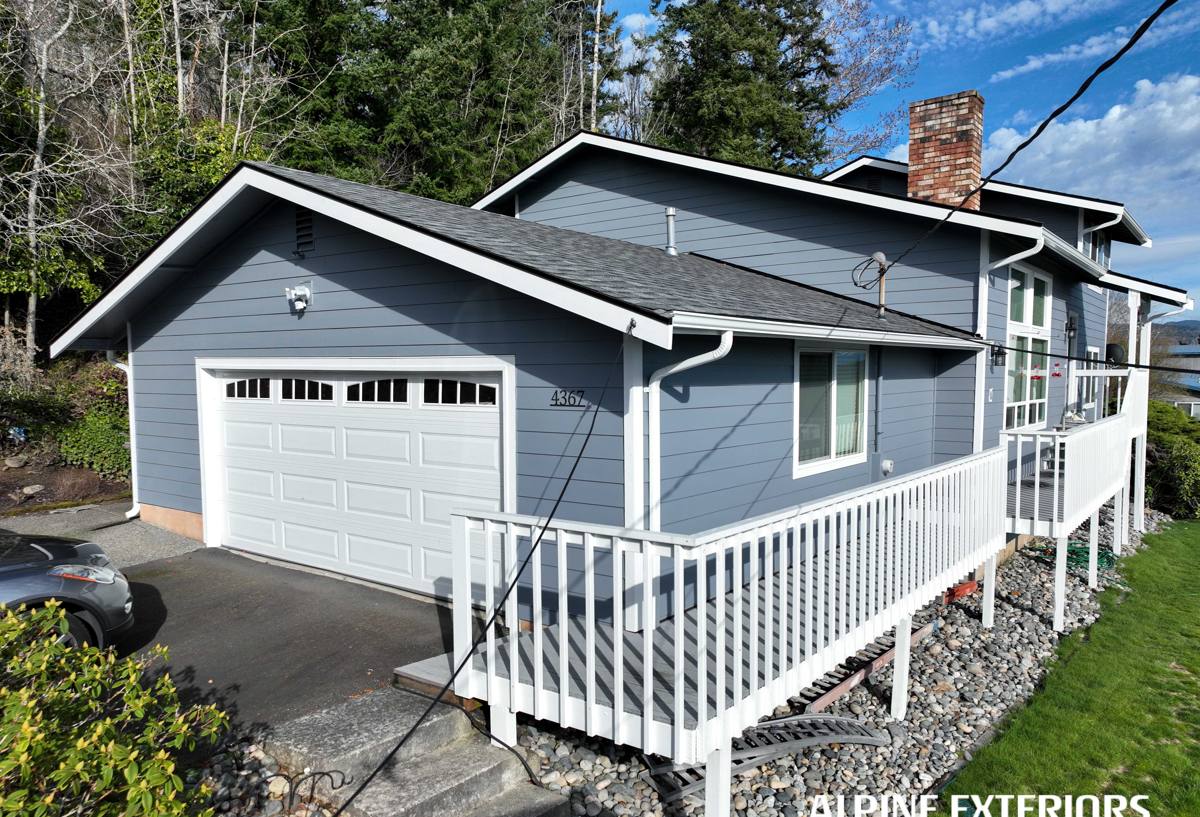
Signs a California Creek Roof Needs Repair Now
Most roof damage out here doesn't announce itself with a dramatic leak. It shows up as small clues that get worse over a wet season if nobody looks closely.
- Dark streaking or green-black growth on north- or shade-facing slopes — early moss and algae, not just cosmetic staining
- Granules collecting in gutters or at downspout outlets — a sign the shingle surface is wearing thin
- Rust-colored streaks below nail heads, vent boots, or metal flashing — the beginning of salt-air corrosion
- Soft or spongy spots underfoot near valleys, chimneys, or skylights
- Curling, cracked, or lifted shingle edges, especially where moss has taken hold
- Water stains on interior ceilings that only appear during wind-driven storms, not steady rain
- Daylight visible around a vent pipe or chimney from inside the attic
Any one of these on its own might be a small, inexpensive fix. Several at once usually means the roof is telling you it needs attention before the next big coastal storm turns a small leak into a ceiling repair.
Why Wind-Driven Storm Leaks Are Different
A roof that never leaks in a calm rain but leaks during a windstorm almost always has a flashing or lap problem, not a worn-out field of shingles. Driving rain gets pushed sideways and even slightly uphill under shingle edges, through hairline gaps in step flashing, and around pipe boots that have shrunk with age. Chasing that kind of leak means tracing water back to its actual entry point, which is often several feet from the ceiling stain — a detail that matters a lot when you're deciding what to repair.
What a Correct Roof Repair Actually Involves
A repair that holds up in this climate goes beyond swapping a few shingles. We treat every repair call as three separate questions: what's failing, why it's failing here specifically, and what needs to change so it doesn't fail again in the same spot.
Diagnosis Before Anything Gets Touched
We start on the roof surface and in the attic if it's accessible. Attic-side inspection often tells us more than the surface does — moisture staining on the underside of the decking, rusted nail tips, or damp insulation point straight to the source, even when the roof looks fine from the ground.
Moss and Growth Removal Done the Right Way
Moss has to come off without tearing up the shingle mat underneath it, which means hand removal and low-pressure rinsing rather than pressure-washing the roof. Pressure washing strips granules and shortens the life of an otherwise sound roof — it trades a short-term clean look for real long-term damage. We treat the cleared area to slow regrowth and check underneath for any shingle damage the moss was hiding.
Flashing, Boots, and Penetrations
Flashing around chimneys, skylights, and sidewalls is where most coastal leaks originate. We re-bed or replace corroded step flashing, reseal counterflashing, and swap out cracked or UV-brittled pipe boots — a five-dollar part that causes a disproportionate share of attic leaks once it dries out and splits.
Fasteners and Metal Components
Standard fasteners corrode faster this close to the water. We use corrosion-resistant fasteners and flashing metals suited to salt air exposure, and we replace any hardware we find already showing rust rather than leaving it for the next repair call.
Ventilation Check
Poor attic ventilation traps moisture that condenses on the underside of the roof deck, which looks and behaves like a leak but isn't one. Since moss and rot both thrive on trapped moisture, we check ridge and soffit venting as part of any repair, because fixing the leak without fixing the airflow just invites the same problem back.
Salt Air, Fastener Corrosion, and Material Choices
Not every material or fastener performs the same way this close to the coast. Choosing the wrong one on a repair doesn't fail today — it fails in three or four years, right when you thought the problem was solved.
| Component | Standard-Grade Option | Coastal-Grade Option | Why It Matters at California Creek |
|---|---|---|---|
| Roofing nails/fasteners | Electro-galvanized | Hot-dipped galvanized or stainless | Salt air breaks down electro-galvanized coating faster, leading to early rust and nail pop |
| Flashing metal | Mill-finish aluminum | Painted or coated aluminum, or stainless | Bare aluminum pits and corrodes faster in salt-laden air near the water |
| Pipe boots | Standard rubber | UV- and weather-rated rubber or silicone | Standard rubber cracks sooner under this region's sun/rain cycling |
| Underlayment | Standard felt | Synthetic or self-adhering ice-and-water membrane at valleys/eaves | Better resistance to prolonged moisture exposure during long wet stretches |
We don't push premium materials on every repair — a small, isolated fix doesn't always need the upgraded version of everything. But where a component sits in a spot that takes direct salt spray, standing water, or heavy wind-driven rain, we'll tell you honestly when the coastal-grade option is worth the difference, and when the standard option is genuinely fine.
Our Repair Process, Step by Step
- Inspection and honest assessment — roof surface, flashing, penetrations, and attic where accessible, with photos of what we find
- Written scope and price — what's being repaired, what materials we're using, and why, before any work starts
- Site protection — landscaping, gutters, and walkways protected before we touch the roof
- Repair work — moss/debris removal, flashing and boot replacement, shingle repair or replacement, fastener upgrades where needed
- Leak-path verification — checking that the actual water entry point was addressed, not just the visible symptom
- Cleanup and walkthrough — ground and gutters cleared, work explained, and any follow-up maintenance noted
We don't upsell a full replacement when a repair will genuinely hold. We also won't tell you a patch will last if what we're actually looking at is a roof past the point where repair makes financial sense — you'll get a straight answer either way.
Repair vs. Replace: How to Think About It
This is the question every homeowner asks, and the honest answer depends on more than the roof's age.
| Factor | Leans Toward Repair | Leans Toward Replacement |
|---|---|---|
| Age of roof | Under 12-15 years | Approaching or past manufacturer lifespan |
| Extent of damage | Isolated to one area (valley, flashing, one slope) | Widespread across multiple slopes |
| Granule loss | Minor, localized | Significant, roof-wide |
| Decking condition | Solid, no soft spots found | Soft or rotted decking discovered |
| Repair history | First or second repair call | Repeated repairs to the same areas |
| Moss/algae extent | Surface growth, shingles intact underneath | Growth has lifted or degraded shingles broadly |
A roof with a single failed flashing detail and otherwise sound shingles is a straightforward, worthwhile repair. A roof where we're finding soft decking in the attic and moss damage on three different slopes is telling you the repairs are about to become a pattern rather than a one-time fix.
Why a Crew That Already Works California Creek Matters
A roofer who mainly works drier, inland areas can still do competent general roofing work, but they may not default to salt-air fastener choices, may not know which flashing details fail first this close to the water, or may treat moss as a one-time cleaning job rather than an ongoing seasonal factor. A crew that regularly works this specific stretch of the Whatcom County coastline has already seen which repair shortcuts don't hold up here and which ones do — that's not a marketing claim, it's just what repeated exposure to the same climate teaches you.
It also means faster, more accurate diagnosis. When you already know what a California Creek roof's failure points tend to look like, you spend less of the homeowner's money chasing the wrong cause.
After the Repair: Keeping It From Coming Back
A good repair buys you time, but this climate doesn't stop working on your roof once we leave. A little seasonal attention keeps a repair from turning into a repeat call.
- Keep gutters and downspouts clear so water isn't backing up under the eaves during heavy rain
- Trim back branches that shade roof sections and slow drying, since shade is what lets moss get a foothold
- Have moss and algae growth addressed early in the season rather than left to spread over winter
- Walk the attic (or have it checked) after major windstorms for new staining, especially near chimneys and skylights
- Don't ignore small granule buildup in gutters — catching it early is cheaper than catching it after a leak
None of this requires major work most years — just enough attention to catch small issues while they're still small, cheap fixes instead of ceiling repairs.
Get a Straight Answer on Your California Creek Roof
If you're seeing moss buildup, rust streaks, or a leak that only shows up in windy storms, it's worth having someone look before another wet season sets in. We'll give you a clear, no-pressure assessment of what's actually going on and what it would take to fix it right — use the form below to request a free estimate.