 Blaine Siding
 Decks in Grandview Face a Different Set of Problems Than Decks Inland
Grandview sits close enough to the water and the weather patterns that roll through Whatcom County that a deck built here has to deal with things a deck in a drier, inland climate never sees. Salt-laden air corrodes hardware faster. Driving rain finds its way into joints and connections that would stay dry somewhere else. And the long stretch of wet, low-sun months every year turns any shaded or north-facing deck surface into a moss farm if it isn't built and maintained with that in mind.
None of this means a deck can't last for decades in Grandview. It means the material choices, the fastener choices, and the small construction details matter more here than they would in a lot of other places. This page walks through what we actually look at when we design and build a custom deck for a home in this area, and why it's worth working with a crew that already knows the local conditions rather than one applying a generic build spec.
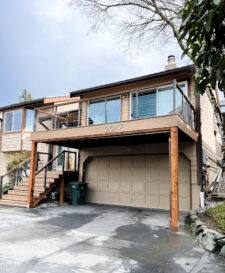
What Salt Air, Driving Rain, and Moss Season Actually Do to a Deck
Salt Air and Hardware
Fasteners, brackets, and connectors that aren't rated for coastal exposure can start showing rust streaks and corrosion within a few seasons in a salt-air environment. Once a fastener starts to corrode, it loses holding strength long before it looks obviously bad, which is part of why so many premature deck failures trace back to hardware rather than the decking boards themselves.
Driving Rain and Water Intrusion
Wind-driven rain doesn't fall straight down — it gets pushed sideways into ledger connections, under railing posts, and into any gap where flashing is missing or was installed as an afterthought. Water that gets behind a ledger board or into an unprotected joist end doesn't dry out quickly in our climate, and that's where rot gets started long before it's visible from the surface.
Moss Season
Grandview gets the same extended damp, low-light stretch as the rest of Blaine and Whatcom County, and moss doesn't need much encouragement to take hold on a shaded deck surface. Beyond the appearance issue, moss holds moisture against the decking material and creates a genuinely slick, dangerous walking surface, especially on stairs.
Choosing the Right Decking Material for a Grandview Property
There's no single "best" decking material — the right choice depends on the deck's exposure, how much upkeep the homeowner wants to do, and budget. Here's how the common options compare for this specific climate:
| Material | Moisture & Rot Resistance | Moss/Algae Resistance | Maintenance | Typical Lifespan |
|---|---|---|---|---|
| Pressure-treated wood | Good if properly sealed and maintained | Low — needs regular cleaning and treatment | High — annual cleaning, periodic sealing | 10–15 years |
| Cedar | Naturally decay-resistant, but surface needs upkeep | Moderate — still needs cleaning in shaded areas | Moderate to high | 15–20 years |
| Composite decking | Very good — won't rot or absorb water like wood | Moderate — algae/moss can still grow on the surface film | Low — periodic washing | 25–30+ years |
| PVC/capped polymer decking | Excellent — fully sealed surface | Good — least hospitable surface for growth | Low | 25–30+ years |
We're generally cautious about recommending uncapped wood-composite blends for shaded, north-facing decks in this area — the moisture-retaining core behind an older-style composite can be a liability in a climate that stays damp this long each year. That's a maintenance and moisture-behavior judgment on our part, not a knock on any manufacturer; it's simply a trade-off worth knowing about before you commit to a product for a spot that doesn't get much sun or airflow.
What a Correctly Built Deck Requires in This Climate
A deck that's going to hold up under Blaine's coastal weather needs more than good-looking boards on top. The details that matter most are mostly invisible once the project is finished:
- Ledger board flashing installed correctly against the house, not just caulked over — this is the single most common source of hidden rot on attached decks
- Joist tape or a comparable protective barrier on top of every joist, so fasteners don't create a direct path for water into the wood
- Stainless steel or coated, corrosion-rated fasteners and structural hardware throughout — not standard galvanized, which corrodes faster in salt air
- Footings set to the frost and load depth required by local code, not just "deep enough to look right"
- Proper drainage and grading underneath the deck so water doesn't pool against posts or footings
- Adequate gaps between boards and enough clearance underneath for airflow, so the structure can actually dry out between rain events
- Railing posts through-bolted into the framing, not just lag-screwed into a rim board
Skipping any one of these doesn't usually show up as a problem in year one. It shows up in year five or six, as soft spots, rust staining, or a railing post that's started to wobble — by which point the fix is a lot more invasive than it would have been to do it right the first time.
Our Process for a Grandview Deck Project
Site Visit and Assessment
We start by looking at the actual conditions on your property — how much sun and shade the deck area gets, which direction the prevailing rain and wind come from, drainage patterns, and what the existing structure (if there is one) tells us about how the last deck held up or didn't.
Design and Material Selection
We walk through the material comparison above in the context of your specific site and budget, and help you land on a decking, railing, and hardware package that fits how the space will actually be used and exposed.
Permitting
Deck projects in Whatcom County typically require a building permit once they pass a certain height or size threshold, and setback rules apply depending on your lot. We handle the permit application and inspections as part of the project so you're not left figuring that out on your own.
Construction
We build the structural elements first — footings, framing, ledger flashing, joist protection — and get those inspected before decking goes down. This is the order that lets a deck actually last, rather than covering up shortcuts under finished boards.
Final Walkthrough
Before we call the job done, we walk the finished deck with you, check railings and stairs for solid connections, and go over basic care so you know what to expect from the material you chose.
Railings, Fasteners, and Hardware Built for Coastal Exposure
Railings take a lot of abuse in a marine climate — they're exposed on all sides, they're handled constantly, and any weak connection there is a safety issue, not just a cosmetic one. We use corrosion-resistant fasteners and connectors rated for coastal or marine-grade exposure on railing posts and structural connections, and we through-bolt post connections rather than relying on screws alone. It costs more up front than standard hardware, but it's the difference between a railing that's still solid in ten years and one that's developed play and rust streaks in three.
Living with a Deck Through Whatcom County's Moss Season
Even a well-built deck needs some seasonal attention here. A short, honest maintenance checklist for Grandview homeowners:
- Sweep debris and standing leaves off the deck surface regularly through fall and winter — trapped organic matter is what feeds moss growth
- Clean shaded or north-facing sections at least once a year with a deck-safe cleaner, more often if you notice green or black staining building up
- Check railing posts and stair connections annually for any looseness or rust staining at fastener points
- Keep gutters and downspouts clear so runoff isn't draining directly onto or under the deck
- Reseal wood decking on the manufacturer's recommended schedule — don't wait until it's visibly graying and cracking
- Clear gaps between boards if debris starts to pack in and block drainage and airflow
None of this is a huge time investment, but skipping it for a few years in a row is usually what turns a good deck into a project that needs early repair.
Why It Matters to Hire a Crew That Already Works in Grandview
A contractor who mostly builds decks in a drier inland climate isn't wrong about deck-building in general — but they may not default to marine-grade hardware, may not think through moss-prone shade patterns, or may not know Whatcom County's permitting requirements without extra back-and-forth. Working with a crew that already builds and repairs decks around Blaine means the coastal-specific details — flashing, fastener grade, drainage, moss exposure — are part of the standard plan from the first conversation, not an afterthought added after something fails.
If you're planning a new custom deck in Grandview or thinking about replacing one that hasn't held up well, we're happy to take a look and talk through what makes sense for your specific site. Reach out for a free, no-pressure estimate using the form below.