 Blaine Siding
 Why Sandy Point Decks Wear Out Faster Than Most
Sandy Point sits right up against the water, and that location is exactly what makes deck replacement here a different job than a deck replacement three miles inland. Salt-laden air off the water accelerates corrosion on anything metal — nails, screws, joist hangers, bolts — long before the wood itself gives out. Add in the driving, wind-blown rain that comes through this part of Whatcom County for much of the year, and you get moisture finding its way into joints and end grain that a more sheltered deck would never see.
Then there's moss. Shaded, north-facing, or low-to-the-ground sections of a deck in this climate can grow a slick green film within a single wet season if they aren't detailed to shed water and dry out between rains. Moss doesn't just look bad — it holds moisture against the wood surface and turns a simple resurfacing job into a rot problem underneath. Homes in and around Blaine deal with this to some degree, but Sandy Point's direct waterfront exposure pushes all three factors — salt, rain, and moss — to the extreme end.
None of this means a deck here can't last. It means the replacement has to be built with those conditions assumed from day one, not bolted on as an afterthought.
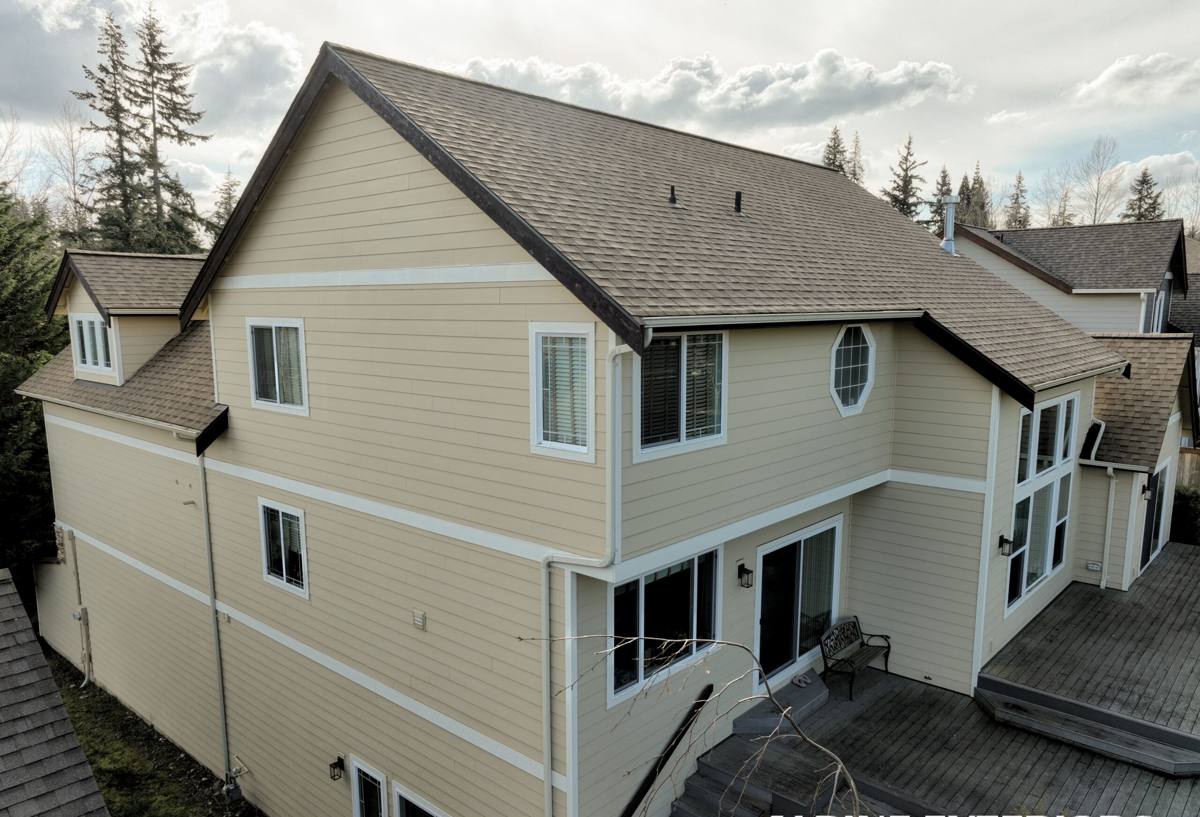
What "Replacement" Actually Includes
A lot of deck jobs sold as "replacement" are really just new boards screwed onto old framing. That can work if the structure underneath is genuinely sound, but on a waterfront deck that's rarely the case once you actually get the old decking off and look. A proper replacement means evaluating — and where needed, rebuilding — everything the walking surface sits on.
Ledger Board and Flashing
The ledger board, where the deck attaches to the house, is the single most common failure point on any deck and the most consequential one near salt air. Water that gets behind a poorly flashed ledger doesn't just rot the ledger — it can work its way into the house band board and framing. A correct replacement uses proper flashing (not just caulk) between the ledger and the siding or sheathing, with the flashing detailed to shed water away from the house, not into it.
Footings and Posts
Footing depth and bearing need to match the soil conditions on the lot, which can vary quite a bit close to the water compared to a typical inland Blaine yard. Posts should be set on proper post bases that hold the wood up off the concrete rather than buried or set directly on grade — a detail that matters even more here, where ground moisture stays elevated for long stretches of the year.
Framing and Hardware
Joists, beams, and the hardware connecting them all get evaluated for both structural adequacy and material choice. This is where a lot of "cheap" deck replacements quietly cut corners, using standard coated fasteners instead of hardware actually rated for coastal or high-moisture exposure. It costs more up front and it's the difference between hardware that's still solid in ten years and hardware that's rusting through in three.
Choosing Decking Material for This Climate
There isn't one "correct" decking material for every Sandy Point home — it depends on budget, how much maintenance you want to do, and how the deck will be used. What matters is picking with your eyes open about how each option actually behaves in salt air and near-constant moisture, not just how it looks on day one.
| Material | How it holds up here | Maintenance burden |
|---|---|---|
| Pressure-treated wood | Affordable, but end grain and fastener holes need vigilant sealing; moss and mildew show up quickly in shaded areas | High — annual cleaning and periodic re-sealing |
| Cedar | Naturally more rot- and insect-resistant than treated pine, but still needs finish maintenance to fight graying and moisture uptake near the water | Moderate to high |
| Composite decking | Doesn't absorb moisture the way wood does, resists rot, but surface can still support moss/algae growth if not cleaned; quality varies a lot by brand and tier | Low — periodic washing |
| PVC decking | Fully synthetic, essentially immune to rot and moisture damage, holds color well in salt air, best option for minimal upkeep | Lowest |
We'll walk you through the honest trade-offs — including upfront cost versus what you'll spend on maintenance or repairs over ten years — rather than steering you toward whatever happens to be easiest for us to install.
Fasteners and Hardware: Not the Place to Save Money
This is worth calling out on its own because it's the most common shortcut we see on older Sandy Point decks that are failing early. Standard galvanized fasteners can start showing surface corrosion within a few years this close to the water. Stainless steel fasteners and connectors, or hardware specifically rated for coastal and treated-lumber exposure, cost more per piece but are a small fraction of the total project cost — and they're nearly impossible to replace later without tearing the deck apart again. On a waterfront rebuild, this is one of the few places where spending a little more up front is simply the correct call, not an upsell.
Railings, Stairs, and Code Requirements
Deck replacement in Blaine and unincorporated Whatcom County typically requires a building permit, and railings and stairs are where inspectors focus the most attention because they're the safety-critical parts of the structure. Current code generally requires guardrails at a set minimum height once a deck is a certain distance above grade, baluster spacing tight enough that a small child couldn't pass through, and stair rise-and-run dimensions kept consistent step to step. Requirements can shift with code updates, so we confirm current specifics with the local building department as part of planning your project rather than relying on what was standard when the old deck went in.
For a waterfront property, we also pay attention to how railings and stair stringers are fastened and flashed, since these lower, more exposed components tend to take the brunt of wind-driven rain and salt spray.
Our Deck Replacement Process
- On-site evaluation. We inspect the existing deck, ledger connection, framing, and footings to see what's actually salvageable versus what needs to come out.
- Plan and material selection. We walk through decking, railing, and hardware options with honest cost and maintenance trade-offs for your specific situation.
- Permitting. We handle the permit application and coordinate required inspections with the local building department.
- Removal. Old decking, and any framing that doesn't meet current structural or moisture-protection standards, comes out.
- Rebuild. Ledger flashing, footings, framing, decking, and railings go in to current code, with coastal-appropriate hardware throughout.
- Final inspection and walkthrough. We confirm the work passes inspection and walk the finished deck with you before calling the job done.
Keeping a New Deck Healthy in Sandy Point's Climate
A well-built deck still needs some seasonal attention in this environment. A few habits go a long way toward protecting the investment:
- Sweep debris off the deck surface regularly, especially in fall — trapped leaves hold moisture and speed up moss growth
- Rinse salt residue off the surface and railings a few times a year, particularly after storms
- Keep gutters and downspouts near the deck clear so runoff isn't draining directly onto or under it
- Check for moss buildup on shaded boards each spring and clean it before it gets established
- Inspect the ledger flashing and any visible fasteners annually for early signs of corrosion or water staining
- For wood decks, re-seal or re-stain on the schedule recommended for the product, not just when it looks worn
Why It Matters to Hire a Crew That Already Works in Sandy Point
A deck replacement crew that's worked in this neighborhood before isn't guessing about how salt air and driving rain treat a deck over time — they've seen it firsthand on other homes nearby. That experience shows up in the small decisions: which fasteners actually hold up, where moss tends to establish first, how a ledger connection needs to be detailed on a house this close to the water. It also means fewer surprises with permitting and site access, since a crew familiar with the area already knows what the local building department expects and how to plan material delivery and staging for a waterfront lot.
For a homeowner, that translates into a deck that's built right the first time, instead of one that needs early repairs because it was built the same way a contractor would build one twenty miles inland.
If your deck is showing its age — soft spots, rusting hardware, moss that won't quit, or a railing that doesn't feel as solid as it used to — we're happy to take a look and give you a straightforward, no-pressure estimate. Use the form below to get started.