 Blaine Siding
 Everson's Climate Is Harder on Siding Than It Looks
Everson sits inland from the water, but it doesn't escape the weather pattern that defines this corner of Whatcom County. Moisture-laden air moves through the region for much of the year, driving rain comes in sideways more often than most homeowners expect, and the shoulder seasons bring a stretch of damp, low-sun weeks that turn north-facing walls and shaded trim into a moss farm if the siding underneath isn't built to resist it. None of that is dramatic on its own. What it does, year after year, is find every weak seam, every unsealed joint, and every spot where the wrong material was used in the wrong place — and it works on those weak points quietly until a homeowner notices soft spots, peeling paint, or a utility bill that's crept up for no obvious reason.
Siding in this part of western Washington isn't just a cosmetic layer. It's the first line of defense against a climate that stays damp for long stretches and rarely gives a wall enough dry time to fully recover between storms. That's the lens we bring to every fiber cement job we do in Everson: not "what looks good today," but "what's still doing its job in fifteen years."
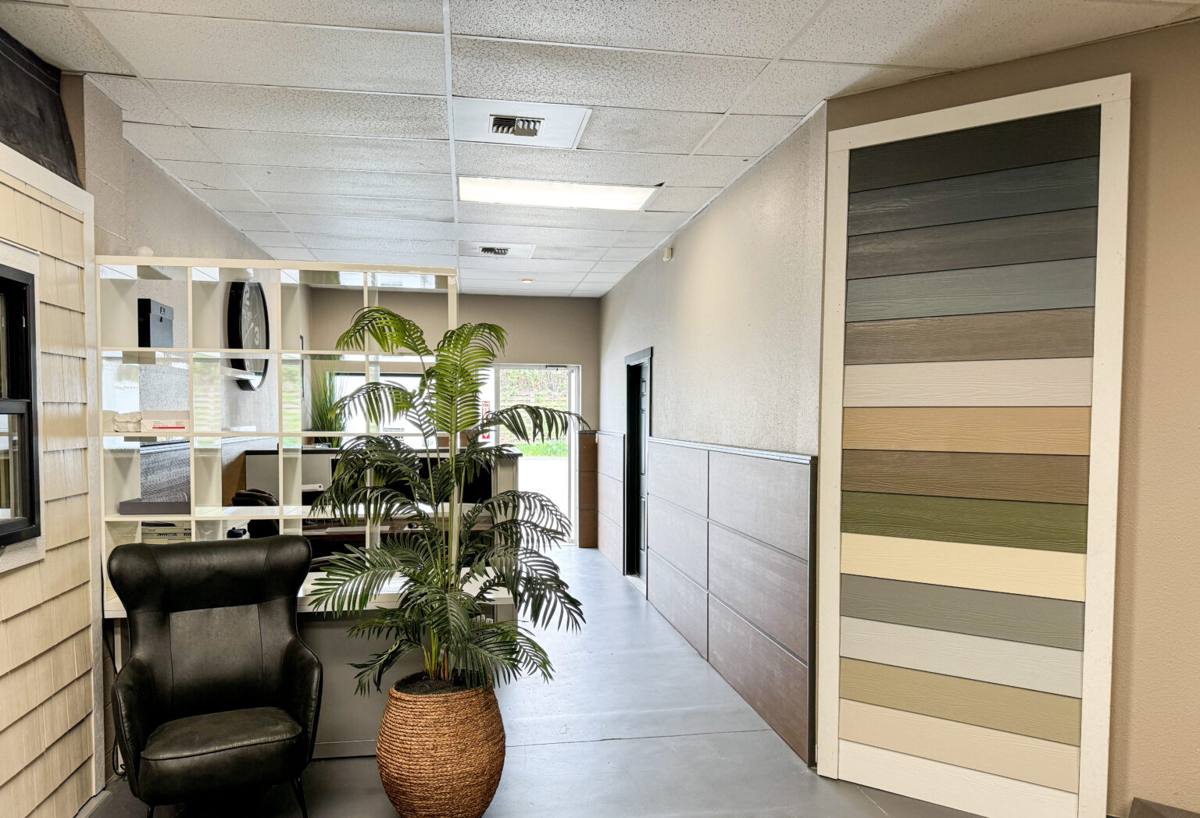
Why Fiber Cement Is the Right Category of Siding Here
Fiber cement siding is made from a mix of Portland cement, sand, and cellulose fibers, pressed and cured into dense, dimensionally stable boards and panels. Unlike wood, it doesn't rot or feed the moss and mildew that thrive in Whatcom County's damp months. Unlike vinyl, it doesn't warp, buckle, or go brittle across our range of summer heat and winter cold. And unlike either of those, it holds a factory finish well enough that repainting isn't something you plan for every few years.
That combination — a non-combustible core, real dimensional stability, and a finish that actually stays put — is why fiber cement has become the standard replacement material for homeowners in this region who are done fighting their siding every wet season.
Why We Only Install James Hardie
Fiber cement is a category, not a single product, and the quality gap between brands is real. We install James Hardie exclusively — not because it's the only fiber cement on the market, but because it's the one we trust to hold up under our specific conditions and to back that performance with a warranty that actually transfers if the home sells. Hardie's ColorPlus factory finish is baked on and warranted separately from the substrate, its HZ product lines are engineered for specific climate zones rather than sold as one-size-fits-all, and its manufacturing consistency means we're not troubleshooting board-to-board variation on install day. When we put our name behind a siding job, we want the product underneath it to be one we don't have to make excuses for later.
Signs an Everson Home's Siding Is Losing the Fight
Most siding failures don't show up as a single dramatic event — they show up as a pattern of small symptoms that add up. Before we ever recommend a full replacement, we look for signs like these:
- Paint that's bubbling, peeling, or chalking heavily, especially on north- and west-facing walls
- Soft or spongy spots when you press on the siding, a sign moisture has gotten behind it
- Persistent moss, algae, or dark streaking that comes back within a season of cleaning
- Visible gaps, warping, or cupping at board seams and corners
- Cracked or missing caulk at trim, window, and door edges
- Rising heating bills without a clear cause, which can point to a compromised weather barrier
- Siding that's original to a home built before engineered moisture barriers were standard
Any one of these can be a minor repair. Several at once, especially on a home that's due for a facelift anyway, usually means it's time to talk about a full re-side rather than another round of patching.
What a Correct Fiber Cement Installation Actually Involves
Fiber cement is only as good as the installation underneath it. Most of the siding failures we get called out to inspect in this region aren't material failures at all — they're installation shortcuts that let moisture in behind a product that was otherwise sound.
Moisture Management Comes First
Before a single board goes up, the wall needs a continuous weather-resistive barrier, correctly lapped and taped at seams, with flashing installed at every window, door, and horizontal transition so water is directed out and down rather than trapped behind the cladding. In a climate that gives walls as little dry time as ours does, this layer matters more than the siding itself — it's the difference between a house that sheds a rainstorm and one that slowly absorbs it.
Fastening and Clearances
Hardie's installation specifications call for specific nailing patterns, fastener types, and minimum clearances — ground clearance, roofline clearance, and gaps at abutting trim and decks — that exist for a reason: they let the material move slightly with temperature and humidity without cracking, and they keep splash-back moisture from wicking into the bottom edge of the boards. Skipping these clearances to save a little material or time is one of the most common ways we see fiber cement siding fail early, and it's avoidable with a crew that follows spec rather than working from habit.
Joints, Caulk, and the Factory Finish
ColorPlus-finished boards are designed to minimize field painting, but joints, cut ends, and trim transitions still need to be sealed with a compatible sealant and, where cut, treated with touch-up product to protect the exposed edge. Getting this step right is what keeps a wall from developing the hairline moisture entry points that show up as staining or soft spots a few years down the road.
How Fiber Cement Stacks Up Against Other Siding Materials
Homeowners comparing options often ask us to lay out the trade-offs plainly. Here's the honest version, based on what each material actually asks of a homeowner over time — not marketing claims.
| Material | Moisture Performance | Ongoing Maintenance | Our Take |
|---|---|---|---|
| James Hardie fiber cement | Strong when installed to spec; won't rot | Occasional rinse and caulk checks; no repainting cycle with ColorPlus | What we install and stand behind |
| Vinyl | Sheds water but can trap moisture behind it; warps under heat | Low, but limited repair options if damaged | Not something we install; appearance and repairability trade-offs concern us |
| Engineered wood (e.g., LP SmartSide) | Treated to resist moisture, but wood-based core remains sensitive to prolonged wet exposure | Requires attentive caulk and paint upkeep in wet climates | We've chosen not to install it; the maintenance margin is thinner than we're comfortable with here |
| Cedar / untreated wood | Naturally attractive but vulnerable to rot and moss in constant damp conditions | Highest — regular staining, sealing, and moss treatment | Beautiful when brand new; the upkeep in this climate is significant |
None of this is a knock on any manufacturer. It's the reason our crew standardized on one product system we can install correctly, warranty confidently, and be honest with homeowners about — rather than juggling several products with different moisture behavior and different failure points.
Choosing Between Hardie's HZ5 and HZ10 Product Lines
James Hardie engineers its siding for different climate zones rather than selling one national product. The two lines relevant to western Washington are HZ5, built for regions with moderate freeze-thaw cycling, and HZ10, engineered specifically for consistently wet, humid climates like ours. The difference isn't cosmetic — it's in the formulation that governs how the board handles sustained moisture exposure over its lifespan.
| Factor | HZ5 | HZ10 |
|---|---|---|
| Designed for | Moderate freeze-thaw climates | Consistently wet, high-humidity climates |
| Typical fit | Drier interior regions | Western Washington, including Whatcom County |
| What it addresses | Freeze-thaw cycling stress | Sustained moisture exposure and humidity |
For a home in Everson, HZ10 is almost always the right call, and it's what we spec by default for jobs in this service area unless a specific wall condition points elsewhere.
Our Process, Start to Finish
Assessment and Measurement
We start by walking the exterior, checking for the failure signs listed above, and identifying any areas where the existing weather barrier or framing needs attention before new siding goes on. This is also when we talk through color, board profile, and which HZ line fits the home.
Tear-Off and Prep
Old siding comes off, and we inspect the sheathing underneath for hidden rot or water damage before it gets covered up again — this is often the point where a homeowner learns whether a past problem was ever actually fixed. Any needed repairs happen here, not after the new siding is already up.
Weather Barrier and Flashing
A new, continuous weather-resistive barrier goes on with correctly lapped seams and flashing at every penetration and transition. This step gets more attention from us than almost any other, because it's the one that determines how the wall performs in ten years, not just how it looks on install day.
Installation
Boards go up to Hardie's fastening spec, with the clearances and joint treatment described earlier. We don't shortcut clearances to save material, and we don't leave cut ends untreated.
Final Walkthrough
We walk the finished job with the homeowner, point out anything worth knowing for future maintenance, and make sure the site is cleaned up before we call it done.
Why It Matters That We Already Work in Everson
A crew that already works this part of Whatcom County isn't guessing about how a wall will hold up here — we've seen how the local moisture pattern plays out on real homes, which orientations take the worst of the driving rain, and which details tend to get skipped by crews used to drier climates. That local pattern recognition shows up in small decisions on every job: where we add extra attention to flashing, which HZ line we default to, and what we flag during the walkthrough as worth watching. It also means faster response if a question comes up after the job is done, rather than chasing down a crew that worked the area once and moved on.
What Maintenance Looks Like After Installation
Correctly installed Hardie siding is low-maintenance, not no-maintenance. A yearly rinse-down knocks back the moss and grime that our damp seasons encourage. Caulked joints and trim edges are worth a visual check every year or two, since caulk is the one component that ages faster than the siding itself. Keeping gutters clear also matters more here than in drier climates — overflow and splash-back are two of the most common ways moisture gets a second chance to find a weak spot in an otherwise sound wall.
If your Everson home's siding is showing any of the signs above, or you're simply due for a straightforward, honest assessment, we're happy to take a look. There's no pressure and no sales script — just a clear read on where things stand and what your options actually are, backed by a free estimate through the form below.