 Blaine Siding
 Everson's Climate Is Harder on Siding Than Most Homeowners Realize
Everson sits inland from the water, but that doesn't mean the house is protected from what Whatcom County's weather does to exterior materials year after year. Moist marine air pushes in off the Salish Sea and settles across the county for much of the fall, winter, and spring, keeping wood and wood-composite siding damp far longer than most manufacturers ever tested for. Add driving rain that comes in sideways during winter storms and a moss season that can stretch six months or more on shaded, north-facing walls, and you have a climate that punishes any siding product not engineered for sustained moisture exposure.
This isn't a cosmetic problem. Siding that stays wet develops soft spots, lets moisture track behind the cladding at seams and fastener points, and eventually feeds rot into the sheathing and framing underneath. By the time paint is peeling or boards are visibly warped, the damage underneath is usually already done. A siding system for an Everson home needs to shed water fast, resist the moss and mildew that thrive in constant shade and dampness, and hold its finish without needing repainting every few years.
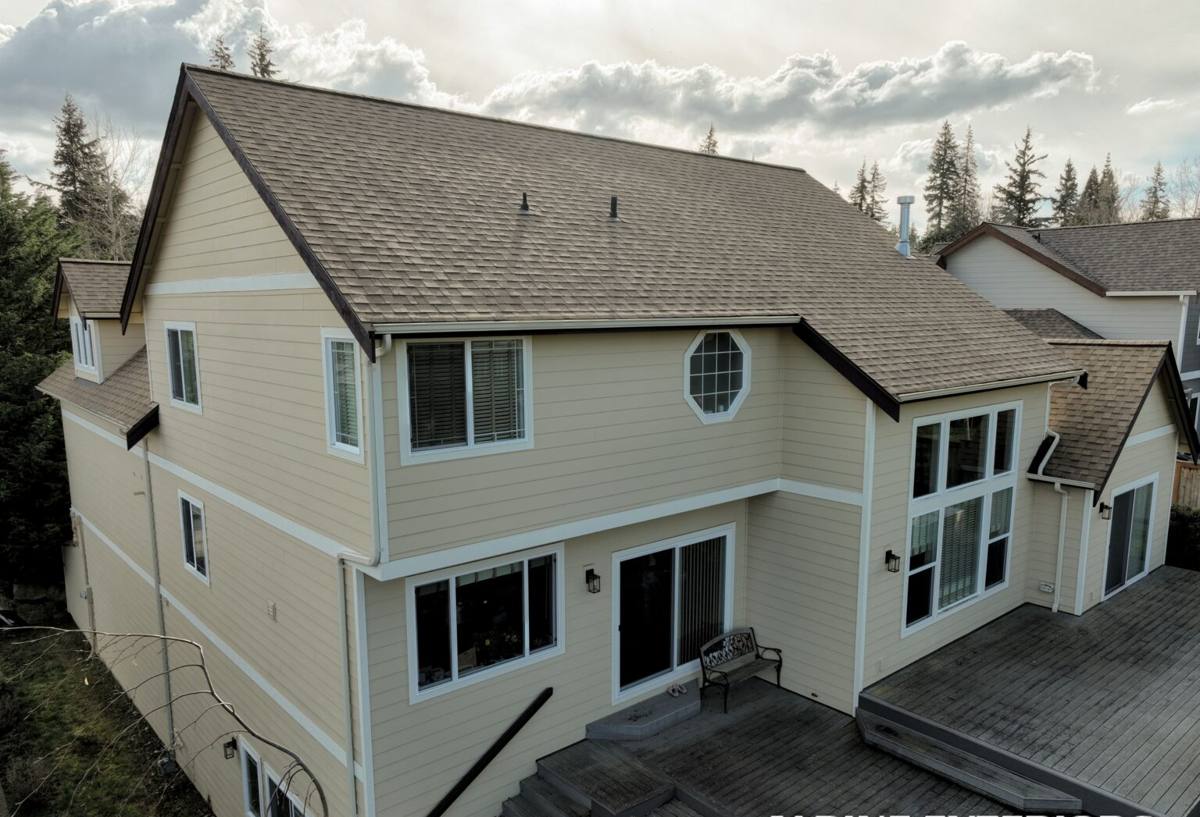
Why We Install Only James Hardie Fiber Cement
We don't offer vinyl, LP SmartSide, cedar, or primed spruce siding, and that's a deliberate standard, not a lack of options. Vinyl expands and contracts with temperature swings and can crack in a hard freeze; it also traps moisture behind it if installed too tight. Wood-based products, including engineered wood siding, rely on a factory coating and careful field sealing of every cut edge to keep water out — miss one edge in a climate like this and moisture gets in before anyone notices. Cedar and primed spruce need ongoing painting and caulking to perform at all.
James Hardie fiber cement siding is made from cement, sand, and cellulose fibers. It doesn't absorb water the way wood does, it won't rot, and it's non-combustible. The ColorPlus factory finish is baked on rather than field-applied, which matters in a climate where a homeowner might otherwise be looking at repainting every five to seven years. For a house that has to shrug off six months of damp shade every year, that's the difference between a wall system that ages well and one that's fighting the weather from day one.
What a Correct James Hardie Installation Actually Involves
The Details That Separate a Good Job From a Bad One
James Hardie siding is only as good as the installation behind it. The manufacturer's own installation instructions are specific, and skipping steps is the single biggest reason any fiber cement job underperforms. On every Everson project our crew follows the same non-negotiable sequence:
- Correct water-resistive barrier and flashing at every window, door, and penetration, lapped so water always sheds outward and down
- Proper drainage plane behind the siding so any moisture that does get past the cladding has somewhere to go
- Manufacturer-specified fastener type, spacing, and placement — over-driven or under-driven nails are a common source of early failure
- Correct clearance between the bottom of the siding and grade, decks, patios, and roof lines so splash-back and standing water can't wick into the material
- Sealed and primed field-cut edges wherever a factory edge isn't used
- Butt joints and seams treated exactly to spec rather than just caulked and hoped for
None of this is visible once the job is finished and painted, which is exactly why it matters who's doing the work. A siding job can look identical to a homeowner walking up the driveway while one house is set up to last decades and the other is set up to fail behind the wall in five years.
Trim, Corners, and Transitions
Everson homes vary in age and style, and the trim details around windows, corners, and roof transitions are usually where a rushed job shows up first. We match trim profiles to the house rather than defaulting to whatever's fastest to install, and we pay particular attention to any horizontal trim or window sill that would otherwise collect standing water during a long winter storm.
Choosing the Right Hardie Product Line for Your Home
James Hardie makes several distinct product lines, and matching the right one to a specific home and budget is part of doing this correctly rather than just installing whatever's on the truck.
| Product | Best Suited For | What It Offers |
|---|---|---|
| HardiePlank lap siding | Most single-family homes, traditional and farmhouse styles common around Everson | Classic horizontal lap look, widest range of textures and widths |
| HardiePanel vertical siding | Board-and-batten style homes, accent walls, gables | Vertical lines, often paired with lap siding for visual contrast |
| HardieShingle siding | Craftsman and cottage-style homes | Staggered or straight-edge shingle profile without the maintenance of real wood shakes |
| HardieTrim boards | Corners, window and door surrounds, fascia | Matches the siding's durability so trim doesn't fail before the field siding does |
James Hardie also engineers its products by climate zone, and homes in this part of Washington should be specified in the HZ5 product line, which is built for regions with more moisture and freeze-thaw cycling. We spec HZ5 as a baseline for Everson jobs rather than treating it as an upgrade.
James Hardie Compared to the Alternatives
Homeowners often ask us directly why we won't install the other products on the market. Here's the honest, side-by-side version of that conversation.
| Factor | James Hardie Fiber Cement | Vinyl Siding | Wood / Engineered Wood |
|---|---|---|---|
| Moisture resistance | Doesn't absorb water; won't rot | Doesn't absorb water but traps it behind panels if installed tight | Absorbs moisture at cut edges and joints without diligent sealing |
| Repainting needed | Rare — ColorPlus finish is factory-baked | Never painted, but fades and can't be color-matched easily if damaged | Every 5-7 years typically, sooner in constant shade |
| Fire resistance | Non-combustible | Melts and can contribute to fire spread | Combustible |
| Long-term cost | Higher upfront, lower lifetime maintenance | Lowest upfront, ongoing replacement of cracked panels | Moderate upfront, highest ongoing maintenance cost |
None of these products are unsafe or fraudulent — they're simply built around different trade-offs. We standardized on James Hardie because, for the moisture load a Whatcom County exterior wall carries most of the year, it's the product that performs with the least maintenance burden over the life of the house.
Our Process, Start to Finish
- Estimate and inspection — we walk the exterior, check for existing moisture damage, and measure for material
- Product and color selection — choosing the right Hardie line, profile, and ColorPlus finish for the home
- Removal and inspection of the sheathing — any rot or damage found behind the old siding is addressed before new material goes up, not covered over
- Water-resistive barrier and flashing installation — the part of the job that determines whether the house stays dry for the next 30 years
- Siding installation to manufacturer spec — fastening, clearances, and seams done to James Hardie's published instructions
- Trim, caulking, and final detailing
- Final walkthrough — we go over the finished job with the homeowner before calling it done
Every step is documented, and nothing gets closed up or painted over without being checked first. That matters most on the steps a homeowner will never see again once the siding is up.
Why Hiring a Crew That Already Works Everson Matters
Siding installation isn't one-size-fits-all across a county. A crew that regularly works Everson and the surrounding Whatcom County towns has already seen how the local moisture pattern plays out on real homes here — which walls stay shaded and damp longest through the winter, where moss establishes fastest, and how older homes in the area were originally built and flashed. That local pattern recognition shows up in small decisions on the job: extra attention to a north wall that never gets direct sun, or flashing details adjusted for a roofline that channels more runoff than usual.
We're based out of Blaine and work this part of Whatcom County regularly, which also means we're not learning the regional permitting requirements or driving hours out of the way for a warranty callback. A siding job is a long-term investment in the house — it helps to hire a crew that's still going to be local when a question comes up five or ten years down the road.
Maintaining James Hardie Siding in Everson's Climate
Fiber cement siding is low-maintenance, not no-maintenance. A little attention once or twice a year keeps it performing the way it's supposed to for decades.
- Rinse the siding down once or twice a year, focusing on shaded and north-facing walls where moss and mildew build up fastest
- Keep gutters clear so overflow doesn't run down the siding face during heavy winter rain
- Trim back shrubs and trees so foliage isn't holding moisture against the siding
- Check and re-caulk around windows, doors, and trim joints every few years as part of general upkeep
- Inspect the bottom edge of the siding near grade, decks, and patios periodically to confirm clearance hasn't been reduced by mulch, soil buildup, or landscaping changes
- Address any impact damage or chipped edges promptly so the underlying material stays sealed
Warranty and Long-Term Value
James Hardie backs its fiber cement siding with a strong, transferable limited warranty, and the ColorPlus factory finish carries its own separate finish warranty. Because both are tied to correct installation, using a crew that installs to spec isn't just about avoiding early failures — it's what keeps the manufacturer's warranty intact if something ever does need to be addressed down the line. That transferability also matters if the home is sold; documented, correctly installed Hardie siding is a point in the home's favor during a sale, not a maintenance item the next owner inherits.
If you're weighing siding options for a home in Everson, we're happy to take a look and walk you through what your house specifically needs — no pressure, no hard sell. Reach out below for a free estimate.