 Blaine Siding
 Siding Around Lynden Deals With a Different Set of Problems Than Siding Inland
Homes in and around Lynden sit close enough to the water and the Canadian border that they take on a mix of conditions most inland Washington siding never has to handle. Salt-laden air moves in off the Strait of Georgia and Boundary Bay, driving rain comes in sideways during winter storms, and Whatcom County's damp season stretches long enough that moss and algae have months to establish themselves on north-facing walls and shaded trim. None of that is exotic weather — it's just relentless, and it's the reason siding that looks fine going up can fail early if it wasn't built or installed for this specific environment.
Salt air is corrosive to exposed metal fasteners and trim, and it accelerates the breakdown of lower-grade paint films faster than dry inland air does. Driving rain finds every gap in flashing, trim, and caulk joints and pushes water sideways and upward, not just straight down — which means siding details that would be fine in a calmer climate become failure points here. And a long moss season means anything that traps moisture against a wall — poor drainage planes, tight-to-grade siding, shaded corners — stays wet longer and grows organic material that holds even more moisture against the substrate. Fiber cement siding, installed correctly, is built to shrug off all three. Installed poorly, it isn't much better than anything else.
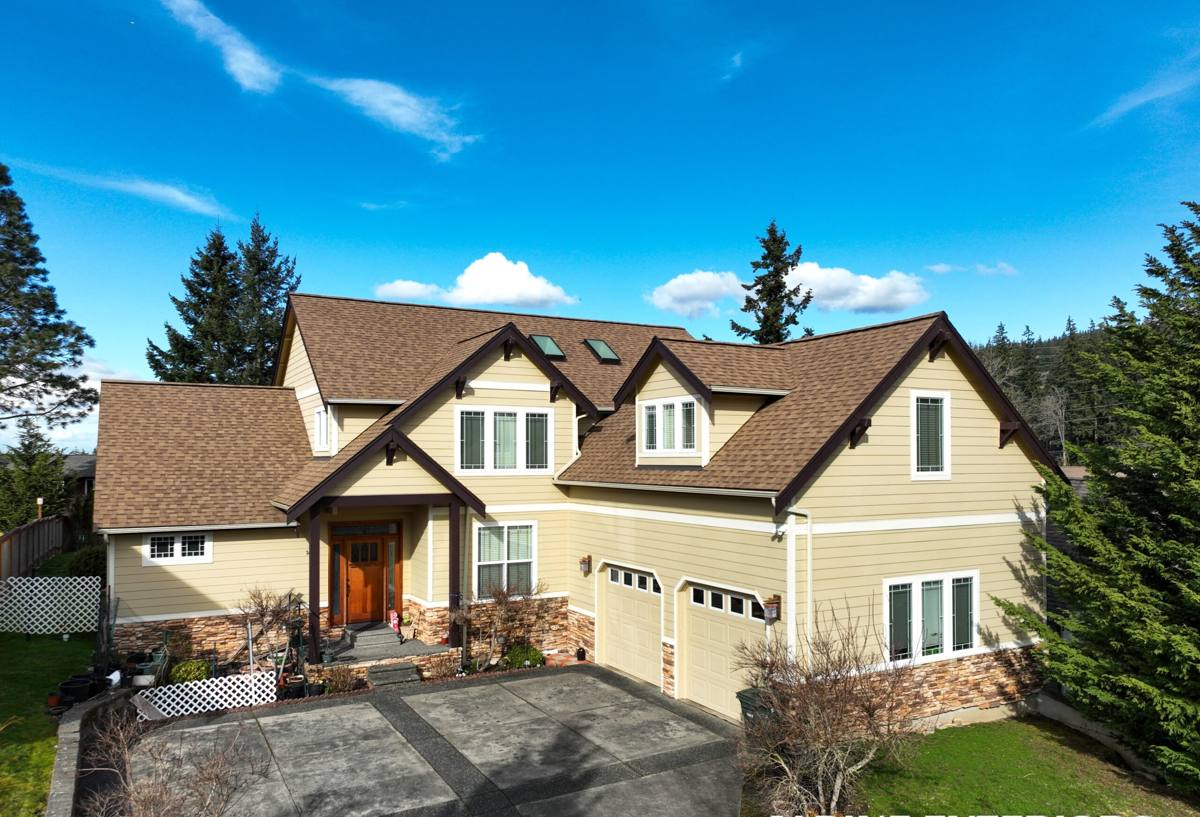
Why Fiber Cement Is the Right Material for This Environment
Fiber cement is a mix of Portland cement, sand, and cellulose fiber, pressed and cured into planks and panels. Unlike wood-based siding products, it doesn't have a wood substrate that can swell, delaminate, or rot when it takes on moisture. Unlike vinyl, it doesn't soften, warp, or become brittle with temperature swings, and it holds a factory finish instead of a thin cap layer that fades and chalks over time. For a coastal, high-moisture climate like Lynden's, that combination — dimensional stability plus a durable finish — is what actually matters.
How It Stacks Up Against the Alternatives
| Material | Moisture Behavior | Fire Resistance | Typical Maintenance |
|---|---|---|---|
| Fiber Cement (James Hardie) | Dimensionally stable; won't swell or rot from moisture exposure | Non-combustible | Occasional wash; repaint cycle much longer than wood |
| Vinyl Siding | Doesn't rot but can warp or crack under temperature stress; seams can let water behind panels | Combustible, can melt/deform near heat | Low, but panels can't be spot-repaired invisibly |
| Engineered Wood (e.g. LP-type products) | Wood-based substrate; sensitive to sustained moisture exposure at cut edges and joints | Combustible | Requires diligent caulk and paint upkeep to protect edges |
| Cedar / Primed Spruce | Natural wood; absorbs and releases moisture, prone to cupping and rot without upkeep | Combustible | Regular refinishing and moisture monitoring |
Every one of these materials has a place somewhere. But for the specific combination of salt exposure, wind-driven rain, and long damp seasons that Lynden-area homes deal with, fiber cement's resistance to moisture-driven failure is the deciding factor for us.
Why We Install Only James Hardie Fiber Cement
Not all fiber cement is engineered the same way, and we've standardized on James Hardie because of how deliberately it's built for exactly this kind of climate.
HZ5 Engineering for the Pacific Northwest
James Hardie manufactures its siding in climate-specific formulations called HZ (HardieZone) products, and the Pacific Northwest falls under the HZ5 designation — engineered for high-moisture, freeze-thaw-capable climates. That's not a marketing label; it affects the actual composition and moisture performance of the board that goes on the wall. Installing a product that was engineered for a wetter, milder climate matters more here than most homeowners realize, because generic fiber cement isn't formulated with the same moisture-cycling resistance.
ColorPlus Factory Finish
Most Hardie products we install come with the ColorPlus finish — a multi-coat, baked-on finish applied under factory conditions rather than a field-applied paint job. In a salt-air climate, this matters because factory-cured finishes bond and cure more consistently than paint applied on-site in variable weather, and they hold color and resist fading and chalking noticeably longer. It also means touch-up paint is matched and available rather than guessed at.
A Warranty Structure Homeowners Can Actually Rely On
James Hardie backs its siding with a long, transferable limited warranty on the product itself, plus separate coverage on the ColorPlus finish. Transferability matters for resale — it's one less thing a buyer's inspector flags. We stand behind our installation work separately, but having a manufacturer warranty that's well-documented and widely recognized gives homeowners a real backstop, not just a promise.
We don't install LP SmartSide, vinyl, Cemplank, Allura, or unfinished cedar and spruce siding. Each of those products has legitimate uses elsewhere, but for the moisture exposure, maintenance expectations, and long-term performance we want to stand behind on homes in this climate, Hardie is what we've chosen to put our name on.
What a Correct Fiber Cement Installation Actually Involves
Fiber cement siding is only as good as the details underneath and around it. Most siding failures we get called out to inspect aren't a problem with the board itself — they're a problem with how it was flashed, fastened, or gapped.
The Details That Matter Most in This Climate
- Clearance from grade and hard surfaces: siding needs a gap above decks, patios, roofs, and soil so it isn't wicking moisture from standing water or splash-back.
- A continuous weather-resistive barrier: a properly lapped house wrap behind the siding is the actual water management layer — the siding is the second line of defense, not the first.
- Flashing at every penetration: windows, doors, hose bibs, light fixtures, and vents all need flashing detailed so wind-driven rain can't track behind the plane.
- Correct fastener placement and depth: over- or under-driven nails compromise both the board and its ability to move slightly with temperature changes.
- Sealed and primed cut edges: any field cut exposes raw material that needs to be primed before it's installed, or it becomes a moisture entry point.
- Proper joint treatment: Hardie's own installation guidance allows for both caulked and gapped-with-flashing joint methods — used correctly rather than mixed sloppily.
Any one of these done wrong can undercut the performance of an otherwise good product. This is where installation quality matters as much as, or more than, brand choice.
Our Process for Lynden-Area Homes
- On-site inspection: we look at your current siding, trim, flashing, and any signs of moisture intrusion or rot before quoting anything, so the estimate reflects your actual wall, not a generic assumption.
- Tear-off and substrate check: once old siding comes off, we check the sheathing and framing underneath for hidden moisture damage, which is common on homes that have had marginal flashing for years.
- Weather barrier and flashing repair: we install or repair the house wrap and flashing at every window, door, and penetration before a single piece of new siding goes up.
- Siding installation to manufacturer spec: fastening, gapping, and joint treatment follow James Hardie's published installation requirements, not shortcuts.
- Trim, caulking, and touch-up: cut edges get primed, joints get treated correctly, and ColorPlus touch-up paint is used where needed so the finish reads as one continuous surface.
- Final walk-through: we go over the finished work with you directly so you know what was done and what to expect from it going forward.
Living With Fiber Cement Siding in a Salt Air, High-Moss Climate
Fiber cement is low-maintenance compared to wood, but "low-maintenance" doesn't mean "no maintenance" — especially this close to the water. A little seasonal attention goes a long way toward getting the full lifespan out of the material.
A Simple Seasonal Maintenance Checklist
- Rinse siding periodically to clear salt film and airborne residue, particularly on walls facing open water or prevailing wind.
- Keep gutters and downspouts clear so overflow isn't running down the siding face during heavy rain.
- Trim back shrubs and trees near shaded or north-facing walls to improve airflow and reduce the moss and algae that thrive there.
- Inspect caulk lines at trim, windows, and joints annually and have any cracked or separated caulk replaced before winter rains set in.
- Address any paint chips or scuffs early with matched ColorPlus touch-up rather than letting exposed material sit unprotected.
None of this is heavy work, but skipping it is exactly how a well-installed system starts to underperform its expected lifespan in a climate like this one.
What Affects the Cost of a Fiber Cement Siding Job Here
Every home is different, so we don't quote off square footage alone. A few factors consistently move the price up or down, and it's worth understanding them before you compare estimates.
| Factor | Effect on Cost |
|---|---|
| Full tear-off vs. installing over existing siding | Tear-off costs more upfront but lets us inspect and fix hidden moisture damage — often necessary on older coastal homes |
| Trim and architectural detail complexity | Homes with more corners, dormers, and trim transitions take more labor per square foot |
| Story height and access | Second-story and steep-site homes require more staging and safety setup |
| Existing rot or sheathing damage | Hidden damage found during tear-off adds repair scope not visible in the original estimate |
| Panel vs. lap siding, and trim package chosen | Different Hardie product lines and trim details carry different material costs |
We walk through these factors with you directly during the estimate so there aren't surprises once the job is underway.
Why It Matters to Hire a Crew That Already Works This Area
A contractor who mostly works drier, inland jobs can install fiber cement perfectly well by the book and still miss the details that matter specifically here — how far siding needs to clear a deck given local rain patterns, which walls in this area tend to hold moss longest, or how much more attention flashing needs on a home facing open water versus a sheltered lot. A crew that already works Lynden and the surrounding Whatcom County coastline has seen what actually fails on homes like yours, not just what the manufacturer manual describes in general terms. That local pattern-recognition is hard to substitute for, and it's a big part of why the installation details above get treated as non-negotiable rather than optional on every job we do.
It also matters for the long run. If a warranty question or a callback comes up years down the line, a local crew is a phone call away rather than a drive across the state.
If you're weighing siding options for a home in the Lynden area, we're glad to come take a look and give you a straight, no-pressure assessment of what your siding actually needs — no obligation, just an honest read on your walls and a clear estimate to go with it.