 Blaine Siding
 Why Everson Roofs Wear Differently Than Roofs Inland
Everson sits in the part of Whatcom County that gets the full weather package: long stretches of steady rain from fall through spring, a marine influence that keeps the air damp even on dry days, and enough tree cover on many lots to keep roof surfaces shaded and slow to dry. Add the salt-laden air that moves inland off the Strait of Georgia and Puget Sound during wind events, and you get a climate that's tough on fasteners, flashing, and any roofing material that isn't built to shed water fast and dry out completely between storms.
None of this means Everson homes need exotic materials or gimmicks. It means the installation details that get skipped on easier jobs — proper ventilation, correct underlayment layering, real flashing work at every penetration — are not optional here. A roof that's "good enough" for a drier climate will show moss, soft decking, and granule loss years before it should in this one.
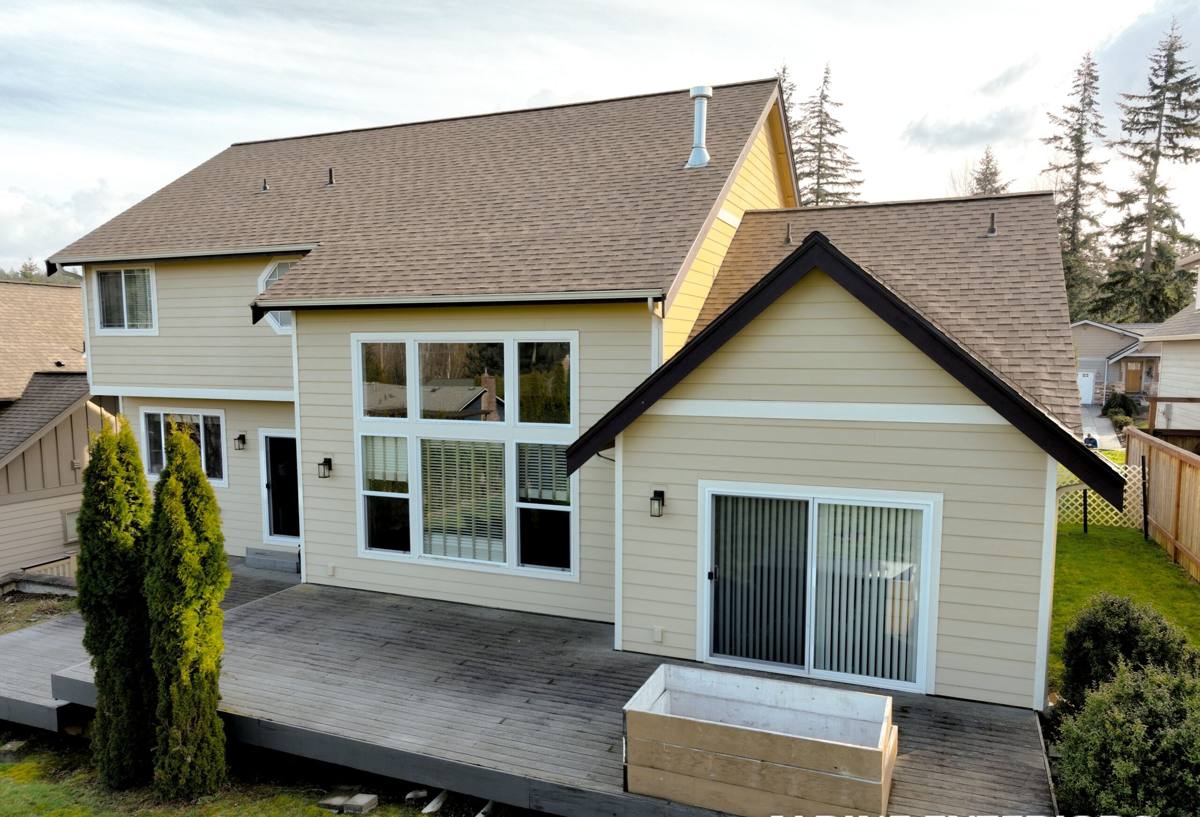
What "Correct" Looks Like on a New Roof Installation
A new roof is more than shingles nailed to plywood. On every full replacement we do, the work breaks down into distinct stages, and each one matters for how the roof performs in Whatcom County's wet-cool cycle:
- Full tear-off — old roofing removed down to the deck so we can actually see what's underneath, not layered over.
- Deck inspection and repair — soft, delaminated, or water-stained plywood/OSB gets replaced before anything new goes down.
- Ice-and-water shield at vulnerable points — eaves, valleys, and around chimneys or skylights, where wind-driven rain finds its way under standard underlayment.
- Synthetic underlayment across the field — a moisture barrier that stays intact through the install process and adds a second line of defense.
- Balanced ventilation — intake at the eaves, exhaust at the ridge, sized to the attic so moisture and heat actually move out instead of condensing on the underside of the deck.
- Flashing at every transition — walls, chimneys, skylights, and roof-to-roof intersections, where the majority of real leaks originate.
- Field material installation — shingles, metal panels, or another system, installed to the manufacturer's nailing pattern and exposure specs, not shortcuts.
Skip any one of these and the roof might look fine for a season or two. In this climate, the gaps show up as moss colonies, soft spots at the eaves, or slow leaks that rot decking from the inside before a homeowner ever sees a drip indoors.
Moss, Moisture, and Why Ventilation Isn't Optional Here
Moss doesn't cause roof failure on its own, but it's a symptom of a roof that stays damp too long — and it accelerates the real damage. Moss holds moisture against the shingle surface, works into granules and seams, and over a long moss season can lift shingle edges enough for wind-driven rain to get underneath. On a shaded Everson lot with limited sun exposure, moss can establish faster than most homeowners expect.
The bigger issue is usually inside the attic, not on the surface. Warm, moist air from the living space rises into the attic, and if it can't escape through a properly balanced intake/exhaust system, it condenses on the underside of the roof deck. Over a wet Whatcom County winter, that condensation cycle rots decking and sheathing from below — invisible until a soft spot or stain finally shows. Correct ventilation sizing at installation time is one of the cheapest, most overlooked ways to add years to a roof's life.
Practical Steps We Take Against Moss and Moisture
- Size and balance ridge and soffit ventilation to the actual attic volume, not a generic rule of thumb.
- Install ice-and-water membrane at eaves and valleys as standard practice, not an upsell.
- Use algae-resistant shingle lines where moss and streaking have been a recurring problem on the property.
- Flash chimneys, skylights, and wall intersections with step and counter-flashing detailed for wind-driven rain, not just surface caulk.
Choosing a Roofing System for This Climate
Most Everson homes are well served by a quality architectural asphalt shingle system installed correctly — it's a proven, well-understood product with a wide range of price points and warranty tiers. Metal roofing is a solid option for homeowners who want a longer service interval and don't mind the higher upfront cost. We don't push either option as automatically "better" — the right call depends on your budget, roof pitch, how long you plan to stay in the home, and how much maintenance you want to think about.
| Factor | Architectural Asphalt Shingle | Standing Seam Metal |
|---|---|---|
| Typical lifespan (this climate) | 20–30 years with correct ventilation | 40–60 years |
| Upfront cost | Lower | Higher |
| Moss resistance | Good with algae-resistant granules; still needs airflow | Very good; sheds moisture fast, little surface for moss to grip |
| Maintenance | Periodic moss/debris cleaning recommended | Minimal, but fastener and seam checks over time |
| Install sensitivity | Moderate — nailing pattern and flashing matter most | High — panel layout and fastening require specialized experience |
| Noise in rain | Standard, well-insulated feel | Can be noticeable without proper underlayment/decking |
We won't install a system we don't think will hold up on your specific roof — pitch, sun exposure, and tree cover all factor into that recommendation, and we'll walk through the trade-offs honestly during your estimate rather than steering you toward whatever has the best margin.
Our Process for an Everson New Roof Installation
1. On-Site Assessment
We look at the current roof from the ground and, where safe, up close: age, material condition, decking soundness where visible, ventilation setup, and any signs of past leaks or moss buildup. We also account for tree cover and drainage patterns specific to your lot, since those affect how long a new roof stays dry between rain events.
2. Written Estimate
You get a clear scope of work and pricing before anything is scheduled — materials, tear-off scope, any deck repair allowance, and ventilation plan spelled out, not buried in vague line items.
3. Tear-Off and Deck Repair
Old roofing comes off completely. We flag any deck damage we find, show it to you, and get sign-off before replacing it — no surprises on the invoice.
4. Underlayment, Flashing, and Ventilation Install
This is where the roof's long-term performance is actually decided. Ice-and-water shield at vulnerable areas, synthetic underlayment across the field, new flashing at every penetration, and ventilation components sized correctly for your attic.
5. Field Material Installation
Shingles or metal panels installed to manufacturer spec, with attention to nailing pattern, exposure, and alignment — the details that separate a roof that lasts its full rated life from one that doesn't.
6. Final Walkthrough
We walk the property with you, check the jobsite is clean, and go over warranty paperwork and any maintenance recommendations specific to your roof and lot.
Signs an Everson Home May Need a New Roof, Not a Repair
- Granules collecting in gutters or at downspout outlets in noticeable amounts
- Shingles that are curling, cracking, or losing their flat profile
- Moss or dark streaking covering large sections rather than isolated spots
- Soft or spongy spots when walked on, especially near eaves or valleys
- Daylight visible through the attic roof deck
- Multiple past repairs in different areas rather than one recurring spot
- The roof is at or past its material's expected service life for this climate
If you're only seeing one or two of these and the roof is otherwise mid-life, a repair may still make sense — we'll tell you that directly rather than pushing a full replacement you don't need yet.
Why a Crew That Already Works This Area Makes a Difference
Roofing crews based outside Whatcom County sometimes underbuild for local conditions — using ventilation ratios or underlayment specs suited to a drier climate, or skipping the ice-and-water detail at eaves because it's not standard practice where they usually work. A crew that regularly installs roofs in and around Blaine and Everson knows the region's rain patterns, the moss pressure on shaded lots, and which flashing details actually hold up through a full wet season here — not in theory, but from doing the work locally, year after year.
That local familiarity also means faster response if a warranty question or storm-related issue comes up after installation. You're not waiting on a crew that has to drive in from out of the area or relearn your roof from scratch.
Get a Straightforward Estimate
If your Everson home's roof is showing its age or you just want an honest read on whether repair or replacement makes more sense, we're glad to take a look. There's no pressure and no obligation — just a clear assessment and a written estimate you can think over. Use the form below to request your free estimate.