 Blaine Siding
 Composite Decking Built for Nooksack's Climate
Nooksack sits inland from the water, but it still gets the full Whatcom County weather package: long wet winters, heavy dew and fog through the shoulder seasons, and enough moisture sitting in the air and on the ground most of the year to keep organic growth going almost year-round. Add in the driving rain that comes through on a west wind and the salt-tinged air that reaches inland from the Strait and Boundary Bay, and you've got a climate that is hard on any exterior wood surface — decks included. A deck built for a dry-summer climate somewhere else doesn't hold up the same way out here. It needs to shed water fast, resist moss and mildew, and tolerate freeze-thaw cycles without cupping, splitting, or rotting from the inside out.
Composite decking exists specifically to solve that problem. It doesn't mean every composite product or every installation method is equal, though, and that's where a lot of homeowners get burned — not by the material, but by a job that ignored the site conditions underneath it.
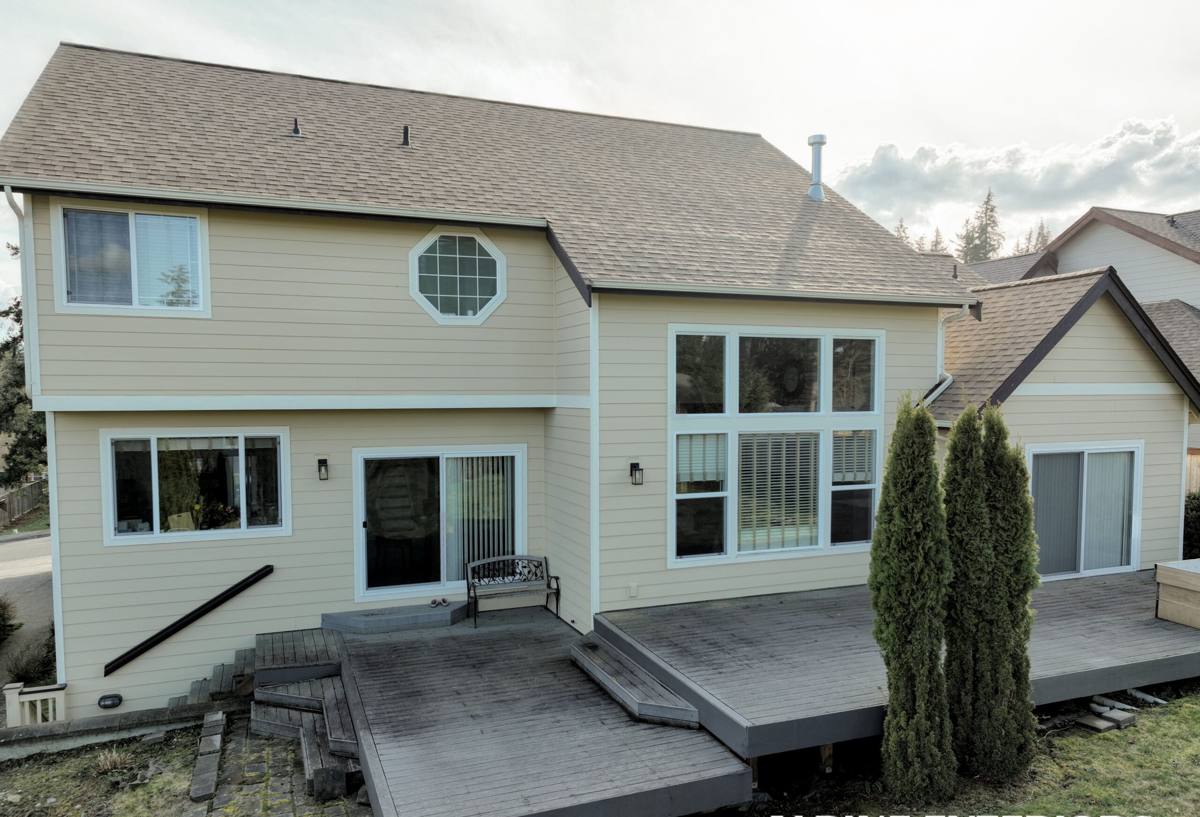
What Local Homes Actually Need From a Deck
Before we talk about boards and fasteners, it's worth being clear about what a deck in this area is actually up against over a typical year:
- Sustained moisture exposure — not just rain events, but weeks of damp air that never fully dries between storms
- Moss and algae pressure — shaded yards, tree cover, and persistent humidity give moss a long growing season on any surface that holds moisture
- Ground moisture and drainage — many lots have heavier clay-influenced soil that drains slowly, so water sits near and under low decks longer than it should
- Salt-influenced air — corrosion of fasteners, flashing, and hardware happens faster near the water than it does further inland
- Freeze-thaw cycling — not extreme cold, but enough freeze and thaw through the winter to stress any joint or seam that wasn't built to move
A deck that's going to last needs to be designed around all five of these, not just the one or two that are obvious when the sun's out.
Why Composite Over Wood in This Environment
Wood decking isn't a bad product, but it's a high-maintenance one in a climate like this. Untreated or under-maintained wood absorbs the moisture that sits in our air for months at a stretch, and that's exactly the environment moss and mildew need to take hold. Keeping a wood deck ahead of that means annual cleaning, periodic stripping, and re-sealing on a schedule most homeowners don't actually keep up with — not because they don't care, but because it's a lot of recurring work for a surface people want to just use.
Composite decking is engineered to resist moisture absorption, which means it doesn't swell, cup, or splinter the way wood does when it's wet for weeks at a time. It also doesn't feed moss the same way bare or weathered wood does, since there's no exposed wood fiber for spores to root into. That doesn't mean composite is maintenance-free — it still needs regular cleaning to stay ahead of surface growth in a moss-heavy climate — but the maintenance burden is lighter and more forgiving if it gets skipped for a season.
Where Composite Still Needs Respect
Composite decking is only as good as the substructure and installation underneath it. The board itself resists moisture, but the framing, fasteners, and drainage details still have to be right, or you end up with a deck surface that looks fine while the structure underneath is quietly failing. This is the part of the job that separates a correct installation from a fast one.
What a Correct Composite Deck Installation Involves
Framing and Substructure
The joists, beams, and posts underneath composite decking take on more importance here than they do in drier climates, because they're the part of the system still exposed to real moisture cycling. We use fasteners and hardware rated for ground contact and coastal-adjacent corrosion resistance, not standard-grade hardware that's fine somewhere with less moisture and no salt influence. Joist tape or an equivalent moisture barrier on top of the framing keeps water from sitting directly against the wood substructure, which is one of the most common places we find hidden rot on decks that were built without it.
Drainage and Airflow Underneath
Low decks and decks built close to grade are common trouble spots. If air can't move underneath the deck, moisture gets trapped there year-round, and that's exactly the damp, shaded environment moss and mold prefer. Proper ledger flashing, correct joist spacing, and adequate clearance from grade all matter more here than they would in a climate that dries out for a few months every summer.
Fastening and Board Layout
Composite boards expand and contract with temperature more than most people expect, and Whatcom County's freeze-thaw swings put that movement to the test every winter. Gapping between boards has to be set correctly at install, not eyeballed, and hidden fastener systems need to be installed to the manufacturer's spec so boards aren't fighting the frame as they move. Get this wrong and you get boards that buckle, gap unevenly, or pull screws loose within a couple of seasons.
Railing, Stairs, and Structural Connections
Ledger board attachment to the house, stair stringer support, and railing post connections are structural, not cosmetic, and they're also where corrosion-resistant hardware matters most since these are often the connections holding the most load. We treat these the same way regardless of how visible they are in the finished deck.
Composite Decking Options: A Practical Comparison
Not every composite product fits every budget or every deck. Here's a general, honest breakdown of the tiers homeowners typically choose between:
| Tier | Typical Characteristics | Best Fit |
|---|---|---|
| Capped composite (entry-level) | Polymer-capped surface over composite core, solid moisture resistance, simpler color range | Budget-conscious replacements, rental or secondary properties |
| Capped composite (mid-to-premium) | Deeper wood-grain texture, wider color range, stronger fade and stain resistance, longer manufacturer warranties | Primary residences, decks that get heavy seasonal use |
| PVC/cellular composite | No wood fiber content at all, maximum moisture immunity, lighter weight | Ground-level decks, areas with the heaviest moss/moisture exposure, dock-adjacent structures |
We'll walk through which tier makes sense for your specific deck, budget, and how much sun or shade the site gets — that last factor matters more for moss and heat-fade behavior than most people expect.
Cost Factors Worth Understanding Up Front
We don't quote broad numbers without seeing the site, but the honest cost drivers on a composite deck project are generally the same from job to job:
| Factor | Why It Moves the Price |
|---|---|
| Deck size and shape | Square footage plus the number of angles, cutouts, and picture-frame border details |
| Substructure condition | Whether existing framing can be reused or needs partial/full replacement |
| Height and grade | Elevated decks and stairs add structural and railing requirements a ground-level deck doesn't need |
| Composite tier chosen | Entry-level, mid-tier, and PVC/cellular products carry different material costs |
| Railing system | Composite, aluminum, and cable railing all price differently and install differently |
| Access and site conditions | Tight lots, slopes, or limited equipment access add labor time |
Our Process for Nooksack Deck Projects
- On-site assessment — we look at grade, drainage, sun/shade exposure, and the condition of any existing structure before recommending anything
- Honest product recommendation — based on your budget, how the deck will be used, and the specific moisture/moss exposure of the site
- Substructure work first — framing, flashing, and drainage corrections happen before a single composite board goes down
- Installation to manufacturer spec — correct gapping, fastening, and ventilation clearances, not shortcuts that save an afternoon
- Final walkthrough — we go over basic seasonal maintenance with you so the deck actually gets the long life the material is capable of
Maintenance Reality for a Whatcom County Deck
Even the best composite deck needs some seasonal attention here. A simple, honest checklist:
- Sweep debris and standing leaves off the surface regularly through fall — trapped organic matter holds moisture against the board
- Rinse or lightly scrub the surface a couple of times a year to stay ahead of moss and algae film, especially in shaded areas
- Keep gutters and downspouts near the deck clear so runoff isn't dumping directly onto or under the structure
- Check railing posts and stair connections annually for movement, especially after a hard winter
- Confirm under-deck airflow isn't being blocked by stored items, planters, or overgrown landscaping
Why Hire a Crew That Already Works This Area
A lot of deck problems we get called out to fix weren't caused by bad composite material — they were caused by an installation that didn't account for local ground moisture, didn't flash a ledger board correctly for our rain patterns, or used standard hardware that started corroding faster than it should have given the salt-influenced air moving through the region. None of that shows up on day one. It shows up two or three winters later.
Working Whatcom County regularly means we're not guessing at how a site drains through a wet winter or how much moss pressure a shaded lot is going to see — we've already seen it on other decks nearby. That local pattern recognition is what keeps a deck performing the way it's supposed to, not just looking right at handoff.
Let's Look at Your Deck
If you're planning a new composite deck in Nooksack or want a second opinion on a deck that's already showing early signs of trouble, we're glad to come take a look. The estimate is free, there's no pressure, and you'll get a straight answer about what your site actually needs — use the form below to get started.