 Blaine Siding
 Building a Deck That Actually Holds Up in Peace Arch
Peace Arch sits close to the water, right up against the international border on Blaine's western edge, which means every deck we build or replace here deals with the same combination of conditions: salt-laden air blowing in off the bay, long stretches of driving rain through fall and winter, and short, low-angle winter sun that leaves shaded areas damp for weeks at a time. A deck design that works fine in a drier inland town can fail early here — not because the workmanship was bad, but because it wasn't built for this specific environment. Our approach for Peace Arch starts with the climate, not the catalog.
This page covers what a custom deck project actually involves in this neighborhood: how salt air and moisture change material and hardware choices, what's happening underneath the decking that most homeowners never see, and how our process works from first walkthrough to final sign-off.
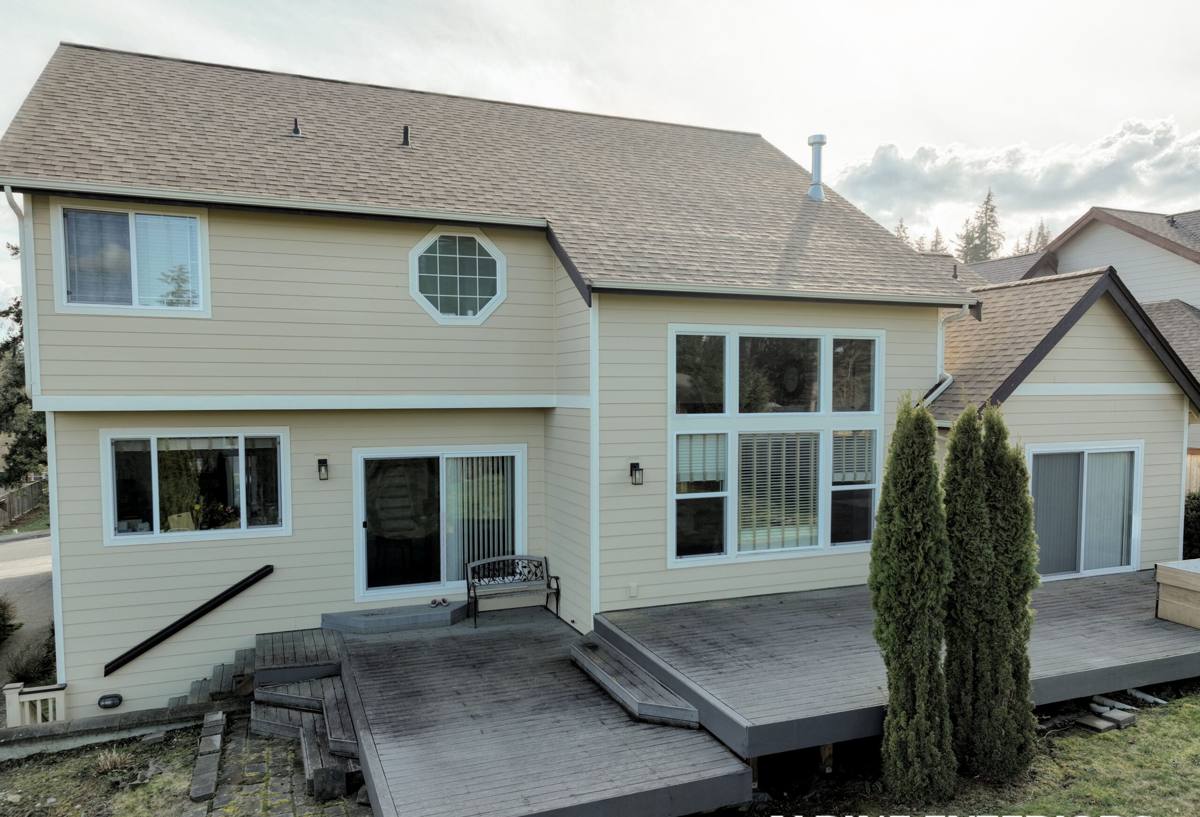
What Blaine's Marine Climate Does to an Outdoor Deck
Whatcom County's coastal weather is mild compared to a lot of the country, but "mild" doesn't mean easy on a structure. Three things do most of the damage to decks in Peace Arch specifically:
Salt Air and Corrosion
Proximity to Semiahmoo Bay and Drayton Harbor means airborne salt reaches homes even a fair distance from the shoreline. Salt accelerates corrosion in any exposed metal — fasteners, brackets, railing hardware — far faster than it would in a landlocked town. A deck built with standard hardware can show rust streaks and weakened connections within a few years in this kind of exposure.
Driving Rain
Storms here often come with sideways wind, which pushes water into places a purely vertical rain wouldn't reach: under railing caps, behind ledger boards, into end-grain cuts on decking. Water that gets trapped rather than shed is what causes rot, not rain itself.
Moss and Prolonged Dampness
Blaine's moss season runs long — shaded decks, north-facing decks, and decks under mature trees can stay damp for much of the fall and winter. Moss holds moisture against the surface of decking and framing, and on wood surfaces it also makes boards slick and dangerous underfoot. A deck design that ignores drainage and airflow is signing up for a moss problem regardless of the decking material chosen.
Choosing the Right Decking Material for This Neighborhood
There's no single "best" decking material — there's a best fit for the home, the budget, and how much maintenance the owner actually wants to do. In a marine climate like Peace Arch's, the trade-offs shift compared to a drier region, so we walk every homeowner through them honestly rather than pushing one product.
| Material | How It Handles Salt Air & Moisture | Maintenance | Typical Lifespan Here |
|---|---|---|---|
| Pressure-treated wood | Resists rot when properly sealed; end cuts and fasteners are the weak points | Annual cleaning, re-sealing every 1-2 years | 15-20 years with upkeep |
| Cedar | Naturally rot- and insect-resistant, but greys and softens faster in salt-heavy, damp air without finish | Regular cleaning and finishing to hold color and resist moss | 15-20 years with upkeep |
| Composite decking | Doesn't absorb water or rot; some early-generation products trapped moisture at the board core, so board design and brand matter | Periodic washing to prevent moss/mildew film; no sealing or staining | 25-30+ years |
| PVC/capped polymer decking | Fully sealed surface, very strong moisture and salt resistance | Washing only | 25-30+ years |
We don't install every product on the market. If a particular composite or wood product has a track record of trapping moisture, being unusually sensitive to installation technique, or carrying a warranty structure that doesn't hold up to real-world coastal use, we'll say so plainly and explain why we're steering you toward something else. That's a standard we hold ourselves to, not a knock on any one brand.
Wood vs. Composite: The Honest Trade-Off
Wood costs less up front and can look excellent with regular care, but "regular care" in Peace Arch means real, recurring maintenance — cleaning, checking fasteners for corrosion, re-sealing on schedule. Composite and PVC decking cost more initially but largely remove that maintenance burden, which matters to homeowners who want to actually use their deck rather than maintain it. Neither choice is wrong; it depends on how much time and money you'd rather spend where.
What's Underneath Matters More Than What's On Top
Homeowners naturally focus on the decking surface — the boards they'll walk on and see — but the framing underneath is what determines whether a deck lasts 10 years or 30 in this climate.
Ledger Attachment and Flashing
Where a deck attaches to the house is the single most common failure point we see on older decks in wet coastal climates. If the ledger board isn't properly flashed to shed water away from the house's wall assembly, moisture works its way in behind the siding and rots both the ledger and the framing it's fastened to — often invisibly, until the deck starts to feel spongy or pull away from the house.
Joist Protection
Cut ends and drilled holes in framing lumber expose untreated wood fiber, and that's exactly where rot starts first, especially on a joist that sits under a board seam collecting runoff. Capping or sealing cut ends and joist tops isn't optional in this climate — it's the difference between framing that lasts and framing that quietly fails from underneath while the surface still looks fine.
Airflow and Drainage Below the Deck
A deck built low to the ground with poor airflow underneath stays damp longer after every rain, which is exactly the environment moss and rot need. Proper joist spacing, gapping, and grading underneath the structure let air move and water drain instead of pooling against the framing.
Railings, Fasteners, and Hardware That Won't Let You Down
This is the part of a deck build that's easiest to shortcut and hardest to fix after the fact, because most of it is hidden once the project is finished.
| Hardware Type | Standard Grade Risk in Salt Air | What We Use Instead |
|---|---|---|
| Deck screws/fasteners | Standard coated screws can corrode and streak decking within a few years near the water | Stainless steel or marine-grade coated fasteners rated for coastal exposure |
| Joist hangers & structural brackets | Basic galvanized coatings wear through faster in salt air, weakening connections over time | Heavier-gauge, corrosion-resistant coated or stainless hardware at load-bearing connections |
| Railing hardware | Cheap post connectors and cable hardware pit and rust, becoming both unsightly and a safety concern | Stainless or marine-rated railing components, especially on decks with a water view or direct salt exposure |
Railings themselves need the same climate-aware thinking. Wood railings need the same sealing schedule as wood decking. Metal railings need coatings and hardware rated for coastal exposure, or they'll show rust at every connection point within a few seasons. Cable and glass railing systems look great but concentrate a lot of hardware in a small area — every one of those connectors needs to be corrosion-rated, not just the visible parts.
Our Custom Deck Process, Start to Finish
Every deck project in Peace Arch follows the same core process, adjusted for the specific home, sun exposure, and how exposed the site is to wind and salt air off the water.
- On-site walkthrough: We look at the house's ledger wall, existing drainage, sun/shade pattern, and how exposed the site is to prevailing weather before recommending materials.
- Design and material selection: We go over decking, railing, and structural options with honest trade-offs for this climate and your budget — not a one-size-fits-all package.
- Permitting: We handle the permit application and inspection scheduling with the local building department so you don't have to chase paperwork.
- Demolition (for replacements): Old decking and, where needed, compromised framing is removed and hauled off. We inspect the ledger and structural connections at this stage before anything new goes up.
- Framing: Structural work is built and fastened with corrosion-rated hardware, proper ledger flashing, and drainage/airflow in mind from the start.
- Decking and railing installation: Boards and railing systems are installed per manufacturer spec — spacing, fastening pattern, and expansion gaps matter more with composite and PVC products than most homeowners expect.
- Final walkthrough and inspection: We review the finished deck with you, confirm any required local inspections are complete, and go over maintenance specific to the materials installed.
Keeping Moss and Moisture From Winning
No deck in Blaine is completely maintenance-free, even the low-upkeep composite and PVC products — they just need less of it. A short, honest maintenance checklist for a Peace Arch deck:
- Sweep debris off the deck surface regularly, especially in fall — trapped leaves hold moisture and feed moss growth
- Rinse or wash the deck surface a few times a year to clear the thin biofilm that leads to moss and slick spots
- Check wood decking and railings annually for soft spots, popped fasteners, or finish wear, and re-seal on schedule
- Keep gutters and downspouts near the deck clear so roof runoff isn't dumping extra water onto or under the structure
- Trim back vegetation that shades the deck and slows drying after rain
- Inspect visible hardware (railing brackets, post connectors) for early rust or pitting so it can be addressed before it spreads
- Confirm under-deck drainage and airflow paths stay clear of stored items, debris, or plant growth
Permits and Local Requirements in Blaine
Most new decks and many deck replacements in Blaine and unincorporated Whatcom County require a building permit, particularly when the deck is attached to the house or built above a certain height. Requirements can vary depending on the specifics of the project, so we confirm what applies to your situation and handle the application and inspection scheduling as part of the job rather than leaving that to you. Skipping permitting on an attached deck isn't worth the risk — it can complicate a future home sale and, more importantly, it removes the inspection step that catches structural issues before they're covered up.
Why Hire a Crew That Already Works in Peace Arch
Deck-building fundamentals don't change from town to town, but the details that determine whether a deck lasts do. A crew that regularly works Blaine's waterfront-adjacent neighborhoods already knows which fastener grades hold up, how far salt exposure actually travels inland here, and where moss problems tend to start on a shaded coastal lot. That's the kind of judgment that shows up years down the road, not on installation day — in whether the railing hardware is still tight, whether the ledger connection is still solid, and whether the deck needs a full rebuild at year twelve or is still going strong at year twenty-five.
We're not interested in cutting corners that only show up as someone else's problem later. We'd rather walk you through the real trade-offs up front, use hardware and materials that actually fit this climate, and build something that holds up to what Whatcom County weather does to it.
Ready to Talk About Your Deck?
If you're planning a new deck or need to replace one that's showing its age, we're glad to take a look and talk through honest options for your home and budget. Request a free, no-pressure estimate using the form below — there's no obligation, just a straight answer about what your Peace Arch deck actually needs.