 Blaine Siding
 Why Peace Arch Homes Need Siding Built for This Exact Climate
The Peace Arch area sits right up against the international border and close enough to Semiahmoo Bay and the Strait of Georgia that homes here take on a different kind of weather load than siding fifty miles inland. You get salt-laden marine air moving in off the water, long stretches of driving rain pushed by wind rather than falling straight down, and a moss season that can run most of the year in shaded, north-facing exposures. None of that is exotic for Whatcom County, but it adds up fast on a wall assembly that isn't built to handle it.
Siding in this zone isn't just a cosmetic choice. It's the first line of defense against moisture intrusion, and it's doing that job in a spot where the combination of salt air and near-constant dampness accelerates corrosion, coating breakdown, and organic growth faster than in drier parts of the state. We install fiber cement siding on Peace Arch homes specifically because it's engineered to take that punishment without the maintenance treadmill that comes with other materials.
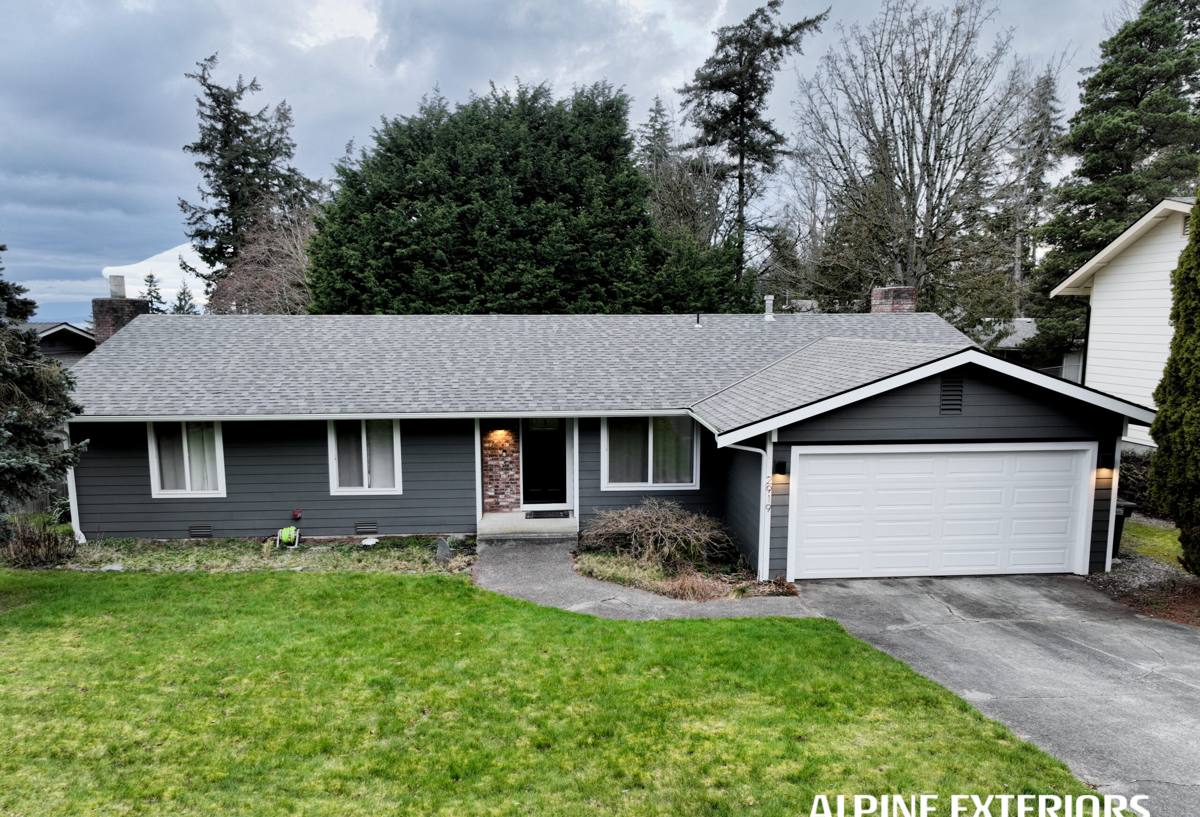
What Salt Air, Driving Rain, and Moss Season Actually Do to Siding
Salt Air
Airborne salt is corrosive to exposed metal fasteners, trim flashing, and any hardware that isn't rated for coastal exposure. It also settles into porous or textured siding surfaces, where it holds moisture against the substrate longer than it would in a dry inland climate. Over years, that combination degrades paint films and accelerates wear on materials that aren't formulated to resist it.
Driving Rain
Wind-driven rain doesn't just wet the face of a wall — it gets pushed sideways and upward into laps, seams, butt joints, and anywhere flashing or caulking is undersized or poorly detailed. A siding system that relies on perfect, unbroken caulk lines to stay dry is a liability in a wind-driven-rain climate, because caulk is the first thing to fail.
Moss and Organic Growth
Shaded, north- and west-facing walls near mature trees or close-set neighboring homes stay damp for extended stretches, which is exactly what moss, algae, and mildew need to establish. Once organic growth gets a foothold on a porous or wood-based surface, it holds moisture against that surface and speeds up decay underneath the growth itself.
Why Fiber Cement Is the Right Material for This Exposure
James Hardie fiber cement siding is made from cement, sand, and cellulose fiber — it's non-combustible and dimensionally stable, meaning it doesn't swell, cup, or warp the way wood-based products can when they take on repeated moisture cycling. That stability matters directly in a driving-rain climate, because a plank that stays flat and tight keeps its joints and laps sealed instead of opening hairline gaps that wind-driven water can find.
Hardie's ColorPlus factory finish is baked on and cured under controlled conditions, which gives it better adhesion and UV resistance than field-applied paint, and it holds up better against the fading and chalking that salt air and sun exposure cause over time. For homes in this bay-adjacent exposure, we typically spec HZ5 product — Hardie's line engineered for harsher climate zones — rather than a standard-zone panel, because it's formulated for the freeze-thaw and moisture-cycling conditions this area actually sees.
What a Correct Installation Involves Here
Fiber cement siding only performs as well as the installation behind it. In a marine, wind-driven-rain environment, the details matter more than they would in a milder climate, and cutting corners on any of them shows up as a callback within a few wet seasons.
- Correct fastener penetration and spacing per Hardie's published fastening schedule — under-driven or over-driven nails are one of the most common causes of early failure
- Stainless steel or coated fasteners rated for coastal/corrosive exposure, not standard galvanized
- Proper water-resistive barrier and rainscreen gap behind the siding so any moisture that does get past the cladding can drain and dry
- Correctly lapped and sealed flashing at every window, door, and roof-wall intersection — these are the highest-risk leak points in driving rain
- Minimum clearance from grade, decks, and roof lines per manufacturer spec, so splashback and standing water don't sit against the bottom course
- Factory-cut and factory-primed edges kept intact wherever possible, with field cuts sealed per Hardie's instructions
- Caulking used only where specified — not as a substitute for correct flashing and lap detail
Every one of these is a place where a rushed or unfamiliar crew can leave a home vulnerable to exactly the conditions Peace Arch sees most: wind-driven water finding a gap, and trapped moisture with nowhere to dry.
Our Process on a Peace Arch Job
1. On-Site Assessment
We walk the home and look specifically at exposure — which walls face prevailing wind and rain, where shade and dampness are creating moss or mildew now, and where existing trim, flashing, or siding is already showing wear.
2. Substrate and Moisture Check
Before any new siding goes on, we check what's underneath. If there's hidden moisture damage from a prior installation, that gets addressed first — installing new siding over a compromised wall just buries the problem.
3. Water Management Detailing
We plan flashing, weather-resistive barrier, and rainscreen detailing around the home's actual exposure, with extra attention on window and door openings and any roof-to-wall transitions, since those are where driving rain does the most damage.
4. Installation to Manufacturer Spec
Fastening, spacing, and clearances are installed to James Hardie's published requirements — this is also what keeps the manufacturer's warranty intact, which matters if anything does come up down the line.
5. Final Walkthrough
We go over the finished work with the homeowner, including simple, realistic guidance on what upkeep this specific siding actually needs in this climate — which is a lot less than most people expect.
Choosing a Line and Color for This Exposure
James Hardie's lap, panel, and shingle-style siding all come in ColorPlus factory finishes, and color choice isn't purely cosmetic here — darker, more saturated colors absorb more heat and can show salt film and water spotting differently than lighter tones. We talk through both look and long-term maintenance when a Peace Arch homeowner is choosing a color, since a finish that hides light mineral deposits and water spotting will look better, longer, in this exposure with less cleaning.
| Factor | Why It Matters in Peace Arch |
|---|---|
| HZ5 vs. standard-zone panel | HZ5 is engineered for harsher moisture and freeze-thaw cycling common near the water |
| Fastener material | Salt air corrodes standard galvanized hardware faster than coastal-rated fasteners |
| Rainscreen assembly | Adds drainage and drying capacity behind the siding for wind-driven rain |
| Trim and flashing detail | Highest-risk leak points in a driving-rain climate |
| Color/finish selection | Affects heat absorption and how visible salt film or water spotting becomes |
| Wall exposure (shade vs. sun) | Shaded walls need attention to moss and drying time; sun-exposed walls face more UV and fading stress |
Maintenance in This Climate — What's Actually Needed
One of the real advantages of fiber cement over wood-based or vinyl alternatives is how little upkeep it needs when it's installed correctly. In the Peace Arch area, a simple annual routine covers most of it:
- Rinse the exterior once or twice a year to clear salt film and airborne debris, especially on walls facing the water
- Check for moss or algae buildup on shaded, north-facing sections and remove it gently before it spreads
- Walk the perimeter after major windstorms and check caulking and trim for any new gaps
- Keep gutters clear so overflow isn't running down the face of the siding
- Trim back vegetation that's keeping any section of wall shaded and damp longer than necessary
That's a short list compared to what wood siding or a painted product needs in this exposure, and it's a big part of why fiber cement holds its value here.
Why It Matters That We Already Work This Area
Installation quality is what determines whether fiber cement siding lives up to its reputation, and the details that matter most — fastening schedule, flashing sequence, rainscreen detailing, clearance from grade — are exactly the things a crew unfamiliar with marine, wind-driven-rain conditions is most likely to underestimate. A crew that already works Blaine and the Peace Arch area has seen firsthand how fast a poorly detailed wall shows problems here versus somewhere drier, and builds every job around that reality from the start rather than learning it on a callback.
If you're planning a siding project on a home in the Peace Arch area, we're glad to walk the property with you, look at your specific exposure, and put together a straightforward, no-pressure estimate using the form below.