 Blaine Siding
 Point Roberts Roofs Take a Different Kind of Beating
Point Roberts sits out on its own peninsula, surrounded on three sides by Boundary Bay and the Strait of Georgia. That location is part of what makes it a great place to own a home — and part of why roofs out there wear faster than roofs ten miles inland. Salt-laden air off the water works on metal fasteners, flashing, and gutter hardware year-round. Wind-driven rain off the Strait doesn't just fall on a roof, it gets pushed sideways and up under laps and around penetrations that would stay dry in a calmer spot. And because so many Point Roberts lots sit under fir and cedar canopy with damp air holding close to the ground for much of the year, moss and algae get a long growing season with very little downtime to dry out.
None of that means a roof out here is doomed — it means a roof replacement has to be built with those three things in mind from the start: salt exposure, wind-driven rain, and moss. A roof installed the same way you'd install one in a dry, inland part of Whatcom County will show its age faster in Point Roberts, whether it's five years old or fifteen.
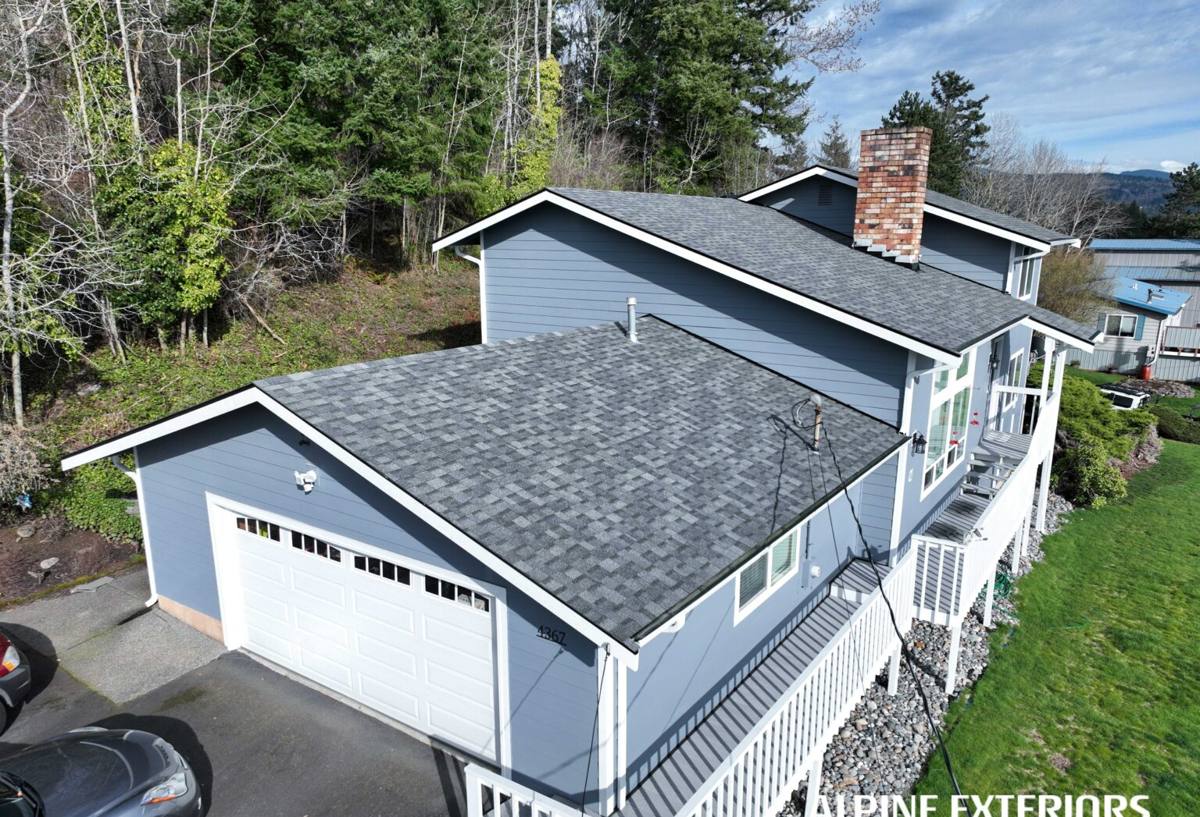
Signs Your Point Roberts Roof Is Ready for Replacement
Repairs make sense when a roof has isolated problems and the field of the roof is still sound. Replacement makes sense once the wear is spread across the whole roof, or once repairs stop holding. In this climate, the tell-tale signs tend to show up first on north-facing slopes and in shaded valleys, since those areas stay wet the longest.
- Moss that keeps coming back within a season or two of cleaning, even on slopes that get some sun
- Granule loss heavy enough that you can see bare, shiny patches on asphalt shingles
- Shingles that are curling, cupping, or lifting at the edges, especially on the side that faces the water
- Rust staining or visible corrosion at flashing, fasteners, or gutter hangers
- Soft or spongy spots underfoot when walking the roof, which usually means the decking underneath has taken on moisture
- Daylight visible through the roof deck from inside the attic, or staining on attic insulation
- A roof that's approaching or past the upper end of its expected service life for its material
If you're only seeing one or two of these and the roof is otherwise young, a targeted repair may still be the right call. Once several of them show up together, replacement is usually the more cost-effective path — patching a roof that's failing broadly just delays a bigger repair bill later.
What a Correct Roof Replacement Involves Out Here
Tear-Off and Deck Inspection
We remove the old roofing down to the deck rather than layering over it. That's the only way to actually see the plywood or plank sheathing underneath, which matters a lot in a climate where trapped moisture is common. Any deck sections that are soft, delaminated, or rotted get replaced before anything new goes down — installing new roofing over a compromised deck just guarantees an early failure.
Underlayment That Matches the Exposure
A synthetic underlayment goes down across the full roof as the primary water-resistive barrier, but the eaves, valleys, and any low-slope sections get a self-adhered ice-and-water membrane on top of that. In a wind-driven-rain climate like this one, that extra layer at the vulnerable points isn't optional — it's what keeps water out when rain is being pushed uphill under the shingles instead of just running down.
Flashing Done Properly, Not Caulked Over
Step flashing at walls and chimneys, counter-flashing tucked into the siding or masonry, and formed valley flashing all get installed as separate, layered pieces rather than relying on a bead of sealant to bridge the gap. Sealant has its place as a backup, but it's not a substitute for correctly lapped metal. In salt air, we also pay attention to the flashing material itself — mixing dissimilar metals or using bargain-grade steel invites galvanic corrosion and rust streaking within a few years.
Fasteners and Hardware
Cheap electro-galvanized nails and screws corrode noticeably faster this close to salt water. We use corrosion-resistant fasteners rated for coastal exposure, along with gutter and hardware finishes that hold up to the same conditions, so the roof isn't shedding rust streaks down the siding within a few winters.
Choosing a Roofing Material for This Location
There's no single "best" roofing material for Point Roberts — the right choice depends on your budget, your roof's pitch and complexity, and how much long-term maintenance you want to take on. Here's how the common options stack up against this specific climate.
| Material | Typical Lifespan | Salt Air & Moss Behavior | Relative Upfront Cost |
|---|---|---|---|
| Architectural asphalt shingle | 20-30 years | Good with proper ventilation; algae-resistant shingle lines help slow moss/algae staining | Lowest |
| Standing-seam metal | 40-50+ years | Very good; sheds moss and moisture fastest, but panel and fastener quality matter more in salt air | Highest upfront, lowest long-term maintenance |
| Cedar shake | 20-30 years with upkeep | Requires the most active maintenance in a damp, moss-prone climate | Mid to high |
We install and stand behind architectural asphalt and standing-seam metal on most Point Roberts homes. We're generally cautious about cedar shake in this specific climate — not because it's a bad product, but because the amount of ongoing maintenance it needs to resist moss and moisture in a high-humidity, tree-shaded coastal setting is a real, honest trade-off homeowners should go in expecting.
Ventilation Matters as Much as the Shingles
A new roof with poor attic ventilation will grow moss again faster than an old roof with good airflow. Balanced intake at the soffits and exhaust at the ridge keeps the underside of the deck drier and the roof surface itself closer to ambient temperature, which slows how quickly moss and algae get a foothold. When we replace a roof, we check the existing ventilation setup and correct it if intake and exhaust aren't balanced — it's a small part of the job that has an outsized effect on how the new roof looks in five years, especially under the tree cover common on Point Roberts lots.
Why Local, Blaine-Based Crews Handle This Job Differently
Point Roberts is part of Whatcom County, but it isn't connected to the rest of the county by road — the only land route in is through Canada, via the border crossings near White Rock and Tsawwassen, B.C. That's not a footnote, it's a real logistical factor on every job: crews, equipment, and material deliveries all have to clear that border, and timing matters. A crew that treats Point Roberts like just another stop on a mainland route will underestimate how a job actually needs to be scheduled.
Working out of Blaine, we're used to planning around that crossing — getting materials staged and crews through efficiently so a tear-off day doesn't stall out waiting on logistics that should have been planned for in advance. That local familiarity is part of what "hiring a crew that already works Point Roberts" actually buys you: fewer surprises, more predictable scheduling, and a crew that isn't learning the area's quirks on your project.
Our Process, Start to Finish
- On-site estimate. We walk the roof, check the attic and decking where accessible, and talk through material options based on your roof's exposure and slope.
- Written scope and schedule. You get a clear breakdown of what's being done and a realistic timeline that accounts for border crossing and material delivery.
- Tear-off and deck repair. Old roofing comes off, the deck gets inspected, and any bad sections are replaced before we move forward.
- Underlayment, flashing, and ventilation corrections. The water-resistive layers and flashing details go in first, since they're what actually keeps water out over time.
- New roofing installed. Shingles or metal panels go on to manufacturer spec, with fasteners and hardware rated for coastal exposure.
- Cleanup and walkthrough. Site is cleared of debris and nails, and we walk the finished roof with you before we call the job done.
Permits and Whatcom County Requirements
Point Roberts is unincorporated, so building permits for a full roof replacement run through Whatcom County rather than a local city office. A reroof typically requires a permit; requirements can shift depending on scope, so we handle that process as part of the job rather than leaving it for the homeowner to sort out. If your home has any Point Roberts Fire District or shoreline-adjacent considerations that could affect the project, we'll flag those during the estimate rather than after work has started.
Get a Straight Answer on Your Roof
If you're not sure whether your Point Roberts roof needs a full replacement or just targeted repair work, the honest answer starts with someone actually walking the roof and the attic, not guessing from the ground. We offer free, no-pressure estimates for homeowners in Point Roberts and throughout the Blaine area — fill out the form below and we'll get a look scheduled.