 Blaine Siding
 Roof Repair Built for Everson's Wet, Wooded Climate
Everson sits inland along the Nooksack River valley, tucked between farmland and second-growth timber that shades roofs for much of the day. That combination of moisture, shade, and tree cover creates a different repair pattern than what we see on more exposed, open-water sites elsewhere in Whatcom County. Where coastal roofs closer to the bay deal more directly with salt-laden wind, Everson roofs deal mostly with standing dampness, driving rain that never fully dries between storms, and a moss season that can run eight months of the year. Both problems come from the same weather systems moving through the county, but they show up on your roof in different ways, and a repair crew needs to know which problem it's actually looking at before pulling a single shingle.
We've worked enough roofs in this part of the county to know that a leak in Everson is rarely a single, obvious hole. It's usually a slow chain reaction: moss holds moisture against the shingle mat, granules wash off faster than normal, the underlayment starts absorbing water at the seams, and by the time a homeowner sees a stain on the ceiling, the actual entry point may be a foot or more upslope from where the water shows inside. Chasing that path correctly is the difference between a repair that lasts and one you're paying for again next winter.
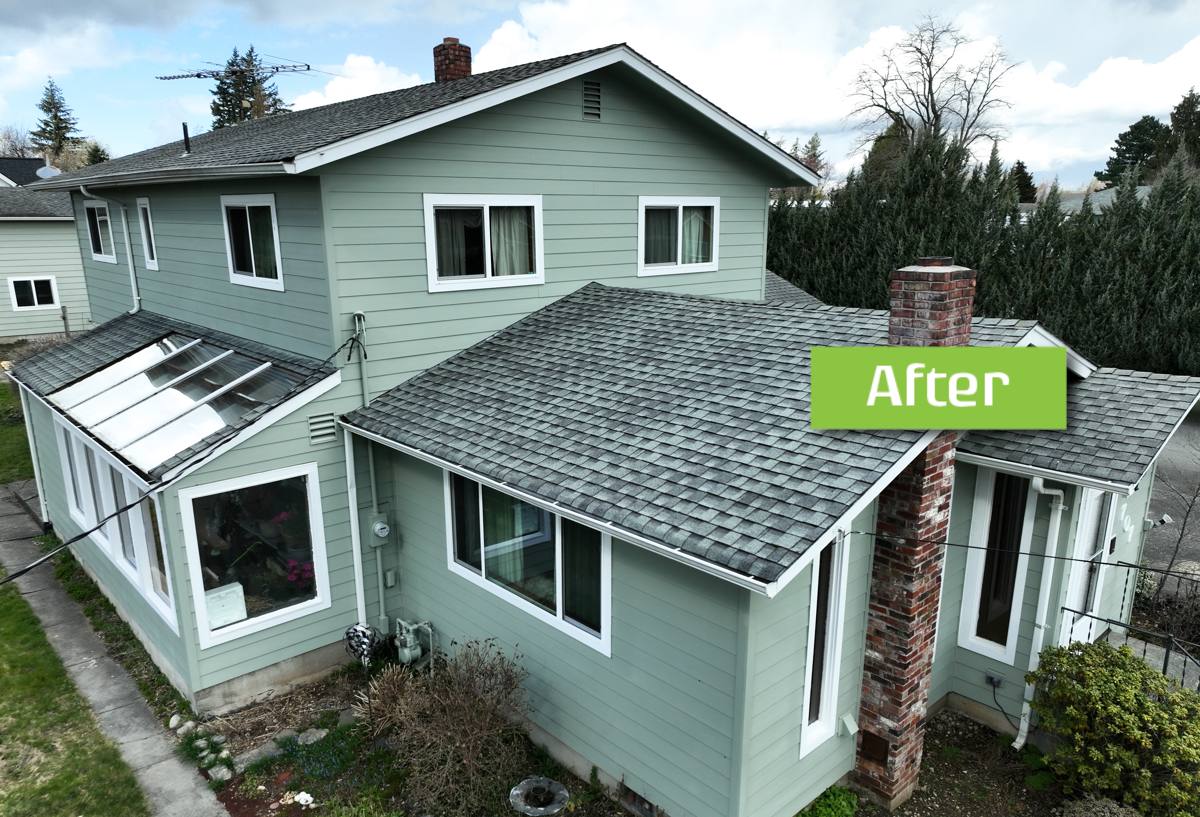
What Everson's Climate Does to a Roof
Shade and Moisture
Roofs under tree cover dry slower after every rain. In a valley town like Everson, where many lots back up to timber or sit near the river, north-facing slopes and shaded valleys between roof planes can stay damp for days after a storm has passed. That constant dampness is exactly what moss, moulds, and algae need to establish themselves in the shingle mat.
Moss, Not Salt, Is the Bigger Local Threat
Salt-driven corrosion is a real concern for roofs closer to open water in this county, but for most Everson homes the bigger enemy is biological growth. Moss doesn't just sit on top of shingles — its rhizoids work down into the granule layer and lift shingle edges as they grow, breaking the seal that keeps wind-driven rain out. Left unaddressed through a full wet season, moss can shorten the usable life of an asphalt roof by years.
Driving Rain and Wind-Loaded Water
Storms moving through the Nooksack valley often bring rain at an angle rather than straight down. That matters for repair work because wind-driven rain finds weaknesses that vertical rain never would — lifted shingle tabs, under-driven nails, gaps at flashing laps. A repair that only addresses the visible damage and ignores how water travels sideways under wind pressure tends to fail again in the next big blow.
Common Roof Repair Needs We See in Everson
- Moss and organic growth removal along shaded slopes, valleys, and north-facing planes
- Flashing repair or replacement at chimneys, skylights, and roof-to-wall transitions where lap seals have opened
- Shingle replacement for wind-lifted, cracked, or granule-stripped sections
- Valley repair where debris and moisture collect and metal or shingle valleys corrode or wear thin
- Underlayment and decking repair where sustained moisture has reached the sheathing
- Vent boot and pipe collar replacement, a common quiet leak source as rubber collars age and crack
- Gutter and edge repair where clogged gutters back water up under the first course of shingles
What a Correct Repair Actually Involves
A roof repair done right starts with tracing water, not patching the spot where it appeared inside the house. We look at the whole roof plane the leak is associated with — slope, shading, nearby penetrations, gutter condition — because a stain on a ceiling is an effect, not a cause. Here's the sequence we follow on most Everson repair calls:
- Inspection from the roof surface, not just the ground or the attic, so we can see actual shingle and flashing condition
- Moss and debris clearing from the affected area and anywhere upslope that could be feeding moisture into it
- Identifying the true entry point by checking flashing laps, nail patterns, and shingle seal lines rather than assuming the nearest visible damage is the cause
- Removing and replacing only the compromised material — shingles, flashing, underlayment, or decking — without disturbing sound roofing around it
- Re-sealing and re-integrating the repair so water sheds over the new material the same way it does over the original roof, with no reverse laps or exposed fasteners
- A final check under simulated wind-driven conditions at flashing and valley points, since that's where most repeat leaks originate
Repair vs. Replacement: How We Help You Decide
Not every roof problem in Everson calls for a full replacement, and not every leak is fixable with a patch. The honest answer depends on the roof's age, how much of it is affected, and whether the decking underneath is still sound. We'll always tell you plainly which category your roof falls into rather than defaulting to the bigger job.
| Factor | Repair Usually Makes Sense | Replacement Should Be Considered |
|---|---|---|
| Roof age | Under roughly 15 years, one repair area | Nearing or past manufacturer's expected lifespan |
| Extent of damage | Isolated to one plane, valley, or penetration | Recurring leaks in multiple locations |
| Decking condition | Sound, dry sheathing under the repair area | Soft spots, rot, or repeated moisture staining on decking |
| Moss/algae extent | Surface growth, shingle mat still intact | Widespread granule loss and lifted shingle edges |
| Remaining shingle stock | Matching shingles still available or close enough | Discontinued product with no reasonable match |
When a repair is the right call, we say so and scope the job to exactly what's needed. When the roof is genuinely past the point where patching makes financial sense, we'll walk you through why, using the roof in front of us rather than a generic sales pitch.
Timing Matters More in This Climate Than Most
In a valley town with heavy shade and a long wet season, small roof problems don't stay small for long. A lifted shingle tab that would take years to become a real leak on a dry, sunny roof can let water in within one or two hard storms on a shaded Everson roof, because the surrounding material never fully dries out between rain events. That's part of why we recommend addressing moss buildup and minor flashing issues before the heaviest part of the wet season rather than waiting until there's an active leak. A short maintenance visit is almost always cheaper than a repair that's had months to spread into the decking.
Simple Signs It's Time to Call
- Visible moss or dark streaking on shingles, especially on shaded slopes
- Granules collecting in gutters or at downspout outlets
- Any ceiling stain, even one that seems to dry up between storms
- Daylight visible through the roof deck from inside the attic
- Curling, cracked, or missing shingles after a windstorm
- Soft or spongy feeling roof sections when walked (we check this, not homeowners)
Why It Matters to Hire a Crew That Already Works This Area
Roofing problems in Whatcom County aren't uniform. A crew used to open, sun-exposed roofs closer to the water can misdiagnose a shaded, moss-prone roof in a valley town like Everson, and vice versa. Knowing which failure pattern to expect — biological growth working under shingle tabs versus wind and salt corrosion at metal flashing — changes where you look first and what materials make sense for the repair. We work throughout Whatcom County, which means we see both patterns regularly and know how to tell them apart on sight, rather than treating every leak the same way.
We also know that in a town this size, a repair job isn't just a transaction — it's a roof we may be asked to look at again down the road, and a reputation that follows us to the next street over. That's reason enough to do it right the first time: proper flashing integration, matched materials where possible, and a scope of work that solves the actual problem instead of just covering the symptom.
What to Expect From Our Process
We keep roof repair straightforward: an on-roof inspection so we can see real conditions, a plain explanation of what's actually causing the problem, and a written scope before any work starts. No pressure toward a full replacement when a repair will hold, and no underselling a repair when the decking or shingle mat is too far gone to patch responsibly. We clean up debris and shingle scrap when we're done, and we'll point out anything else we noticed on the roof while we were up there — even if it's not part of the current job — so you're not surprised by it later.
If you're dealing with a leak, moss buildup, storm damage, or just want an honest read on where your Everson roof stands going into the next wet season, we're happy to take a look. Reach out for a free, no-pressure estimate using the form below.