 Blaine Siding
 Point Roberts Puts More Stress on Siding Than Most of Whatcom County
Point Roberts sits on a small peninsula that's surrounded by water on three sides, which means homes there catch wind-driven salt air and rain that inland Whatcom County properties simply don't deal with. Add in the long, wet moss season that this corner of the Pacific Northwest is known for, and siding here ages differently — often faster — than siding on a house just a few miles inland. We've repaired enough siding out there to know that a "small patch job" mentality doesn't hold up against this environment for long.
Salt-laden air is corrosive to exposed fasteners and metal flashing, and it accelerates the breakdown of caulk and paint film on almost every siding material. Combine that with near-constant moisture exposure for large stretches of the year, and you get the two things that cause most of the repair calls we see: trapped water and failed seals. A repair that only addresses what's visible on the surface, without dealing with why that spot failed in the first place, tends to fail again within a season or two.
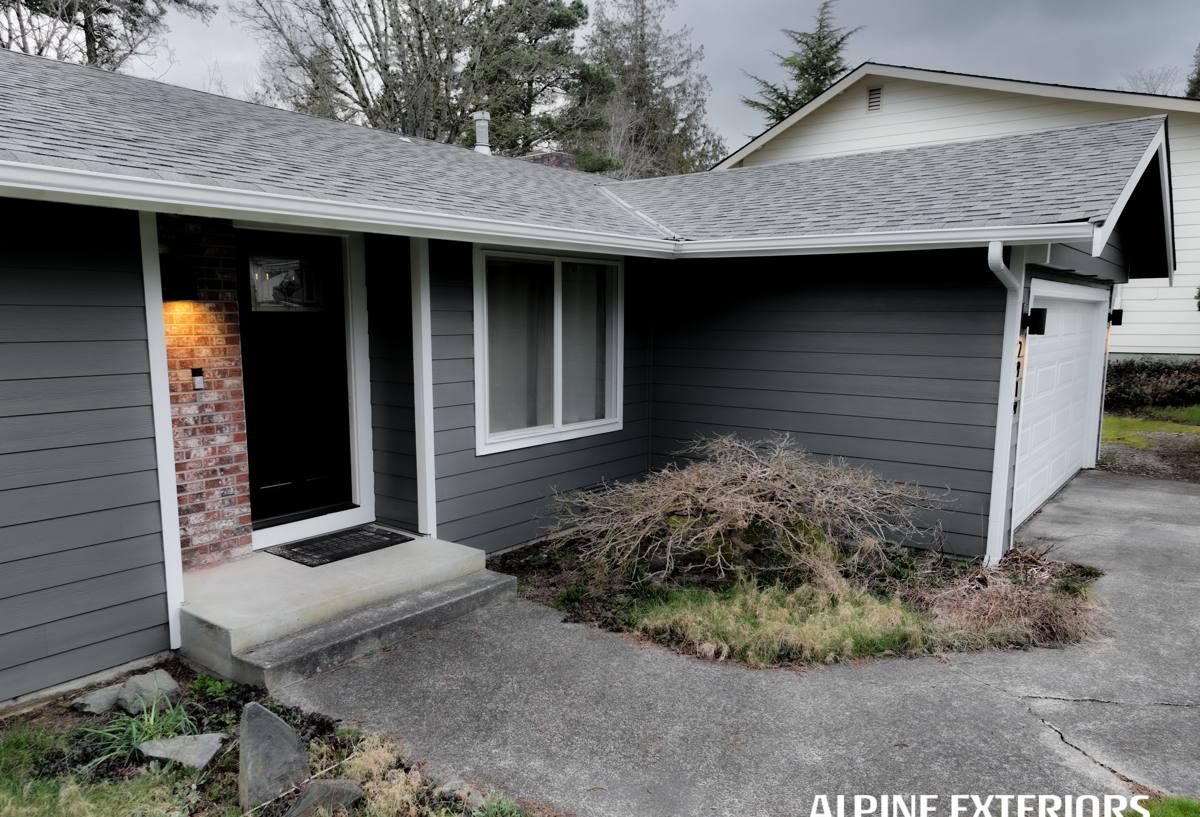
The Repair Problems We See Most Often in Point Roberts
Every siding material has its own failure points, but the marine exposure in Point Roberts tends to push the same handful of issues to the front:
- Moss and algae buildup on north-facing walls and anywhere siding stays shaded and damp, which holds moisture against the surface far longer than it should sit there
- Caulk and sealant failure around trim, window and door casings, and butt joints — salt air and UV exposure break down sealants faster than in drier inland areas
- Corroded or backed-out fasteners, especially on older installations where standard nails or staples were used instead of corrosion-resistant fasteners
- Rot at the bottom courses and trim where wind-driven rain collects and wicks upward, particularly on the weather-exposed sides of a house
- Warping or delamination on wood-based and engineered wood siding products that have absorbed repeated moisture cycles
- Cracked or brittle sections on older vinyl siding that has spent years cycling through temperature swings and salt exposure
None of these are unusual siding problems on their own. What's different in Point Roberts is how much faster they show up and how often they cluster together on the same wall, because the underlying cause — sustained moisture plus salt exposure — doesn't let up for long stretches of the year.
Why Diagnosis Matters More Than the Patch Itself
The single biggest mistake we see in siding repair — anywhere, not just Point Roberts — is treating the visible damage as the whole problem. A stained or buckled board is usually a symptom, not the cause. Before we touch a single piece of siding, we're trying to answer a more basic question: why did this spot fail while the rest of the wall didn't?
That usually means pulling back the damaged section to look at what's underneath it — the water-resistive barrier, the sheathing, the flashing details around windows and penetrations. In a high-moisture, high-salt environment like Point Roberts, we're specifically checking for:
- Soft or delaminating sheathing behind the damaged area
- Missing, torn, or improperly lapped house wrap
- Flashing that was installed backward, missing entirely, or corroded through
- Signs that moisture has been tracking sideways or downward from a point higher on the wall
If we just cut out the bad board and nail up a new one without checking what's behind it, we're guaranteeing a repeat visit. A correct repair fixes the entry point for moisture, not just the piece of siding that showed the damage first.
When a Repair Turns Into a Bigger Conversation
Sometimes what looks like a single bad board turns out to be evidence of a wider moisture problem — a failed window flashing detail, a section of house wrap that was never properly lapped, or rot that's traveled further into the wall assembly than the surface damage suggests. When that happens, we tell you plainly. Continuing to patch a wall with an underlying moisture problem isn't a favor to a homeowner — it just delays a bigger repair and adds cost. We'd rather give you the honest scope up front.
Repair Considerations by Siding Material
Point Roberts has a mix of siding materials on its homes — vinyl, wood, engineered wood products, and fiber cement among them. What a repair involves, and how well it holds up afterward, depends heavily on what's already on the wall.
| Siding Material | Repair Complexity | Salt Air / Moisture Behavior |
|---|---|---|
| Vinyl | Generally straightforward to patch or replace individual panels if matching stock is available; older colors can be hard to match exactly | Doesn't rot, but becomes brittle with age and UV/salt exposure; cracks rather than bends when stressed |
| Solid wood | Labor-intensive — often requires scraping, treating, priming, and repainting in addition to replacing damaged boards | Absorbs moisture readily; repeated wet-dry cycling in this climate accelerates rot at joints and lower courses |
| Engineered wood (OSB-based) | Moderate to difficult; damaged sections usually need full-panel replacement rather than spot patching | Sensitive to sustained moisture exposure; edge swelling is a common early warning sign |
| Fiber cement (James Hardie) | Straightforward when installed to spec — damaged planks can be cut out and replaced cleanly along existing seams | Non-combustible and dimensionally stable; holds paint and caulk longer, which matters directly in salt-air conditions |
This is part of why we standardized on James Hardie fiber cement for full replacements: it's simply more forgiving in an environment like Point Roberts. That said, repair work is about extending the life of what's already on your house whenever that makes sense — we're not going to tell you to tear off sound siding just because it isn't Hardie.
What a Correct Repair Job Actually Involves
A repair done right in this environment generally follows the same sequence, regardless of material:
- Identify and mark every affected area, not just the spot that was reported
- Remove damaged siding carefully to expose the wall assembly underneath
- Inspect sheathing, house wrap, and flashing for hidden moisture damage or rot
- Repair or replace compromised wrap, flashing, and sheathing before any new siding goes back on
- Install matching or appropriate replacement siding with correct fastener spacing and type
- Re-seal joints, trim, and penetrations with sealants rated for exterior, coastal-adjacent exposure
- Prime and paint as needed so the repaired section weathers consistently with the surrounding wall
Skipping steps 3 and 4 is the most common shortcut in the industry, and it's the one that causes repairs to fail again within a year or two. It's also the part of the job that's easy to skip because it's invisible once the new siding is up — which is exactly why it matters who's doing the work.
Reaching Point Roberts Is Part of the Job
Point Roberts is geographically separated from the rest of Whatcom County — getting a crew, materials, and equipment there means routing through the border, both directions. That's a routine part of how we schedule and staff jobs out there, but it's also exactly the kind of logistical detail that trips up contractors who don't regularly work in the area. Material deliveries, crew scheduling, and even something as simple as a same-day follow-up visit all take more planning in Point Roberts than in a typical Blaine neighborhood job.
A crew that already works this community has that logistics figured out before your job starts. That means fewer delays, fewer surprise trip charges, and a contractor who isn't learning the realities of Point Roberts access on your project's timeline.
Signs Your Point Roberts Home Needs a Siding Repair Now
- Visible moss or dark streaking that keeps returning after cleaning
- Soft or spongy siding when you press on it, especially near the bottom of walls
- Cracked, missing, or shrunken caulk lines around windows, doors, or trim
- Paint that's peeling, bubbling, or failing in a specific area rather than evenly across the wall
- Visible gaps, warping, or buckling in individual boards or panels
- Rust streaks running down from fastener heads or metal trim
- A musty smell or visible staining on interior walls that share an exterior wall with a problem area
Catching any of these early is almost always cheaper and simpler than waiting until the damage spreads into the wall assembly itself.
Repair or Replace? An Honest Look
Not every damaged section needs a full re-side, and not every repair is worth doing on its own. As a general guide: if damage is isolated to one or two areas and the rest of the siding is sound, a targeted repair makes sense. If we're finding moisture problems in multiple, unrelated areas of the same wall, or the siding material itself is nearing the end of its useful life, a partial repair often just delays a larger project without solving the underlying issue. We'll walk you through what we find and give you a straightforward recommendation — including telling you when a repair is genuinely the right call, not just the easier sale.
If you're seeing signs of siding trouble on your Point Roberts home, we're happy to take a look and give you a clear, no-pressure assessment of what's actually going on and what it will take to fix it right. Reach out using the form below to schedule a free estimate.