 Blaine Siding
 Sandy Point's Siding Takes a Different Kind of Beating
Sandy Point sits right up against the water, and that location is exactly why siding here ages differently than siding a few miles inland in Blaine or elsewhere in Whatcom County. Homes in this community are exposed to near-constant marine air, salt-laden wind, and driving rain that comes in sideways off the water during winter storms. Add in a moss season that can stretch from fall through spring under the Pacific Northwest's low winter sun angle, and you have a set of conditions that will find every weakness in a siding system faster than a typical suburban lot would.
We're not talking about cosmetic wear alone. Salt air accelerates corrosion on fasteners and trim metal. Wind-driven rain pushes moisture into joints and laps that would stay dry in a calmer setting. Moss and algae hold dampness against the siding surface for weeks at a time on shaded, north-facing walls. Individually, none of these are dramatic. Together, over years, they're what turns a small, fixable problem into a rot repair that costs many times more.
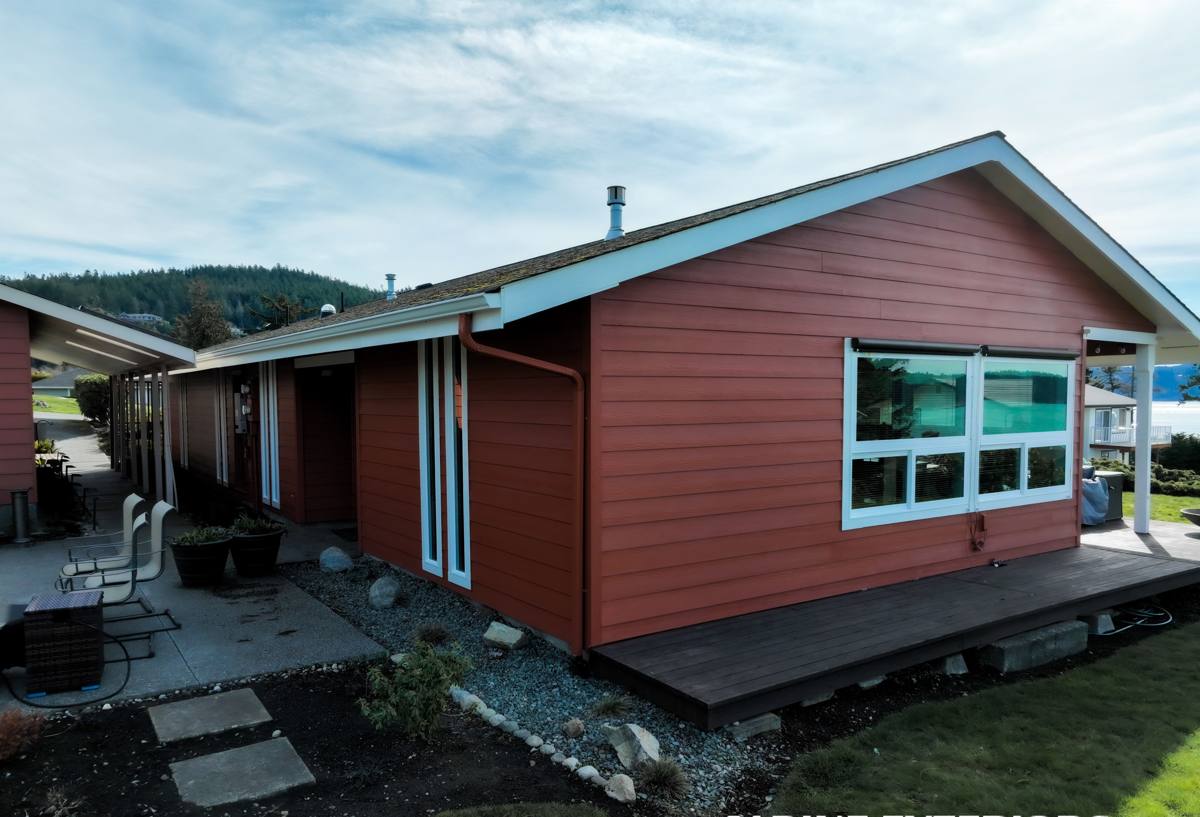
What Siding Repair Actually Means Out Here
"Siding repair" covers a wide range of work, and the right approach depends entirely on what's actually failing underneath the surface. On a waterfront property like this, we typically see:
- Cracked or separated caulk joints at trim, corners, and butt joints, letting wind-driven rain track behind the siding
- Swollen, delaminating, or soft panels where moisture has been getting behind the cladding for a while
- Rusted or failing fasteners, especially on older installations that didn't use corrosion-resistant hardware
- Persistent moss and algae staining on shaded walls and lower courses near grade or landscaping
- Impact damage from storm debris, given how exposed this stretch of coastline can get in winter weather
- Gaps or warping around window and door trim where the original flashing detail was never quite right
A correct repair starts by figuring out which of these is the real cause, not just patching the symptom on the surface. Caulking over a swollen panel, for example, traps moisture in rather than letting the wall dry out, and the problem resurfaces — usually worse — within a season or two.
Diagnosing Before Touching Anything
Before any repair begins, we pull back the affected siding, look at the water-resistive barrier and flashing underneath, and check the condition of the sheathing. This is the step that gets skipped by crews trying to move fast, and it's the single biggest reason repairs fail to hold up in a marine climate like Sandy Point's. If the barrier is intact and the sheathing is sound, a targeted repair is usually the right call. If moisture has been working its way in for a long time, the honest answer is sometimes a larger section replacement rather than a patch that won't last.
Repair or Replace? A Practical Way to Decide
Homeowners often ask us to just fix the visible problem without digging into whether it's worth fixing at all. Here's the framework we actually use when we're standing in front of a wall in Sandy Point:
| Situation | Usually Repair | Usually Replace |
|---|---|---|
| Isolated cracked caulk joints, sheathing dry underneath | Yes | |
| One or two impact-damaged panels, no rot found | Yes | |
| Soft or delaminating panels across multiple wall sections | Yes | |
| Rot found in sheathing or framing behind the siding | Yes | |
| Siding is an older cedar, LP, or vinyl product past its practical service life | Yes | |
| Persistent moss staining but sound material underneath | Yes (repair + cleaning plan) | |
| Multiple prior repairs to the same wall section | Yes |
That last row matters more than people expect. If a wall has already been patched two or three times, the underlying cause hasn't been solved — it's just been covered up again. At some point, section replacement with a properly detailed water barrier is the cheaper option over a five-year horizon, even though the invoice is bigger today.
Why the Siding Material Behind the Repair Matters
We install James Hardie fiber cement siding exclusively, and that standard shapes how we approach repairs, too. When we're patching a wall that's already Hardie, we can match the ColorPlus factory finish and HZ product line with confidence, because it's an engineered, consistent product — not a mixed batch of material with unknown age and fade.
When we're called out to repair a home sided in something else — vinyl, LP SmartSide, Cemplank, Allura, primed spruce, or cedar — we'll still do honest, correct repair work. But we tell homeowners plainly what we see: these products behave differently once water gets behind them. Vinyl can warp and doesn't stop moisture on its own; it depends entirely on the barrier behind it. Wood-based products like cedar and primed spruce absorb moisture readily and are the first to show rot in a wet, salt-air climate like this one. LP SmartSide and other engineered wood products hold up reasonably well when installation and maintenance are kept up, but they still rely on wood fiber, which is more moisture-sensitive than fiber cement over the long run. None of these are "bad" products — they're just a different set of trade-offs, and repeated repair calls on the same wall are often where those trade-offs show up first.
Fiber cement doesn't rot, doesn't feed moss the way wood fiber does, and doesn't warp from humidity swings. In a climate that alternates between soaking rain and salt spray, that's the difference between a repair that holds and one that's back on our schedule next winter.
Fastener and Flashing Details We Don't Skip
A large share of the repeat repair calls we see anywhere near the water trace back to fastener corrosion or missing flashing at trim intersections. On every repair, we use corrosion-resistant fasteners rated for the exposure, and we correct flashing details as we go rather than reinstalling the same setup that failed the first time. It costs a little more time. It's also the part of the job that determines whether the repair lasts five years or fifteen.
Our Repair Process, Start to Finish
- On-site inspection. We walk the exterior, note every area of concern, and probe any soft or suspect siding by hand rather than guessing from the ground.
- Diagnosis. Where damage is suspected, we open up a small section to check the water-resistive barrier, flashing, and sheathing condition before quoting anything.
- Written scope. The homeowner gets a clear explanation of what's failing, why, and what we recommend — repair, section replacement, or a mix of both across the wall.
- Repair work. Damaged material is removed, the barrier and flashing are corrected where needed, and new material is installed to the same standard as new construction — not a shortcut version.
- Finish matching. For Hardie siding, we match ColorPlus finishes so repaired sections don't stand out. For other materials, we're upfront about what can and can't be matched exactly.
- Final walk-through. We review the completed work with the homeowner before calling the job done.
Moss, Algae, and the Maintenance Side of Repair
Even a perfect repair won't stay clean on its own in Sandy Point's shaded, damp microclimate. Moss and algae growth is a maintenance issue as much as a repair issue, and addressing it protects whatever work we've just done. A few habits go a long way:
- Keep gutters clear so overflow isn't running down the siding face during heavy rain
- Trim back vegetation and tree cover that keeps north- and west-facing walls shaded and damp
- Rinse visible moss and algae buildup before it gets a foothold, using gentle low-pressure methods rather than a pressure washer aimed directly at siding joints
- Have caulk joints and trim checked every year or two, since UV and salt air break down sealants faster here than inland
- Address small caulk cracks and gaps promptly — they're a five-minute fix now and a rot repair later
A Homeowner's Quick Walkaround Checklist
Before calling anyone, it's worth doing a slow walk around the exterior and noting what you see. This is the same list our crew works from on an initial inspection:
- Soft spots when you press firmly on the siding, especially near the bottom courses and around windows
- Visible gaps, cracks, or missing caulk at corners, trim, and butt joints
- Streaking, bubbling, or peeling paint, which often points to moisture movement underneath
- Persistent green or black staining that doesn't wash off easily
- Rust streaks below fasteners or trim metal
- Panels that look slightly warped, bowed, or misaligned compared to the wall around them
- Any area that's been patched or caulked more than once in recent memory
If you find two or more of these on the same wall section, it's worth getting a professional look before it turns into a bigger job.
Why Local Experience on This Coastline Matters
Sandy Point isn't a typical Blaine lot, and a crew that's only worked drier, more sheltered sites in Whatcom County can miss things that are second nature to a crew that works this stretch of coastline regularly. That includes knowing which wall orientations take the worst of the wind-driven rain, which fastener and flashing details actually hold up against salt air over time, and how much lead time to build in around winter storm windows so a repair isn't left half-open in bad weather. It also means showing up with the right expectations set from the start — an honest read on whether a wall needs a patch or a proper section replacement, not a guess dressed up as a quote.
We stand behind fiber cement siding because we've seen how it performs against this exact climate over the years, and we bring that same standard to every repair — matching materials correctly, fixing the water management detail that actually failed, and not leaving a homeowner with a patch that's just buying time.
Get a Straight Answer on Your Siding
If you're seeing soft spots, cracked caulk, persistent moss, or siding that's already been patched once or twice, it's worth having someone take an honest look before winter weather makes the problem worse. We offer free, no-pressure estimates for homeowners in Sandy Point and throughout the Blaine area — just fill out the form below and we'll take it from there.