 Blaine Siding
 Siding Replacement for Peace Arch Homes
The Peace Arch area sits on the coastal edge of Whatcom County, close enough to the water and the border that homes here take a different kind of weather beating than siding twenty miles inland. Salt-laden air off the bay, wind-driven rain that hits walls sideways instead of straight down, and a moss season that can stretch from October through May all work on exterior cladding year after year. When siding starts to fail in this neighborhood, it's rarely one dramatic event — it's a slow accumulation of moisture intrusion, coating breakdown, and organic growth that eventually adds up to rot, mold, or a wall assembly that can't do its job anymore.
This page is about one thing: replacing siding correctly on a Peace Arch home, with a product and installation approach built for this specific climate, not a generic one.
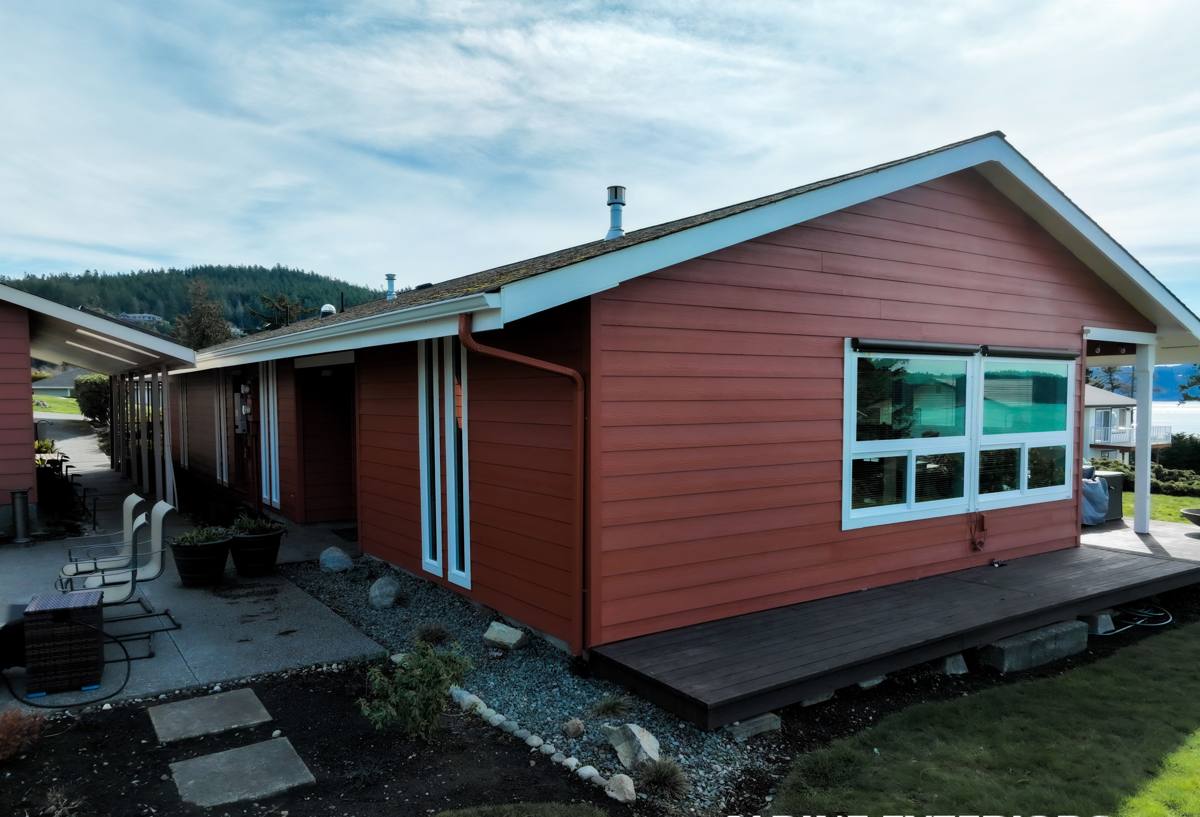
Why Peace Arch's Climate Is Hard on Siding
Three conditions define what siding has to survive here, and most siding failures we see trace back to one of them.
Salt Air
Homes near the water pick up airborne salt that settles on exterior surfaces. Over time it accelerates the breakdown of paint films, corrodes exposed fasteners, and speeds up the weathering of anything not engineered to resist it. Wood-based products and lower-grade coatings show this first — chalking, fading, and fastener staining well ahead of their expected life.
Driving Rain
Storms coming off the Salish Sea don't just fall on a house, they push against it. That matters more than most homeowners realize, because siding is only half the story — the other half is the water-resistive barrier, flashing, and drainage plane behind it. Wind-driven rain finds every gap in caulking, every un-flashed penetration, and every seam that wasn't lapped correctly, and it drives moisture in rather than letting it run off.
Extended Moss Season
Shaded north walls, tree cover, and a long wet stretch of the year give moss and algae months to establish themselves on siding. Beyond the cosmetic issue, sustained moisture trapped under moss and mildew keeps the siding surface — and sometimes the substrate behind it — wet far longer than it should be, which is exactly the condition that leads to rot in wood-based products and coating failure in lesser fiber cement.
Signs a Peace Arch Home Needs Siding Replaced, Not Patched
Not every siding problem calls for a full replacement, but certain signs mean patching is just delaying the inevitable:
- Soft or spongy spots when you press on the siding, especially near the bottom courses and around windows
- Persistent black or green staining that returns quickly after cleaning
- Paint that's peeling or bubbling rather than just fading
- Visible gaps, warping, or buckling panels
- Rust streaks below nail heads or fasteners
- Interior signs — musty smell, peeling interior paint, or soft drywall on an exterior wall
- Siding that's original to a home built before better moisture-barrier practices were standard
If you're seeing two or more of these on the same wall, that's usually a sign the water-resistive barrier behind the siding has already been compromised, not just the visible surface.
What a Correct Siding Replacement Actually Involves
Siding replacement done right is not a cosmetic swap — it's a rebuild of the entire wall's moisture management system. On a Peace Arch home, we treat every one of these steps as non-negotiable given how much water pressure the walls see:
Full Tear-Off and Inspection
Old siding comes off completely so the sheathing underneath can be inspected. Any rot, soft sheathing, or hidden water damage gets addressed before anything new goes on — covering over a compromised wall with new siding just hides the problem for a few more years.
Weather-Resistive Barrier
A proper house wrap or building paper goes on correctly lapped, shingle-style, so water sheds down and out rather than working its way behind the barrier. This is the layer that actually keeps driving rain out of the wall assembly — the siding itself is the first line of defense, not the only one.
Flashing at Every Penetration
Windows, doors, vents, hose bibs, and any other wall penetration get properly flashed and integrated with the weather barrier. This is where most water intrusion actually starts on homes in wet coastal climates, and it's the step that gets rushed on lower-budget jobs.
Correct Fastening and Clearances
Fiber cement siding has manufacturer-specified nailing patterns, clearances from grade, roof lines, and decks, and gapping requirements at butt joints. Getting these wrong doesn't show up immediately — it shows up in three to five years as trapped moisture, cracking, or premature coating failure.
Why We Install Only James Hardie Fiber Cement
We standardized on James Hardie siding and don't install vinyl, LP SmartSide, primed spruce, cedar, or other fiber cement brands. That's a deliberate call based on what actually holds up in this climate, not brand preference.
Fiber cement, done right, doesn't rot, doesn't feed moss the way wood-based products can, and doesn't warp or become brittle in prolonged wet-dry cycling the way some engineered wood products do under sustained coastal moisture. James Hardie's ColorPlus factory-applied finish is baked on under controlled conditions, which gives it more consistent resistance to fading and chalking from salt air and UV than field-applied paint. Hardie also engineers specific product lines — including HZ5 formulations — for climate zones like ours, accounting for moisture exposure rather than using a one-size-fits-all formula. And the warranty structure is transferable and backed by a manufacturer with decades of fiber cement manufacturing behind it, which matters when you're making a siding decision meant to last 30-plus years.
None of this means other products are junk — vinyl is inexpensive and low-maintenance in mild climates, and cedar has real aesthetic appeal. But we've made a professional judgment that in a salt-air, high-rainfall, long-moss-season environment like Peace Arch, those trade-offs aren't ones we're willing to put our name behind.
Comparing Siding Options for This Climate
| Factor | James Hardie Fiber Cement | Vinyl | Wood / LP SmartSide |
|---|---|---|---|
| Moisture resistance | High — non-combustible, engineered for wet climates | Moderate — can warp, water can get trapped behind panels | Variable — vulnerable to rot if coating or edge sealing fails |
| Moss/algae resistance | Good with factory finish; cleans up well | Fair — surface can stay damp longer | Lower — organic material can promote growth if moisture is trapped |
| Salt air durability | Strong — factory-cured finish resists chalking and fading | Can become brittle and discolor over time | Coating needs more frequent maintenance near salt air |
| Fire resistance | Non-combustible | Combustible | Combustible |
| Typical lifespan (installed to spec) | 30+ years | 20-30 years | 15-25 years, coating-dependent |
| Maintenance | Periodic washing, repaint on your schedule (decades out) | Low, but damage often means full panel replacement | Regular repainting/resealing to protect against moisture |
What Drives the Cost of a Siding Replacement
Every home is different, but the same handful of factors drive the price on most Peace Arch siding jobs:
| Cost Factor | Why It Matters |
|---|---|
| Home size and wall complexity | More square footage and more corners, gables, and cutouts mean more material and labor |
| Sheathing condition | Rot repair discovered during tear-off adds cost but is far cheaper than ignoring it |
| Siding profile and trim | Lap width, trim boards, and accent details affect material and install time |
| Number of window and door penetrations | Each one needs individual flashing and detail work |
| Access and site conditions | Multi-story walls, tight lot lines, or landscaping can add labor |
| Existing siding removal | Layered old siding or asbestos-era materials can add disposal steps |
We don't quote broad ballpark numbers on this page because every Peace Arch home is different — that's exactly what the free estimate below is for.
Our Process for Peace Arch Homeowners
- On-site inspection of existing siding, sheathing condition where accessible, and problem areas you've noticed
- A written scope and estimate that spells out product, prep work, and any anticipated repairs
- Full tear-off, sheathing inspection, and repair of any rot or damage found underneath
- Weather-resistive barrier and flashing installed to manufacturer and code standards
- James Hardie siding installed to specified nailing patterns, clearances, and joint treatment
- Final walkthrough so you understand what was done and why
Why Local Experience in Peace Arch Matters
A crew that regularly works this part of Whatcom County already knows how the weather behaves on these lots — which walls take the worst wind-driven rain, where moss tends to establish first, and how much clearance salt-air conditions really call for around grade and hardscaping. That's not something you get from a general contractor who does one job in the area and moves on. It shows up in the details: correct flashing sequencing, realistic fastening schedules for this exposure, and product choices matched to what actually survives here rather than what's cheapest to install.
If your Peace Arch home is showing signs of siding failure, or the existing siding is simply reaching the end of its useful life, we'd be glad to take a look. We offer free, no-pressure estimates — walk the property with you, explain what we see, and give you a straightforward scope and price with no obligation.