 Blaine Siding
 Why Birch Bay Roofs Wear Differently Than Roofs Inland
Birch Bay sits right on the water, and that changes what a roof has to deal with year after year. Homes here face a steady mix of salt-laden air off the bay, wind-driven rain that doesn't just fall straight down but gets pushed sideways under shingle tabs and around flashing, and a wet season that runs long enough for moss and algae to get a real foothold on north-facing slopes and shaded roof sections. None of these things are dramatic on their own, but together, over a decade or two, they add up to the kind of roof failures we see most often out here: lifted or cracked tabs at the edges, rusted-out fasteners and flashing, and moss mats that hold moisture against the shingle surface long after a storm has passed.
A roof built for a dry inland subdivision in eastern Washington doesn't need to think about any of that. A roof in Birch Bay does. That's the difference between a roofing job that looks fine at installation and one that's actually going to hold up through Whatcom County winters.
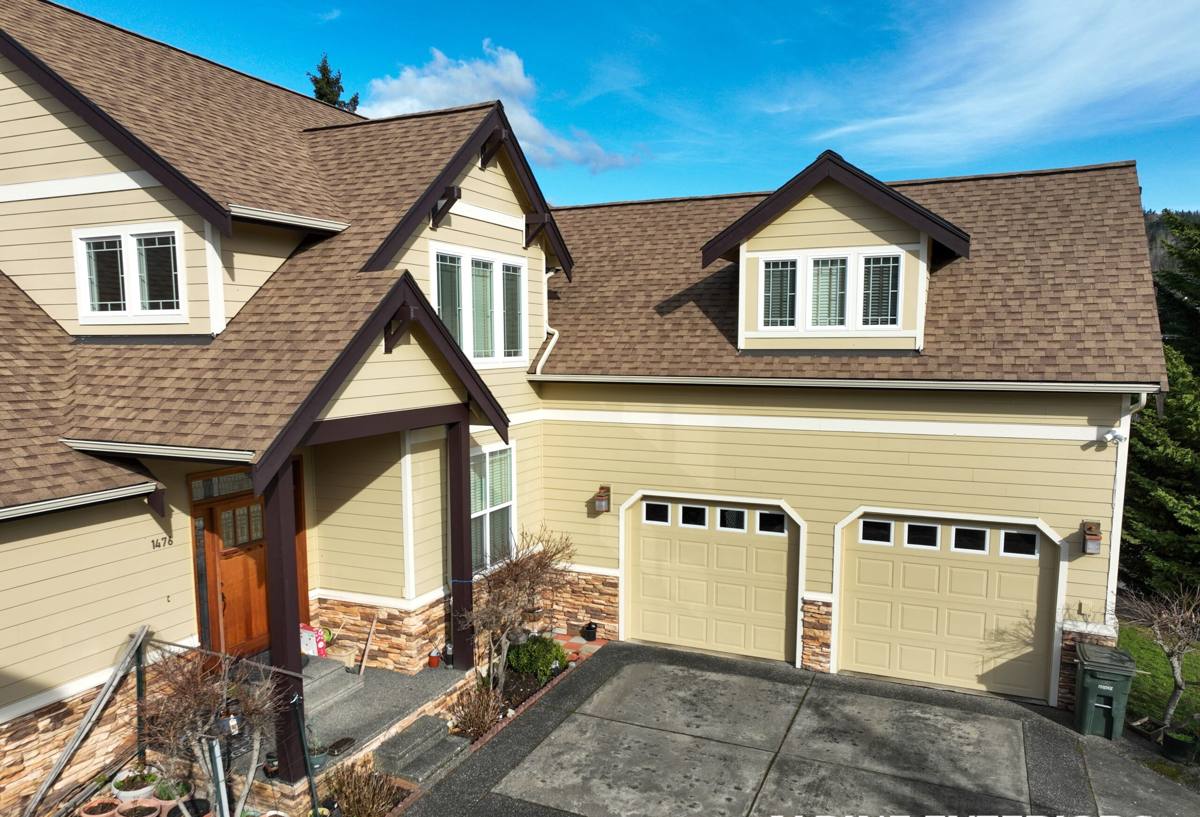
What Salt Air and Coastal Exposure Actually Do to a Roof
Metal Components Take the First Hit
Asphalt shingles themselves are fairly resistant to salt, but the metal parts of a roofing system aren't as forgiving. Flashing around chimneys, valleys, skylights, and roof-to-wall transitions, along with exposed nail heads and roof vents, are all vulnerable to accelerated corrosion in a marine air environment. Once flashing starts to rust and thin out, it stops doing its job of shedding water, and that's usually where a leak starts — not in the field of the shingles themselves.
Why Material Choice Matters More Near the Bay
This is why we pay close attention to the grade of flashing, fasteners, and vent components we spec for homes close to the water. Standard galvanized hardware can hold up fine inland but corrode noticeably faster with regular salt exposure. On Birch Bay homes we lean toward corrosion-resistant flashing and fastener options and make sure they're installed correctly the first time, since replacing failed flashing later usually means pulling shingles to get at it.
Wind-Driven Rain: The Other Half of the Equation
Birch Bay gets its share of storms rolling in off the water, and the rain that comes with them rarely falls straight down. Wind pushes it sideways and even upward under shingle edges, which is a very different stress than a calm, vertical rain. A roof that's watertight in dry, still conditions can still leak during a windstorm if the installation didn't account for wind-driven moisture.
That comes down to a few specific details done right:
- Proper shingle nailing pattern and nail placement — high-nailed or underdriven shingles are far more likely to lift in wind
- Correct overlap and exposure on each course, not just "close enough"
- Self-sealing shingle strips fully activated, which depends on installing at the right temperature and giving them time to bond
- Underlayment that's actually a water barrier, not just a nailing surface, especially at eaves and valleys
- Ice-and-water shield or equivalent membrane at vulnerable transitions — valleys, eaves, and around penetrations
Any one of these done poorly is a future leak waiting for the right storm. We treat wind-driven rain as the baseline condition to design for here, not an occasional worst case.
Moss, Algae, and Whatcom County's Long Wet Season
Whatcom County doesn't get a short, sharp rainy season — it gets a long stretch of overcast, damp weather that gives moss and algae plenty of time to establish themselves, especially on north-facing roof planes, shaded areas under trees, and low-slope sections that don't dry out quickly between rains. Moss isn't just a cosmetic problem. As it grows, it lifts shingle tabs slightly, holds water against the shingle surface, and works its root structure into the granule layer that protects the asphalt underneath from UV and weather damage. Over time that shortens the life of the shingle underneath it.
What Moss Prevention Actually Looks Like
Full moss removal and treatment can be part of a maintenance conversation, but at the installation stage, there's a real, lasting decision to make: whether to install zinc or copper control strips near the ridge on shade-prone slopes. Rain washing over these strips carries trace metal ions down the roof that inhibit moss and algae growth for years. It's not a guarantee against moss forming anywhere on the roof, but on the shaded slopes where Birch Bay homes struggle most, it meaningfully extends the time between cleanings and reduces the granule loss that comes with letting moss sit untreated.
What a Correctly Installed Asphalt Shingle Roof Includes
A shingle roof is a system, not just a layer of shingles nailed to plywood. Each component below plays a specific role, and skipping or cutting corners on any one of them is usually where problems start.
| Component | Role | Why It Matters in Birch Bay |
|---|---|---|
| Deck inspection and repair | Solid, dry nailing surface | Coastal moisture can hide rot under old shingles; a compromised deck won't hold fasteners securely |
| Underlayment | Secondary water barrier | Backstops the shingles during wind-driven rain and wherever water gets past the shingle layer |
| Ice-and-water membrane | Sealed protection at vulnerable spots | Valleys and eaves see concentrated water flow during heavy coastal storms |
| Drip edge | Directs water off the roof edge into gutters | Prevents water from wicking back under the fascia in wind-driven conditions |
| Flashing (chimney, valley, wall, vent) | Seals transitions and penetrations | The most common leak point, and most exposed to salt-air corrosion |
| Shingles, correctly nailed | Primary weather layer | Nailing pattern and exposure directly affect wind resistance |
| Ridge and soffit ventilation | Moisture and temperature control in the attic | Poor ventilation traps humid coastal air, accelerating deck rot and shingle aging from below |
| Zinc/copper control strips | Moss and algae suppression | Addresses the long, damp Whatcom County moss season directly |
Our Process for Birch Bay Roofing Jobs
Assessment
We start by looking at the whole roof system, not just the shingle surface — deck condition, existing flashing, ventilation, and any signs of past moss or water damage. On coastal homes we pay particular attention to flashing condition and any corrosion on metal components, since that tells us a lot about how the roof has actually been holding up against the salt air, independent of how the shingles look from the ground.
Scope and Materials
We walk through what the roof actually needs — full replacement, partial repair, or targeted flashing and ventilation fixes — and spec materials appropriate for a coastal exposure rather than defaulting to whatever's standard inland. That includes flashing grade, fastener type, and whether moss control strips make sense for the shade pattern on your specific roof.
Installation
Tear-off and deck repair where needed, correct underlayment and membrane placement at vulnerable areas, proper nailing and exposure on every course, and flashing installed to actually shed water rather than just cover the gap. We don't install shingles outside the manufacturer's temperature range for sealing, since a shingle that hasn't sealed properly is more likely to lift in the first windstorm it faces.
Final Check
We walk the finished roof, check flashing and penetration seals, confirm ventilation is functioning, and go over what you should watch for and when it makes sense to have moss or debris cleared in future years.
Repair, Partial Replacement, or Full Replacement?
Not every roof issue in Birch Bay means a full tear-off. The right call depends on the age of the roof, how widespread the damage or wear is, and what's driving the problem in the first place.
- Localized repair makes sense for isolated flashing failures, a section of wind-lifted or cracked shingles, or a single leak with a clear, contained cause on an otherwise sound roof
- Partial replacement fits when one slope — often the north-facing or heavily shaded side — has taken the brunt of moss damage or sun exposure while the rest of the roof is in decent shape
- Full replacement is the honest answer when the shingles are broadly past their service life, granule loss is widespread, or repeated repairs are treating symptoms of a system that's simply worn out
We'll tell you plainly which category your roof falls into. Recommending a full replacement when a repair would genuinely hold up doesn't serve either of us, and neither does patching a roof that needs real work.
Maintenance That Actually Extends a Birch Bay Roof's Life
Even a well-installed roof benefits from a bit of attention given the local conditions. Keeping gutters clear so water isn't backing up under the eaves during heavy rain, having moss physically removed (not just chemically killed and left in place) before it builds into a thick mat, and having flashing and penetrations checked periodically for early signs of corrosion or lifting all go a long way. None of this is complicated, but it's the kind of upkeep that's easy to skip until it turns into a repair bill.
Why It Matters That We Already Work in Birch Bay
Roofing crews who mostly work drier, inland areas don't always think about salt-air corrosion on flashing, or plan for wind-driven rain as the normal condition rather than the exception, or know how aggressive moss gets on a shaded roof slope this close to the water. That's not a knock on general roofing skill — it's just a different set of conditions than what most of Washington's roofing work involves. Working in and around Blaine and Birch Bay regularly means we're already accounting for these factors before the first shingle goes down, not discovering them the first time a homeowner calls about a leak.
If you're dealing with a leak, visible shingle damage, heavy moss buildup, or you're just trying to figure out how much roofing life you have left, we're glad to take a look. Reach out for a free, no-pressure estimate using the form below.