 Blaine Siding
 Why Dakota Creek Decks Age Differently
A deck in the Dakota Creek area doesn't fail the same way a deck fails in a dry inland climate. Out here, the wear pattern is driven by three things working together: salt-laden air coming off the water, long stretches of driving rain, and a moss season that can run from fall through spring. None of these alone would be a big deal. Combined, and repeated year after year, they find every weak point in a deck's design and materials.
Salt air accelerates corrosion in fasteners, joist hangers, and any exposed metal hardware. Once a nail or screw starts rusting, it swells slightly, splits the wood fibers around it, and gives water a path deeper into the structure. Driving rain compounds this by hitting the deck at an angle instead of falling straight down, which pushes moisture into seams, ledger connections, and end-grain cuts that a vertical rainfall would never reach. And moss doesn't just sit on the surface looking bad — it holds moisture against the decking boards and framing for weeks at a time, which is exactly the condition wood rot and fastener corrosion need to take hold.
We've replaced enough decks in this part of Whatcom County to know that a deck built without these three factors in mind rarely makes it to a normal service life, no matter how good it looked the day it was finished.
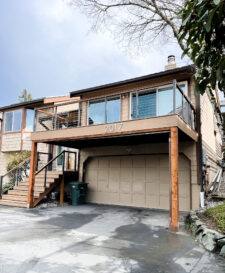
Signs a Deck Needs Replacement, Not Just Repair
Homeowners often ask us to "just fix the bad boards." Sometimes that's genuinely all that's needed. Other times, replacing a few boards is a temporary patch on a structure that's already failing underneath. Here's how we tell the difference on-site.
- Soft or spongy decking in multiple, unconnected spots usually means moisture has gotten under the surface finish, not just worn it off.
- Rust streaking below fastener heads or joist hangers is a sign the hardware itself is corroding, not just the wood surface staining.
- Movement at the ledger board — any bounce, gap, or visible separation where the deck meets the house — is a structural red flag, not a cosmetic one.
- Persistent moss or black staining that comes back within weeks of cleaning, even after a fresh wash, points to a moisture-trapping design issue, not a cleaning problem.
- Posts or footings that feel loose underfoot, especially near grade level where splash-back and standing water are common.
If only one of these shows up in one spot, repair is often reasonable. If we find two or three of these together, that's usually a sign the deck's substructure has been absorbing moisture for years and a full replacement is the honest recommendation — not because it's more work for us, but because a repair on a failing frame just fails again in a season or two.
What a Correct Deck Replacement Actually Involves
A deck replacement done right is a structural project, not a cosmetic one. The decking boards are the part everyone sees, but the parts that determine whether the deck lasts are underneath.
Ledger and House Connection
The ledger board — where the deck attaches to the house — is the single most important connection on the whole structure, and it's also the point most exposed to wind-driven rain. We flash this connection properly, with the flashing lapped correctly behind the house's water-resistive barrier or siding, not just caulked over the top. Caulk alone is not a flashing detail; it's a maintenance item that will eventually fail.
Framing and Footings
Joists, beams, and posts need to be sized for the actual span and load, not just matched to what was there before. Footings need to sit below frost depth and bear on undisturbed or properly compacted soil. In areas with poor drainage or heavier clay content, we may recommend larger or deeper footings than the minimum code requires, simply because it costs little extra at construction time and prevents settling later.
Fasteners and Hardware
Given the salt air in this area, we use corrosion-resistant, coated fasteners and connectors rated for exterior and ground-contact use — not general-purpose hardware. This is one of the most common shortcuts we see on decks that failed early, and it's one of the least visible to a homeowner until the damage is already done.
Drainage and Airflow Underneath
A deck that traps moisture underneath will grow moss and rot from below, out of sight. We grade and, where needed, add ventilation gaps or drainage detailing so air can move under the deck and water doesn't pool against posts or framing.
Decking Material Options for This Climate
There's no single "best" decking material for every home — it depends on budget, maintenance tolerance, and how much moss and moisture exposure the specific site gets. Here's an honest comparison of the main options we install.
| Material | Moisture/Moss Resistance | Maintenance | Typical Lifespan |
|---|---|---|---|
| Pressure-treated wood | Good if sealed regularly; end grain and fastener points are the weak spots | Annual cleaning and re-sealing recommended | 15–20 years with upkeep |
| Cedar | Naturally decay-resistant but still needs finish maintenance in wet climates | Periodic cleaning, staining, or sealing | 15–25 years with upkeep |
| Composite decking | Very good — doesn't absorb water like wood, but surface can still hold moss film if not cleaned | Occasional washing, no staining/sealing | 25–30+ years, manufacturer-warrantied |
| PVC/capped polymer | Excellent — fully moisture-sealed board, minimal moss adhesion | Lowest maintenance of the group | 25–30+ years, manufacturer-warrantied |
We install all of these depending on what the homeowner wants, but for decks with heavy shade, north-facing exposure, or a history of moss buildup, we usually steer the conversation toward composite or capped polymer boards. It's not that wood is a bad material — it's that wood in a shaded, damp, salt-air spot requires a maintenance commitment a lot of homeowners underestimate when they're picking materials at the start of a project.
Cost Factors Homeowners Should Understand
We don't publish fixed prices because deck replacement cost depends heavily on site conditions, but these are the factors that actually move the number, in rough order of impact.
| Factor | Why It Matters |
|---|---|
| Deck size and height | Larger decks and multi-level or elevated decks need more framing, more footings, and more labor time |
| Substructure condition | Rotted framing or failed footings found once demo starts adds cost — this is why we inspect before quoting whenever possible |
| Decking material chosen | Composite and PVC boards cost more up front than wood but reduce long-term maintenance spending |
| Railing and stair complexity | Custom railing designs, multiple stair sets, or code-required guardrail changes add labor and material |
| Site access | Decks over slopes, near tight side yards, or requiring material to be hand-carried cost more in labor time |
We walk through each of these with the homeowner during the estimate so there are no surprises once work starts — and if we find hidden rot or a footing problem mid-project, we stop and talk to you before proceeding, not after.
Our Process, Start to Finish
- On-site assessment. We inspect the existing deck, ledger connection, framing, and footings to determine what's actually salvageable versus what needs full replacement.
- Written estimate. You get a clear breakdown of scope, materials, and price — no vague allowances that turn into surprise charges later.
- Permitting. We handle the permit process where required so the work is inspected and legal, protecting you at resale and with insurance.
- Demolition and disposal. Old decking, framing, and debris are removed and hauled off; we don't leave a jobsite full of scrap wood.
- Structural rebuild. Ledger flashing, framing, footings, and hardware go in to current code and to a standard that accounts for this area's rain and salt exposure — not just the code minimum.
- Decking, railing, and finish work. Boards, railings, and stairs are installed to manufacturer spec, with attention to fastener pattern and board spacing for proper drainage.
- Final walkthrough. We go over the finished deck with you, including what maintenance (if any) the material you chose will need going forward.
Permits, Codes, and Inspections
Deck replacement in Blaine and Whatcom County typically requires a building permit once you're past minor repair work, particularly for decks attached to the house, elevated decks, or any deck with guardrails. Permitted work means an inspector checks the ledger connection, footing depth, and structural framing before it's covered up — which is exactly the part of a deck a homeowner can't check themselves once decking boards are down. We pull permits as part of our process rather than treating it as optional, because unpermitted deck work can become a real problem at resale or with a homeowner's insurance claim if something goes wrong later.
Maintenance Checklist for a New Deck
Whatever material you choose, a little seasonal attention goes a long way in this climate. Here's what we recommend to every Dakota Creek homeowner after a replacement.
- Sweep or blow off leaves and debris regularly, especially in fall — trapped debris holds moisture and feeds moss growth.
- Rinse or wash the deck surface at least once or twice a year to remove moss spores and algae film before they take hold.
- Check fastener heads and railing hardware annually for early rust staining, and address it before it spreads into the wood.
- Keep gutters and downspouts clear so roof runoff isn't dumping extra water directly onto or under the deck.
- For wood decking, plan on re-sealing or staining on the schedule the product calls for — skipping a cycle in this climate shortens the board's life noticeably.
- Trim back overhanging vegetation that keeps sections of the deck shaded and damp longer than the rest.
Why Local Experience in Dakota Creek Matters
A deck built to a generic spec sheet can look fine on paper and still underperform here. Crews who haven't worked this specific stretch of the Whatcom County coastline don't always account for how much moss pressure a shaded, north-facing deck will see, or how quickly unprotected hardware corrodes this close to the water. We've worked on homes throughout Blaine and the Dakota Creek area long enough to know which details actually matter on this ground — not just which details are technically up to code.
That local pattern recognition shows up in small decisions: where we add extra ventilation gaps, which fastener coating we default to, how we detail the ledger flashing, and which decking materials we steer homeowners toward when a site gets heavy shade or salt exposure. None of it is exotic — it's just experience applied consistently, on the same kind of homes, in the same climate, over time.
If your deck is showing its age, or you just want an honest read on whether it needs repair or full replacement, we're happy to take a look. Reach out for a free, no-pressure estimate using the form below.