 Blaine Siding
 Windows Built for Everson's Weather, Not Just Any Weather
Whatcom County doesn't get extreme weather so much as it gets persistent weather. Out here, the challenge for windows isn't a single hard freeze or a single big storm — it's month after month of driving rain, damp air, and shaded moss growth that never fully lets a house dry out. Our crew works out of Blaine, where salt-tinged air off the water is part of daily life for window hardware and finishes, and we bring that same attention to detail inland to Everson, where the moisture problem shows up differently: valley fog, humidity off the Nooksack River corridor, and long stretches of gray, wet days that keep siding and window frames damp far longer than homeowners in drier climates ever have to deal with.
Windows that aren't built or installed for this kind of sustained moisture exposure don't usually fail dramatically. They fail slowly — a soft spot in the sill, a seal that fogs between panes, a corner joint that lets in a draft you can feel but not quite locate. By the time it's obvious, you're often looking at frame or sheathing damage behind the window, not just the window itself. That's the real argument for energy-efficient replacement windows in this area: it's not only about a lower heating bill, it's about keeping water out of your wall assembly year-round.
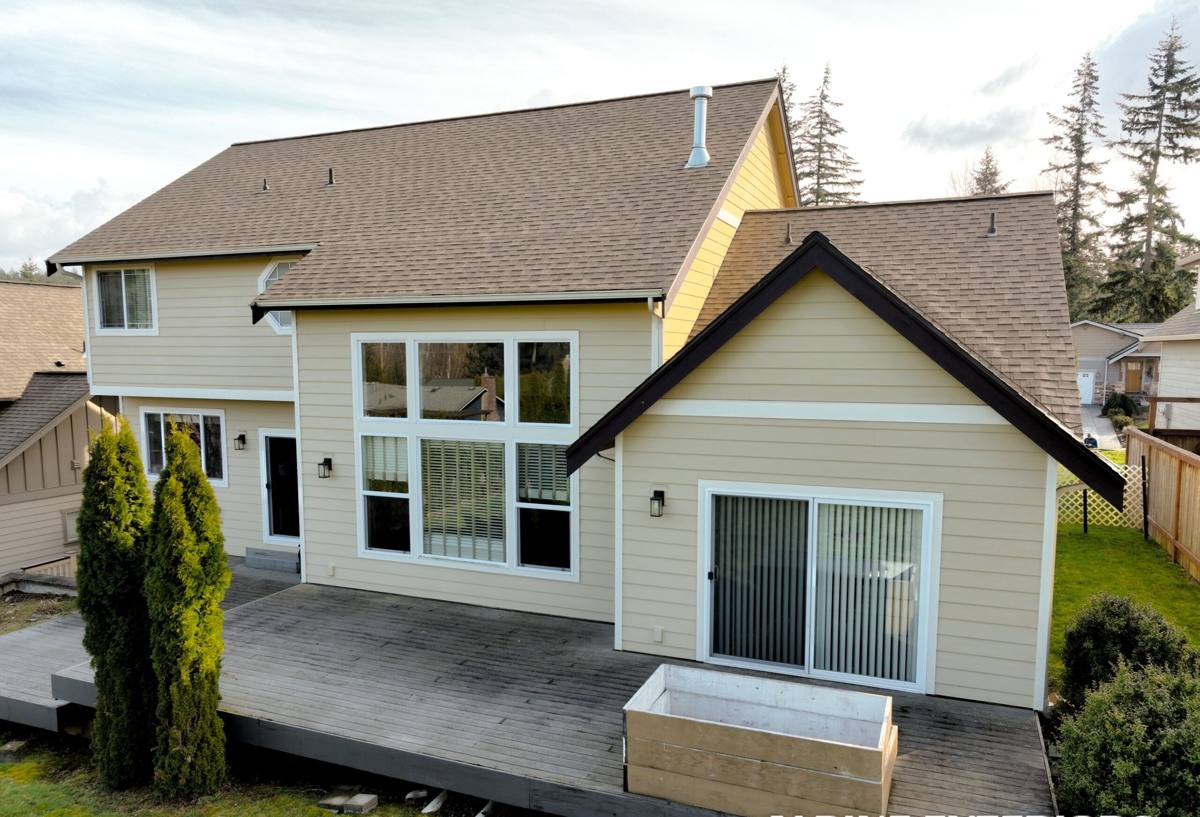
What "Energy-Efficient" Actually Means for a Whatcom County Home
"Energy-efficient" gets used loosely in this industry, so it's worth being specific about what actually matters for a home in this climate. Every legitimate replacement window carries an NFRC (National Fenestration Rating Council) label with a few key numbers:
- U-factor — measures how well the window resists heat loss. Lower is better; in our climate, look for U-factor in the 0.27–0.30 range or better.
- SHGC (Solar Heat Gain Coefficient) — measures how much solar heat passes through. In the Pacific Northwest, where winter heat gain is welcome and summer overheating is rarely severe, moderate SHGC values usually strike the right balance.
- Air leakage rating — measures drafts through the assembly itself, separate from installation quality. Even a great window performs poorly if it's installed with a bad air seal.
Glass Packages That Make Sense Here
Double-pane, low-E, argon-filled glass is the practical standard for this region — it balances upfront cost against real-world performance in a marine climate with mild winters and mild summers. Triple-pane glass exists and does perform better on paper, but for most Whatcom County homes the added cost doesn't pencil out against the incremental efficiency gain, given our winters rarely see the deep cold that makes triple-pane worth it elsewhere. We'll walk through the trade-off honestly rather than upsell glass a home doesn't need.
Frame Materials and Moisture
Frame material matters as much as glass in a climate like ours, because the frame is what takes the direct hit from driving rain and standing moisture at the sill. Vinyl and fiberglass frames handle sustained wet weather well because they don't absorb water or require refinishing. Wood and wood-clad frames can look excellent, but they demand upkeep — recaulking, repainting, and vigilance around the cladding seams — that a lot of homeowners underestimate until moss and mildew start showing up on the exterior face. We're upfront about that maintenance burden rather than letting a homeowner find out the hard way three winters in.
Signs Your Current Windows Are Costing You Money
Most homeowners don't replace windows because one window fails outright — they replace them because a handful of smaller symptoms add up. Here's what we tell Everson homeowners to watch for:
- Fogging or a milky haze between the panes (a failed seal — the argon gas has escaped and moisture has gotten in)
- A noticeable draft near the frame even when the window is fully latched
- Condensation forming on the inside of the glass regularly, especially in bedrooms and bathrooms
- Visible gaps, cracked caulk, or soft wood at the sill or exterior trim
- Windows that are difficult to open, close, or lock — often a sign the frame has shifted or swollen
- A heating bill that's crept up over a few years without a clear explanation
- Moss or dark staining building up on the exterior trim around the window opening
Any one of these on its own might not mean much. Two or three together, especially on a home more than 15–20 years old, usually means the windows are past the point where caulk and weatherstripping alone will fix the problem.
Comparing Window Materials for This Climate
There's no single "best" window material — the right choice depends on budget, how long you plan to stay in the home, and how much upkeep you're willing to do. Here's how the common options stack up for a damp, moss-prone climate like ours:
| Material | Upfront Cost | Maintenance | Moisture Performance | Typical Lifespan |
|---|---|---|---|---|
| Vinyl | Lowest | Minimal — no painting or sealing | Very good; won't rot or corrode | 20–30 years |
| Fiberglass | Mid to high | Low — stable, paintable if desired | Excellent; very stable in wet/temperature swings | 30–40+ years |
| Wood / Wood-Clad | Highest | High — recurring caulk, paint, and cladding checks | Good if maintained; vulnerable if neglected | Varies widely with upkeep |
| Aluminum | Low to mid | Low | Poor thermal performance; prone to condensation | 20–25 years |
For most Everson homes, we steer people toward vinyl or fiberglass — not because other materials are bad products, but because our professional standard is to recommend what will hold up with the least fuss in a climate that gives a window very little downtime between rain events. If you love the look of wood and are willing to keep up with it, we'll install it correctly and tell you exactly what that upkeep schedule looks like.
How We Install Energy-Efficient Windows the Right Way
A quality window installed poorly will underperform a mid-grade window installed correctly — that's true anywhere, but it matters more here because of how much moisture our walls see over a year. Our process is built around keeping water out of the wall assembly at every step, not just getting a new window into the opening.
1. Assessment and Measurement
We check the existing opening for rot, soft sheathing, or prior water intrusion before we ever measure for a new window. If there's hidden damage, we'd rather find it during the estimate than mid-install.
2. Removal and Opening Prep
Old windows come out carefully to avoid damaging surrounding siding or trim more than necessary. Any compromised wood or sheathing gets addressed here — this is the step that gets skipped by crews trying to move fast, and it's the one that causes callbacks two winters later.
3. Flashing and Weather Barrier
Proper flashing tape and a correctly lapped weather-resistant barrier around the new window are what actually keep driving rain out of the wall — the window unit itself is only part of the water-management system. This step matters more in our climate than in drier parts of the country, and it's the step most likely to be shortcut by an unlicensed or rushed crew.
4. Setting, Shimming, and Air-Sealing
The window gets set plumb, level, and square, shimmed correctly so it doesn't bind or sag over time, and air-sealed around the frame with appropriate insulation and sealant — not just a bead of caulk on the exterior trim.
5. Trim, Finish, and Cleanup
Interior and exterior trim gets finished to match the home, hardware is tested, and the job site is cleaned up. We walk the homeowner through operation and basic care before we consider the job done.
Why a Crew That Already Works in Everson Makes a Difference
Everson is part of the Whatcom County service area we work regularly out of our Blaine base, and that matters for a few practical reasons beyond just familiarity with the roads. We know what typical construction looks like on homes of different ages in this part of the county, which affects how an opening is likely to be framed and what we should expect to find once old trim comes off. We're set up for warranty follow-up without a long drive being a barrier to a quick fix. And because we work this climate day in and day out — not occasionally — our default material and installation choices are already calibrated to what actually holds up here, instead of what's popular in a catalog written for a different part of the country.
That local consistency also shows up in smaller ways: knowing which product lines are realistically available and serviceable in this region, understanding permitting expectations for Whatcom County jurisdictions, and being straightforward about timelines that account for our wetter months rather than promising a schedule we can't hold to when the weather doesn't cooperate.
What Affects the Cost of a Window Project
Every home is different, so we don't quote sight unseen, but the main cost drivers on a window project are consistent:
- Number of windows being replaced in the project
- Frame material — vinyl, fiberglass, and wood-clad sit at different price points
- Glass package — standard double-pane low-E versus upgraded coatings or triple-pane
- Opening condition — whether hidden rot or sheathing repair is needed once old windows come out
- Access and window size — second-story or oversized openings take more time and equipment
- Trim and finish work — matching existing interior trim profiles or exterior detail adds labor
We'd rather walk your specific windows and give you real numbers than throw out a broad estimate that doesn't hold up once we're on site.
If your Everson home has windows showing any of the signs above, or you're planning ahead before the wetter months set in, we're happy to take a look and give you a straightforward, no-pressure estimate. Use the form below to get in touch.