 Blaine Siding
 Board & Batten Siding for Grandview Homes
Grandview sits in the part of Blaine where farmland, older homesteads, and newer construction meet the water — close enough to Drayton Harbor and Semiahmoo Bay that salt air is a daily fact of life, not an occasional one. It's also a stretch of Whatcom County that sees long stretches of driving rain off the Strait of Georgia and a wet season that can stretch from October well into spring. Board and batten siding — with its clean vertical lines, wide boards, and narrow battens covering the seams — is a natural fit for the farmhouse and craftsman-style homes common in this area. But that same vertical profile, with its exposed seams and reveals, is less forgiving of a rushed or generic installation than standard lap siding. Done right, it looks sharp for decades. Done wrong, it's one of the faster ways to trap moisture behind a wall.
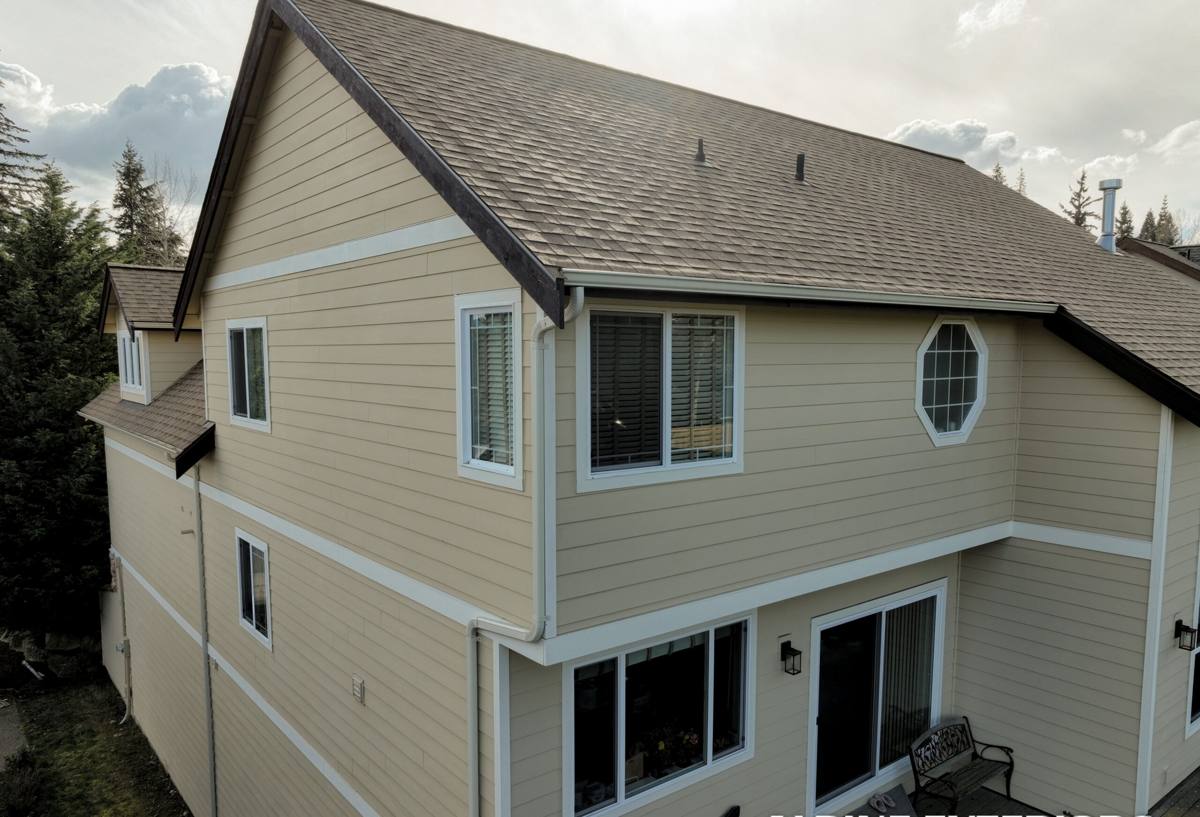
Why Grandview's Climate Is Hard on Vertical Siding
Three things work against siding here, and board and batten interacts with each of them differently than horizontal lap siding does.
Salt Air
Airborne salt from the bay accelerates corrosion on any fastener, flashing, or trim that isn't rated for it, and it degrades cheap coatings faster than inland exposure would. On a board and batten wall, every batten is fastened through the board beneath it — more penetrations per square foot than a lap profile, and every one of them is a potential weak point if the fastener or flashing detail is wrong.
Driving Rain
Wind-driven rain off the water doesn't just run down a wall — it gets pushed sideways and upward into laps, seams, and butt joints. Board and batten has more vertical seams than lap siding, and each one needs a real drainage path behind it, not just a bead of caulk holding back the weather.
Moss Season
Shaded lots, tree cover, and a long damp season mean moss and algae get a running start on any siding that stays wet. Vertical battens create narrow shadow lines and horizontal ledges at trim and flashing where moisture and organic growth like to sit if the assembly doesn't drain and dry properly.
What a Correct Board & Batten Installation Requires
The visual result — evenly spaced battens over clean boards — is the easy part to get right. What separates a siding job that lasts from one that fails early is almost entirely hidden once the crew is finished.
- A drainage plane behind the siding. A weather-resistive barrier (WRB) installed with correctly lapped and taped seams, so any water that gets past the cladding has somewhere to go besides your sheathing.
- A rainscreen air gap. Furring strips or a drainage mat that hold the siding off the WRB, letting bulk water drain and the wall assembly dry between rain events — critical in a climate where "between rain events" can mean a matter of hours.
- Correct flashing at every horizontal transition. Window heads, roof-to-wall intersections, and any horizontal board break need proper flashing, not just caulk, to shed water outward instead of behind the panel.
- Proper batten spacing and fastening. Battens fastened into structural framing or blocking, at the spacing and pattern the manufacturer specifies, with fasteners rated for coastal exposure.
- Factory-finished edges wherever possible, sealed field cuts where not. Cut ends need to be primed and sealed per manufacturer instructions, or they become the first place moisture gets in.
- Clearance from grade, decks, and roof lines. Siding that sits too close to soil, hardscape, or a roof surface stays damp longer and moss finds it first.
Skip any one of these and the siding can still look correct for a year or two before the problems it created start showing up as staining, soft trim, or moss creeping up from the bottom courses.
James Hardie Board & Batten: The Only System We Install
We install James Hardie fiber cement exclusively — no vinyl, no LP SmartSide, no primed spruce or cedar board and batten, and no other fiber cement brands. For a coastal, wet-climate installation like Grandview's, that's a deliberate choice, not a default one.
Hardie's board and batten systems are non-combustible fiber cement, engineered in HZ product formulations for regional moisture and temperature conditions rather than a one-size-fits-all mix. The factory-applied ColorPlus finish is baked on under controlled conditions, which holds color and resists the fading and chalking that field-applied paint struggles with under constant salt exposure and UV. It also comes backed by a real transferable warranty — something that matters more, not less, in a climate that's actively working against the siding from day one.
There are two ways to get a board and batten look with Hardie: true board and batten panels with separate battens over the seams, and vertical HardiePanel with matching battens applied for the same profile. Both give you the same clean, high-contrast look Grandview's farmhouse and craftsman homes tend to call for — the choice comes down to the specific look and budget, and we'll walk through both during your estimate.
Comparing Board & Batten Material Options
| Material | Moisture Behavior in Salt/Rain Climate | Maintenance | Warranty Structure |
|---|---|---|---|
| James Hardie fiber cement | Non-combustible, engineered for regional moisture; stable when installed with proper drainage plane | Occasional wash; factory finish resists fading/chalking | Strong transferable manufacturer warranty |
| Primed wood (spruce/cedar) | Absorbs moisture at cuts and joints; prone to cupping and rot in constant damp exposure | Repaint/reseal cycle, higher upkeep near water | Typically limited or none on the material itself |
| Engineered wood (e.g., LP SmartSide) | Wood-based core; performance depends heavily on sealed edges and correct flashing | Moderate; edge sealing is critical and easy to miss in the field | Manufacturer warranty, often with strict install/maintenance conditions |
| Vinyl board and batten | Doesn't absorb water, but can warp/distort and shows salt film buildup; seams can allow wind-driven rain intrusion | Low, but limited touch-up options if damaged or faded | Warranty often prorated over time |
None of these alternatives are inherently bad products — each has situations where it's a reasonable choice. Our position is narrower than that: for the moisture, salt, and installation-sensitivity realities of Grandview specifically, fiber cement gives us the most predictable long-term result, and James Hardie is the fiber cement system we trust to back it up.
Our Process for a Grandview Board & Batten Project
- On-site assessment. We look at existing wall condition, sheathing, moisture history, sun/shade exposure, and proximity to water or heavy tree cover before recommending anything.
- WRB and rainscreen installation. Weather barrier installed and detailed first, with a drainage gap built in behind the siding — non-negotiable in this climate.
- Flashing at every transition. Windows, doors, roof lines, and horizontal joints flashed before a single board goes up.
- Board and batten installation to spec. Manufacturer-specified fastening, spacing, and clearances, with sealed and primed field cuts.
- Final inspection and walkthrough. We check reveals, fastener lines, and clearances, and walk the finished job with you before we call it done.
Living With Board & Batten in a Salt Air, High-Moss Climate
Correct installation does most of the work, but a little seasonal attention keeps a board and batten exterior looking the way it should for the long haul.
- Rinse salt film and airborne grime off the siding a couple of times a year, especially on walls that face open water or prevailing wind.
- Keep gutters clear so overflow doesn't run down the wall and feed moss growth at the top courses.
- Trim back vegetation and tree cover that keeps any section of wall shaded and damp longer than the rest of the house.
- Watch shaded, low-sun sides of the house for early moss or algae and address it before it spreads across a full wall section.
- Have caulking at trim and penetrations checked periodically — it's a maintenance item, not a permanent seal.
Why a Crew That Already Works Grandview Matters
Board and batten installed correctly in an inland, drier part of Whatcom County can get away with details that simply don't hold up two miles from the water. A crew that works Grandview regularly already knows which walls take the brunt of the wind-driven rain, where moss shows up first, and how much drainage margin to build in rather than guess at. That local pattern recognition shows up in fewer callbacks and a wall assembly that's built for the specific exposure your home actually sees, not a generic specification pulled off a data sheet.
Get a Free, No-Pressure Estimate
If you're considering board and batten siding for a home in Grandview, we're happy to walk the exterior with you, talk through what your specific exposure calls for, and give you a straightforward estimate — no pressure, no upsell. Use the form below to get started.