 Blaine Siding
 Siding Repair for Nooksack: A Whatcom County Climate That Doesn't Go Easy on a Wall
Nooksack sits inland from the water compared to towns like Blaine or Birch Bay, but it isn't spared from what a long Whatcom County wet season does to a house. Marine air still reaches this far into the county, driving rain off the Pacific still pushes sideways into wall assemblies during fall and winter storms, and the mild, damp conditions that support a long moss season here are just as present as they are closer to the coast. The difference isn't whether a Nooksack home takes on exterior wear — it's that the damage tends to build quietly for longer before anyone notices, since this area doesn't get the same reputation for salt exposure that the coastal towns do.
That's exactly why siding repair calls in and around Nooksack often turn up more damage than the homeowner expected from what looked like a small problem. A hairline crack, one soft board, a patch of stubborn staining — by the time it's visible, moisture has usually had a head start. This page is about that one job specifically: what causes siding damage in this part of Whatcom County, what a correct repair actually involves, and how our process works when we're brought in to fix it rather than replace an entire wall unnecessarily.
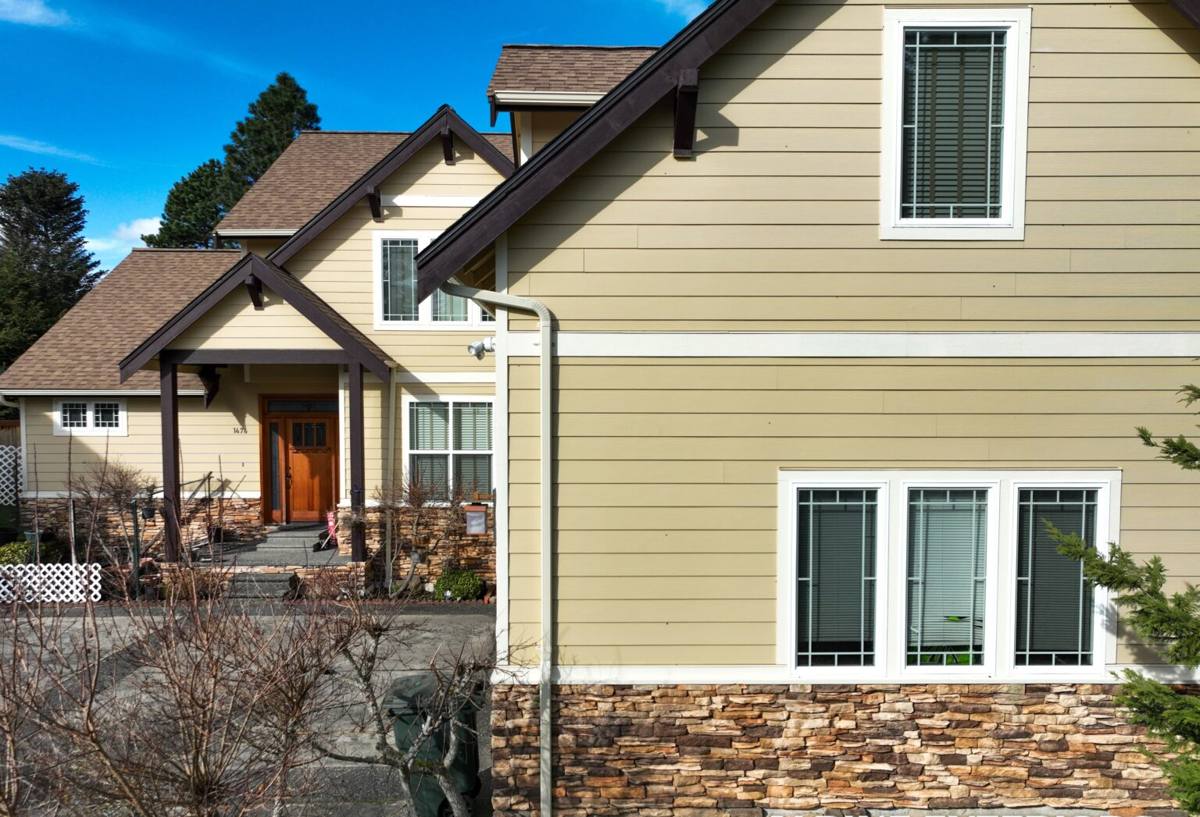
What's Actually Wearing Down Siding in Nooksack
Salt-Tinged Marine Air, Even This Far Inland
Salt air is usually associated with waterfront towns, but Puget Sound and Strait of Georgia marine air moves across Whatcom County more broadly than people assume, and it settles on fasteners, trim, and lower-grade coatings even miles from open water. It's a slower, lower-dose version of what a coastal home deals with, but over years it still accelerates corrosion on exposed metal and wears down a weak finish faster than a truly dry inland climate would.
Driving Rain Through Fall and Winter
Storm systems moving through this part of Washington rarely drop rain straight down. Wind pushes it sideways into siding joints, trim transitions, and anywhere flashing is doing less than it should, which is a harder test on a wall than the same rainfall total falling calmly. Whatcom County's wettest stretch, typically late fall through winter, is when small gaps and aging caulk lines get found out.
A Moss Season That Runs Most of the Year
Mild temperatures and near-constant moisture give moss and mildew a long growing window on shaded and north-facing walls, and Nooksack's mix of tree cover and farmland humidity is a good match for that pattern. Any siding surface with even a little porosity becomes a place for organic growth to take hold, and once it does, it tends to hold moisture against the wall longer than a clean, dense surface would.
Repair or Replace? How We Actually Make That Call
Not every damaged section of siding means the whole wall needs to come off, and not every homeowner who calls about "a repair" actually has a repair-sized problem. We look at three things before recommending either path:
- How far the damage has spread: A few isolated boards or one section near a downspout is a different job than staining and softness running across multiple walls.
- What's happening behind the siding: If the sheathing or house wrap underneath is still sound, a targeted repair usually holds. If moisture has already compromised the wall assembly, patching the surface just hides the real problem.
- Whether a color and profile match is realistic: Older siding, especially discontinued colors or profiles, sometimes can't be matched closely enough to make a small patch look right, which changes whether a repair is the practical choice.
We're upfront when a "repair" call turns out to need a full section replacement, and just as upfront when a homeowner braced for a big job only needs a handful of boards addressed.
What a Correct Siding Repair Actually Involves
Finding Out What's Behind the Damaged Section
Before anything gets patched, we pull back enough of the damaged area to see what the moisture actually did to the sheathing, house wrap, and framing underneath. Skipping this step is the single most common reason a "repaired" section fails again within a year or two — the surface gets fixed while the real problem keeps working underneath.
Matching Material and Finish
When the repair is to James Hardie fiber cement, we match the existing profile and, where possible, the ColorPlus factory finish so the repaired section blends in rather than reading as an obvious patch. If an exact color match isn't available because a line has changed, we tell the homeowner that upfront rather than after the work is done.
Flashing and Moisture Barrier Repair
Any repair that involves an opening in the wall — around a window, a corner, a utility penetration — gets the flashing and house wrap detail put back correctly, lapped to shed water downward and outward. A new board over a broken moisture barrier is a cosmetic fix, not a real one.
Fastening and Sealing to Spec
Replacement boards go in with the fastener type and spacing the manufacturer specifies, and joints and trim transitions get sealed the way the original installation should have been. Loose fastener spacing and skipped sealant are two of the most common causes of the same repair coming back a second time.
Why We Only Repair and Install James Hardie Fiber Cement
We install James Hardie exclusively — not LP SmartSide, vinyl, Cemplank, Allura, primed spruce, or cedar — and that standard shapes how we handle repairs too. Each of those other products has homeowners who are satisfied with them, but from what we've found doing repair work across Whatcom County, they carry trade-offs that show up specifically at repair time:
- Non-combustible fiber cement core: Doesn't feed a fire the way wood-based siding products can, which matters for both safety and insurance considerations on any repair or replacement.
- Factory-applied ColorPlus finish: Baked on under controlled conditions rather than brushed on site, so a properly matched repair section holds its color evenly instead of weathering at a different rate than the surrounding wall.
- Climate-engineered HZ product lines: Hardie's HZ5 formulation is built for sustained moisture and freeze-thaw cycling, which fits this part of Whatcom County's winters better than a generic national formulation.
- Dimensional stability: Doesn't swell, cup, or warp the way engineered wood can after repeated wet-dry cycles, which is exactly the condition that causes many of the repair calls we get on other products.
- Strong transferable warranty: Backed by one of the stronger warranty structures in the industry when installation and repair work follow Hardie's own spec.
We won't patch a Hardie repair with a different material just because it's on hand, and we won't take on repair work on other siding types with the expectation of matching them long-term. When a home has non-Hardie siding failing repeatedly, we're honest that a full replacement onto one system we stand behind is often the more durable answer than another round of patching.
Common Repair Scenarios We See Around Nooksack
| Repair Type | What It Typically Involves | Local Climate Factor |
|---|---|---|
| Cracked or split boards | Removing and replacing individual boards, checking sheathing underneath | Wet-dry cycling through winter widens hairline cracks over time |
| Soft or rotted sections | Cutting back to sound material, repairing house wrap and sheathing before re-siding | Moisture that's tracked in through a failed joint or fastener |
| Failed caulking and open joints | Removing old sealant, re-sealing butt joints and trim transitions to spec | Driving rain finds gaps left by aged or under-applied sealant |
| Loose or popped fasteners | Re-securing with correct fastener type and spacing, sometimes replacing the board | Wind load and repeated moisture cycling working fasteners loose |
| Persistent moss or staining | Cleaning, inspecting the surface underneath, repair or replacement if the material has degraded | Long moss season on shaded, tree-covered lots typical of this area |
These are general patterns, not a quote for your home. The right scope depends on what we find once we're actually looking at the damaged section up close, which is why we walk the property before giving a real number.
Our Repair Process, Start to Finish
- Inspection: We look at the damaged area and enough of the surrounding wall to understand whether the problem is isolated or spreading.
- Diagnosis: We identify the actual cause — a failed joint, a fastener issue, trapped moisture — rather than just noting the visible symptom.
- Scope and estimate: We tell you plainly whether this is a targeted repair or something a patch won't solve, and what it will involve either way.
- Repair: Damaged material comes out, the wall assembly gets corrected if needed, and new material goes in matched as closely as possible and fastened and sealed to spec.
- Final check: We confirm the repair sheds water the way the surrounding wall does before we consider the job finished.
Signs a Nooksack Home Needs Siding Repair Now
- Soft or spongy siding when pressed, especially low on the wall or around window trim
- Cracks or splits, particularly at board ends or around window and door corners
- Moss or dark staining that returns quickly after cleaning
- Gaps, loose panels, or fasteners that have visibly popped or backed out
- Peeling paint or chalky residue on siding that used to hold its finish
- Interior signs along exterior walls — musty smell, soft drywall, or peeling paint near the base of a wall
Why Hiring a Crew That Already Works Nooksack Matters
Siding repair on a home in this part of Whatcom County isn't identical to repair work in a drier inland region, and it isn't identical to a repair a mile from open water either. A crew that regularly works this area — including the Nooksack side of our Blaine-area service territory — has already seen where moisture actually gets in on homes like yours: which wall orientations stay wet longest, which fastener types hold up, and which "quick patches" tend to fail again within a season. That familiarity means fewer surprises mid-job and a more accurate first estimate, because the inspection accounts for how this specific climate behaves rather than applying a generic checklist to every repair call.
If you've got a section of damaged, soft, or aging siding on a Nooksack-area home, we're glad to take a straightforward look and tell you honestly what it needs — a targeted repair, a larger fix, or in some cases, not much at all. Reach out using the form below to schedule a free, no-pressure estimate.