 Blaine Siding
 Why Decks Near Peace Arch Take More Punishment
If you own a home in the Peace Arch area of Blaine, you already know your deck doesn't age the way a deck does forty miles inland. Sitting this close to the water and the border, homes here get a steady diet of salt-laden air off the bay, driving rain that comes in sideways more often than straight down, and a moss season that can stretch from October clear through April. Individually, none of those things is unusual for Whatcom County. Together, on a deck that's exposed to all of them at once, they shorten the life of fasteners, finishes, and framing faster than most homeowners expect.
We're not describing a hypothetical. It's the pattern we see over and over on repair calls in this part of Blaine: a deck that looked fine from a distance but had rust bleeding from fastener heads, soft spots developing where moss held moisture against the boards, and ledger connections that needed a closer look than a quick glance would give them. None of that means your deck was built badly. It means coastal decks need repair work that accounts for what's actually attacking them, not a generic patch job.
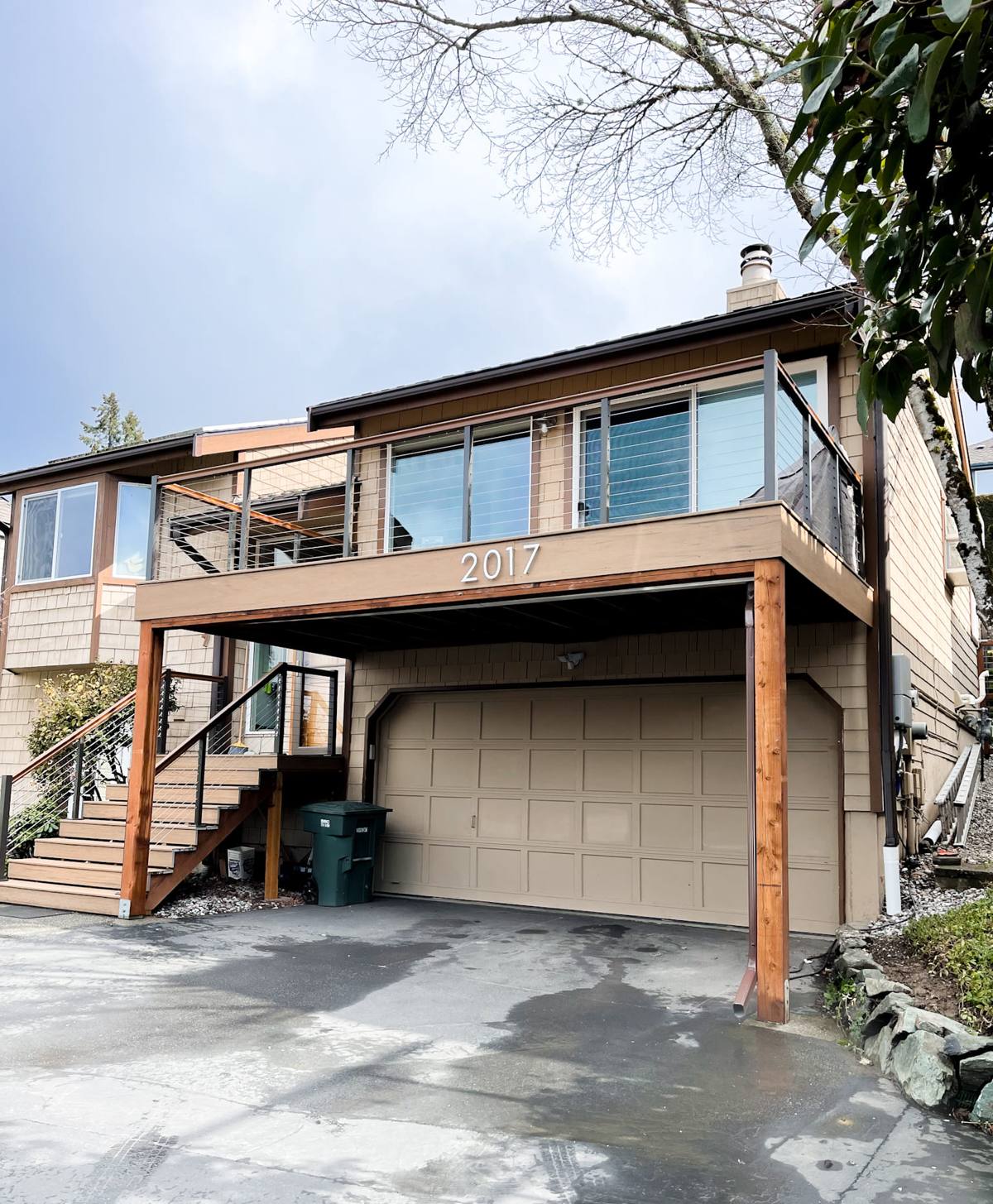
What Salt Air, Rain, and Moss Actually Do to a Deck
Salt Air and Metal Fasteners
Airborne salt accelerates corrosion on anything metal — nails, screws, joist hangers, bolts. Once a fastener starts rusting, it loses holding strength gradually and often invisibly, since the corrosion is happening inside the wood where you can't see it. By the time rust stains show up on the surface of a board, the fastener underneath has usually been degrading for a while.
Driving Rain and Water Intrusion
Wind-driven rain doesn't behave like a light, straight-down shower. It gets pushed sideways into ledger boards, up under railing caps, and into any gap where flashing is missing or has failed. On an older deck, this is the single biggest cause of hidden rot — water getting into a joint that was never designed to shed water from that angle.
Moss and Prolonged Moisture Contact
Whatcom County's moss season means organic growth on deck surfaces for a large part of the year. Moss holds moisture against the wood surface long after the rain has stopped, which keeps boards damp far longer than they'd otherwise be. Over time that constant dampness softens wood fibers, and it also makes the deck surface slick and unsafe underfoot.
Signs a Peace Arch-Area Deck Needs Repair
- Boards that feel spongy, springy, or soft when you walk on them, especially near the house or along the outer edge
- Rust streaking below screw or nail heads, or visible corrosion on joist hangers and brackets where you can see under the deck
- Gaps opening up at the ledger board where the deck attaches to the house
- Railings or posts that wobble more than they used to
- Persistent green or black growth that comes back within weeks of cleaning
- Stairs that feel less solid, or noticeable flex when descending
- Water pooling on the surface instead of draining off after rain
- Visible daylight or gaps where flashing should be sealing a joint
Any one of these on its own might be minor. Two or three together, especially soft spots combined with rust or ledger separation, usually mean it's time for a real inspection rather than another round of surface cleaning.
What a Correct Deck Repair Actually Involves
A repair that just replaces the boards you can see and skips everything underneath is a repair that fails again in a year or two. Here's what we check and address on a proper job:
Structural Framing
Joists, beams, and posts get probed for soft or rotted wood, not just looked at. Any structural member that's compromised gets sistered or replaced — this isn't optional, since it's what the rest of the deck's safety depends on.
Ledger Board and House Connection
The ledger board — where the deck attaches to your house — is the single most important connection on the structure and the most common source of hidden water damage. We check the flashing above it, the fasteners holding it, and the wood on both sides of that joint.
Fasteners and Hardware
Rusted or corroded fasteners get replaced with hardware rated for coastal, high-moisture exposure — not standard interior-grade hardware that will just start corroding again on the same timeline.
Flashing and Water Management
Where water is getting into a joint it shouldn't, we correct the flashing or drainage detail rather than just resealing the surface. Caulk over a bad flashing detail is a short-term fix that fails again.
Decking Boards and Railings
Damaged boards get replaced, and railings get re-secured or rebuilt if posts have loosened. We also check stair stringers, since stairs take concentrated weight and see some of the earliest wear.
Repair, Board Replacement, or Full Rebuild — How to Tell
| Situation | Typical Approach | What Drives the Decision |
|---|---|---|
| A few soft or split boards, framing is solid | Spot repair — replace boards only | Framing inspection shows no rot or fastener failure |
| Rusted hardware, ledger showing early water damage | Targeted structural repair | Caught before rot spreads into adjacent joists |
| Widespread soft framing, multiple rotted joists | Partial or full rebuild | Cost and safety of patching individual members no longer make sense |
| Deck is 20+ years old with recurring moss and moisture issues | Rebuild with better drainage detailing | Underlying design is fighting the climate rather than working with it |
We'll always tell you honestly which category your deck falls into. A deck that only needs board replacement doesn't need a rebuild quote, and we're not going to sell you one.
Our Process on Peace Arch Repair Calls
- On-site inspection. We walk the full deck, check underneath where accessible, probe suspect boards and framing, and look closely at the ledger connection and any flashing details.
- Honest scope and estimate. You get a plain explanation of what's actually wrong, what repair options exist, and a written estimate before any work starts — no surprise add-ons mid-job.
- Repair work. Structural issues get addressed first, then hardware and fasteners, then surface boards and railings. We use fasteners and hardware suited to coastal exposure, not standard-grade replacements that will corrode again quickly.
- Water management check. Before we call the job done, we confirm the deck actually sheds water the way it should — this is the step that determines whether the repair lasts five years or fifteen.
- Walkthrough. We show you what was done and what to watch for going forward, including basic seasonal maintenance that fits this area's moss cycle.
Material Choices: What Holds Up in This Climate
Wood decking, properly maintained with regular sealing and moss control, can perform well here — but "properly maintained" is doing real work in that sentence, and a lot of homeowners underestimate the upkeep a wood deck needs this close to the water. Composite decking trades that maintenance burden for a higher upfront material cost, and it handles moisture and moss differently than wood — it won't rot, but surface growth still needs to be cleaned off, and not all composite products handle standing water at the edges equally well.
We don't push one material over another as a blanket rule. What we do is walk you through the honest trade-offs — install sensitivity, ongoing maintenance, how each material behaves under prolonged dampness, and warranty structure — so you're choosing based on how you actually want to spend your time, not a sales pitch.
Maintenance Checklist for a Coastal Deck
- Clean moss and organic buildup off the surface before it has a chance to sit through a full wet season
- Inspect fasteners and visible hardware once a year for early rust staining
- Check the ledger board area and flashing for gaps or separation, especially after a hard windstorm
- Re-seal or re-stain wood decking on the manufacturer's recommended schedule, not just when it looks faded
- Keep gutters and downspouts clear so runoff isn't draining directly onto or under the deck
- Address soft spots or wobble immediately rather than waiting for the next dry season
Why a Crew That Already Works Peace Arch Matters
Deck repair isn't identical everywhere in Whatcom County. A crew that mostly works drier, inland jobs can still do competent carpentry, but they may not immediately recognize the specific corrosion pattern salt air causes on fasteners, or budget enough time to properly dry out and inspect framing that's been sitting under moss for months. Working this area regularly means we're used to diagnosing that combination quickly and pricing the repair accurately the first time, instead of finding a bigger problem halfway through the job and having to revise the scope.
It also means a shorter response time and a crew that's familiar with the general building patterns common to decks in this part of Blaine — which speeds up both the inspection and the repair itself.
Get a Straight Answer on Your Deck
If your deck near Peace Arch is showing soft boards, rust stains, stubborn moss, or just doesn't feel as solid as it used to, it's worth having it looked at before another wet season adds to the damage. We offer free, no-pressure estimates — we'll tell you honestly whether you're looking at a simple repair or something more, with no obligation to move forward. Use the form below to get started.